
It is the second week of the month and there is a line on your card statement you forgot about. Shop software, $349, auto-renewed. You signed up during a slow February because a rep showed you a nice demo, you use it for repair orders and not much else, and now it just leaves your account every 30 days. You are not even sure what the other tiers do, or whether you are on the right one.
Here is the short answer, because you are busy. Full shop management software for an independent auto repair shop runs about $180 to $500 a month for the mainstream names, and $400 to $1,300 for the premium ones. The sticker is rarely the real price: per-seat fees, setup charges, payment processing, texting usage and multi-location add-ons can add $50 to $500 a month. Below is every major vendor’s real 2026 number, the fees they leave off the pricing page, and what a shop your size actually pays.
What’s on this page
- Why the sticker price is never the real price
- Every major vendor’s 2026 price
- The seven-vendor teardown
- The fees nobody puts on the pricing page
- What a shop your size actually pays
- The other cost model: owning your platform
- The compliance cost nobody budgets for
- Straight answers to the objections
- FAQ
Why the sticker price is never the real price
Shop software sits in the same budget line as your scan tool subscription and your labor guide. It feels fixed, so most owners stop looking after the first month. That is a mistake, because the pricing page is a starting number, not a bill.
Three things move the real cost. First, your labor rate sets what an hour of your time is worth, which is the whole reason this software exists: to stop you answering phones during billable hours. The national average shop labor rate is $132 an hour in 2026, ranging by state from about $85 to $197, per Tekmetric’s 2026 labor rate report. Second, the advertised tier rarely includes everything a working shop needs. Third, the fees off the pricing page, setup, seats, texting and payment processing, quietly stack up.
Keep that last number in mind. A plan that reads $349 on the website is frequently a $450 to $500 line on your statement once it is doing the full job.
Every major vendor’s 2026 price
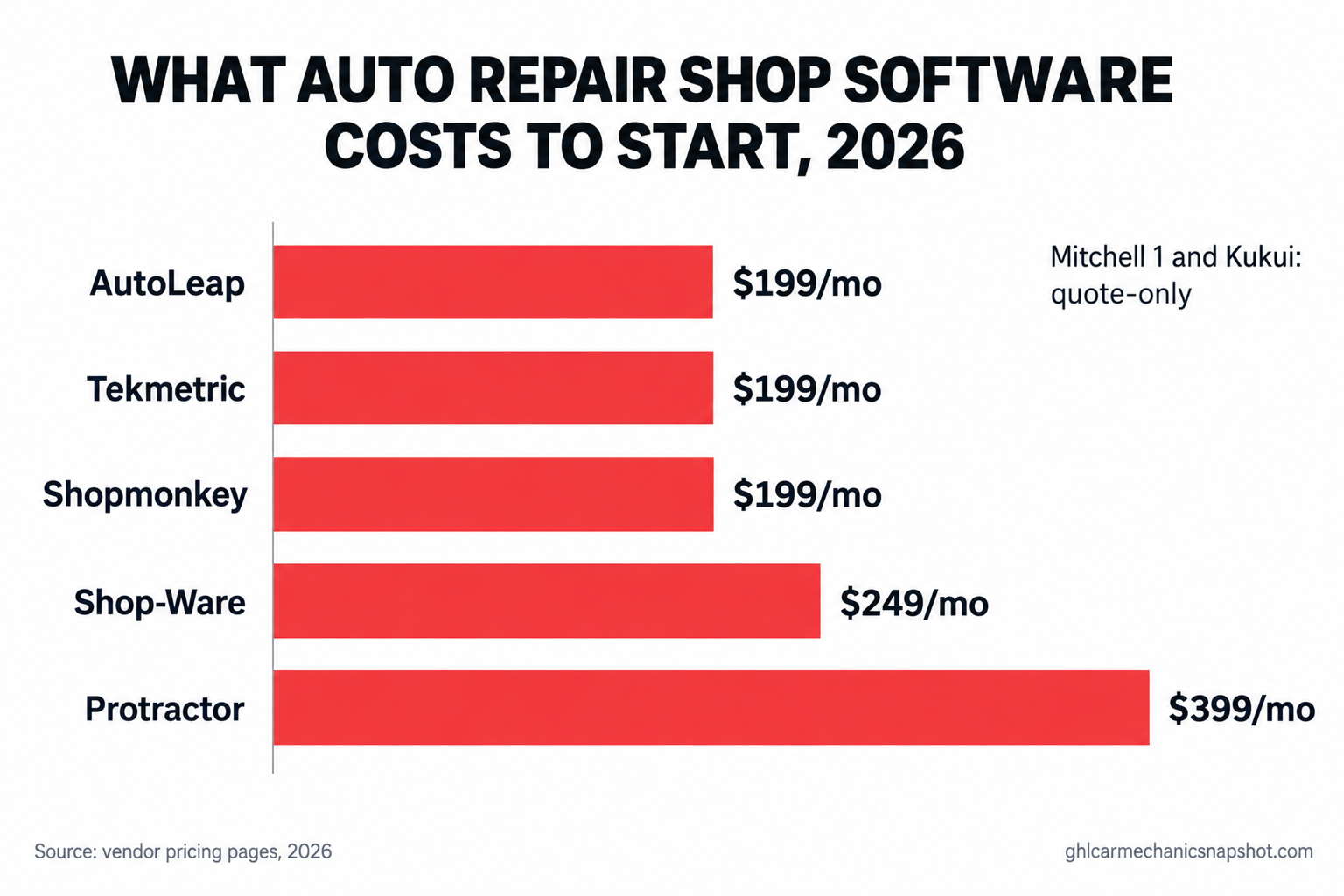
Here is where the mainstream names start, from published monthly figures on each vendor’s pricing page and the major review aggregators. Mitchell 1 and Kukui do not publish, so they are covered in the teardown rather than charted.
Lowest published monthly plan, US dollars. Sources: Tekmetric, Shopmonkey, AutoLeap, Shop-Ware, Protractor. Mitchell 1 and Kukui are quote-only.
The entry price tells you little about who each tool is for. The real spread is at the top of each ladder, where a growing shop ends up.
Highest published standard monthly plan, US dollars, excluding custom Enterprise tiers. Same sources as above.
The seven-vendor teardown
Each of these does the core job: repair orders, invoicing, some flavor of digital inspection, and integrations. What separates them is what they charge for the parts you use every day, and where they break.
Tekmetric: the popular mid-market pick
Tekmetric runs three published tiers, Start at $199, Grow at $349 and Scale at $439 a month, plus custom Enterprise, dropping to roughly $179, $309 and $409 on annual billing. The headline is no per-user or per-RO charge, so unlimited techs and repair orders come with every plan, per Tekmetric’s pricing page.
The catch is where the good stuff lives. Two-way texting and real-time reporting sit on Scale, the $439 plan. Multi-location features are paid add-ons: Multi-Shop Management is $70 a month per shop, the Tire Suite $39, and Marketing $345, per Capterra. A three-location group that wants texting and marketing is not paying $439, it is paying well over $1,000. Shops often land on Grow, find texting is a Scale feature, and either upgrade or keep texting from a personal cell, which is a compliance risk.
Shopmonkey: four tiers and a per-user meter
Shopmonkey runs Basic around $199, Clever $324 to $399 and Genius $475 to $499 a month, plus custom Multi-Shop, per Shopmonkey and Capterra. Numbers vary a little by source and by annual versus monthly billing.
Watch the seats. Each plan includes a set number of user licenses and every additional user is $20 a month on top. A writer, three techs and an owner is five logins, so a growing shop quietly adds $60 to $100 a month in user fees. Shopmonkey does offer a genuinely full-featured free trial, rare here and worth using before you commit.
AutoLeap: clean tiers, top features gated
AutoLeap publishes Essentials near $199, Pro near $349 and Elite near $449 a month, dropping to roughly $179, $309 and $409 annually, per AutoLeap’s pricing and Capterra. Two-way texting, labor guides and QuickBooks sit on Pro. The next-generation inspections and integrated Google reviews live on Elite.
So the two things most owners buy the software for, texting and reviews, are split across the upper tiers. If reviews matter, and for a local shop they should, you are looking at Elite. The common regret is buying Essentials for the repair orders, then finding the review engine you wanted two tiers up.
Shop-Ware: built for bigger shops, priced for them
Shop-Ware starts higher and climbs: Startup $249, Pro $379, Master $499 and Ultimate $799 a month, per Software Finder. The upper tiers add integrated accounting, deeper reporting and multi-location support.
Plan for the fees that miss the pricing page. Exceeding your user count or heavier customization can add $100 to $500 a month, and implementation with data migration commonly runs $500 to $2,000 up front, per ITQlick. It is built for shops doing real volume, not a two-bay operation, so a small shop that buys in at Startup expecting a Master-level demo leaves disappointed.
Protractor: premium, and priced like it
Protractor is the high end. Published tiers run Core $399, Performance $599, Prestige $1,099 and Elite $1,299 a month, per SpotSaas, with $500 to $2,000 of setup. For a large, process-heavy group that wants deep accounting and inventory control, that can be justified. For a two-to-six bay shop it is almost certainly more system than the job needs.
Mitchell 1 Manager SE: you have to ask for the price
Mitchell 1 does not publish Manager SE pricing. You get a number from a rep, which tells you the price is built per shop from seats and modules. One owner reported paying less than $500 a month for a bundle of the management system, digital inspection, texting, repair info and a CRM, per a Shop Tech Score review. Other references put the Manager SE module near $129 a month and Mobile Manager Pro at $249, plus a per-seat Additional User line, per Capterra. Treat those as one shop’s bundle, not a quote: two shops the same size can pay very different amounts, and you only learn where you land after the call.
Kukui: a marketing platform, not a management system
Kukui is the odd one out. It is an all-in-one website, marketing and CRM platform for auto repair, not a repair-order system, and it is fully demo-gated. Reported pricing runs $500 to $2,000+ a month for the bundled package, per GetApp. That is a different budget line, closer to hiring a marketing company than buying shop software. Owners who expect it to replace their management system find they still need one, so it becomes a second bill rather than a replacement.
The fees nobody puts on the pricing page
The advertised plan is what everyone compares. The fees below decide your actual total, and they rarely make the chart.
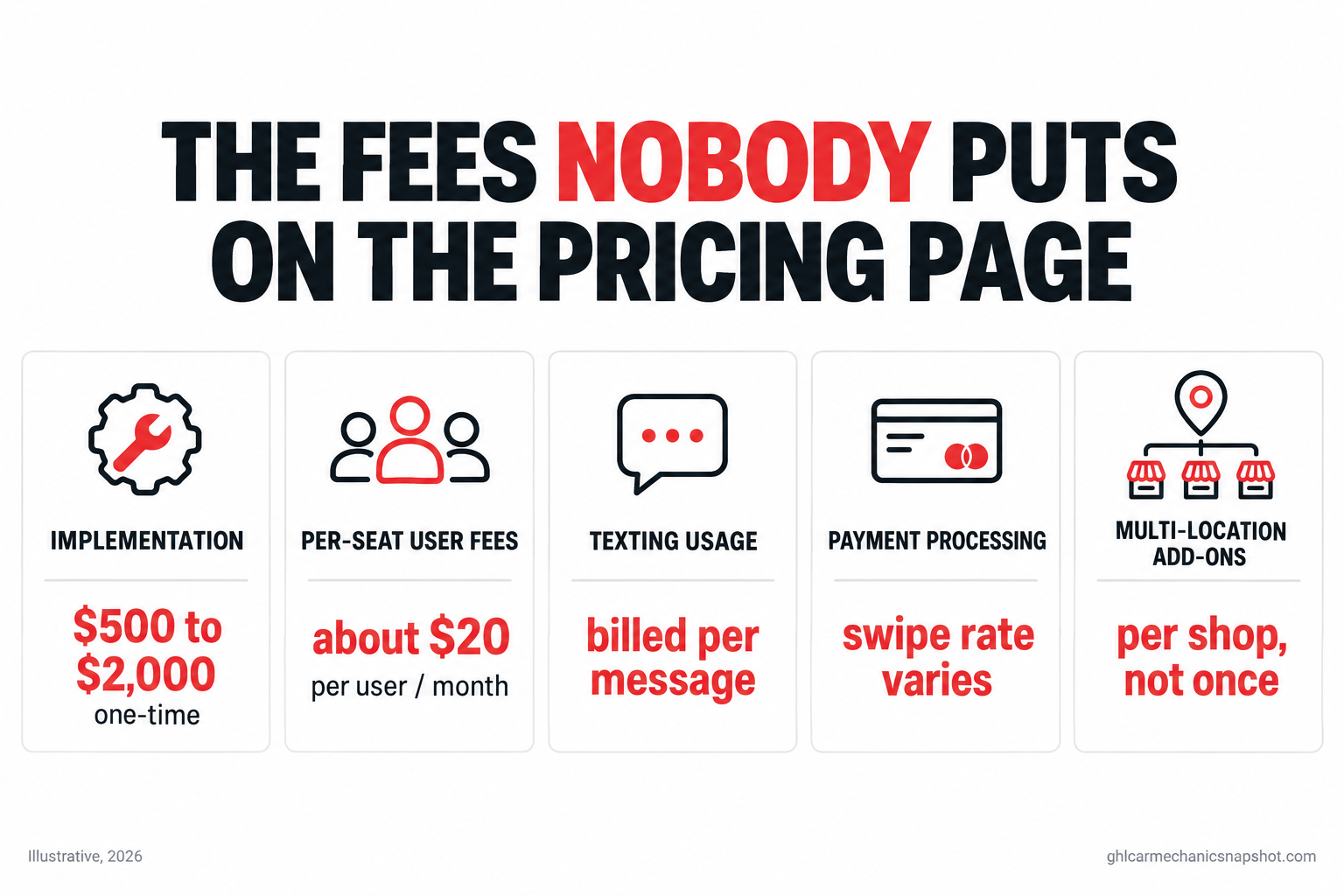
- Implementation and onboarding. Data migration and setup commonly runs $500 to $2,000 one time on heavier platforms. Get it in writing before you sign.
- Per-seat user fees. Some vendors include unlimited users (Tekmetric). Others meter them, like Shopmonkey’s $20 per extra user per month. Count every login before you compare.
- Texting usage. SMS costs money per message, baked into a tier or billed on usage, and a busy shop sends a lot of it.
- Payment processing. If the software processes card payments, the swipe rate matters as much as the subscription, and can dwarf a $50 plan difference.
- Multi-location add-ons. Per-shop fees, like Tekmetric’s $70 multi-shop and $345 marketing module per shop, mean a group pays per location.
- Contract length and data export. Annual contracts lock you in, and getting your data out when you leave is sometimes paid or painful. Ask how you export customers and history before you sign.
What a shop your size actually pays
The framework gives three very different answers by size. Here is honest first-year math, assumptions stated so you can check it against your own quotes.
| Shop profile | Plan you realistically land on | Monthly plan | Likely add-ons | First-year all-in estimate |
|---|---|---|---|---|
| Solo / 1-2 bays, 2 users | Entry tier | ~$199 | Minimal setup, light texting | ~$2,400-$3,000 |
| Mid-size / 4 bays, 5 users | Mid-to-top tier (texting + reviews) | ~$349-$449 | Extra seats, texting usage, $500-$1,000 setup | ~$5,000-$6,500 |
| Multi-location / 2 shops, 10+ users | Top standard tier + per-shop add-ons | ~$499-$799 | Multi-shop + marketing per location, $1,000-$2,000 setup | ~$9,000-$15,000+ |
The solo shop’s real cost is close to the sticker, because it uses little beyond the base plan. The mid-size shop is where advertised and actual diverge most, because it needs texting and reviews (upper tiers) plus a few extra seats. The multi-location group pays per location for the modules that matter, so its bill is a multiple. None of this makes shop software a bad buy. It means you should walk into the sales call knowing your all-in number.
The other cost model: owning your platform
Everything above is a subscription you rent, where the price climbs with your headcount and locations and the communication features you want most sit in the upper tiers. A second model changes the math for the texting, reminder, review and follow-up side.
Instead of renting those features inside a management system’s top tier, you can run them on a general platform you control. GoHighLevel is the common choice for small local businesses, at $97 a month for Starter and $297 for Unlimited, with messaging and AI usage billed on top. It is a CRM, texting, booking and automation platform, not a repair-order system, so it does not replace your estimating and parts workflow. It replaces the patchwork of a personal cell for texts, a notebook for follow-ups, and hoping somebody remembers to ask for the review.
The cost difference is structural. With a rented management system, texting and reviews are a moving bill that rises with your tier, seats and locations. With a platform you own, the front-office automation is a flat fee plus a one-time build, and it does not care how many techs you hire. That is the model we build for: our Car Mechanic system is a set of done-for-you GoHighLevel workflows, missed-call text-back, estimate follow-up, reminders, review requests and reactivation, installed for a one-time $997 instead of rented back at a higher tier. You still need a management system for repair orders and parts. What this changes is whether the communication layer is a rising rental or a fixed asset you own.
The compliance cost nobody budgets for
One more line item nobody puts in the spreadsheet until it bites. When you text customers, you are under the federal Telephone Consumer Protection Act, and the numbers are not small. Statutory damages are $500 per text, and up to $1,500 for willful violations, with no cap and no need for the customer to prove harm, under 47 U.S.C. 227.
Here is the trap that catches good shops. A plain service reminder (“Your Civic is ready for pickup”) is transactional and generally fine. Add one promotional line (“and refer a friend for $20 off”) and the whole message is reclassified as marketing, which needs prior express written consent and instant STOP handling. One cheerful add-on line turns a compliant text into a violation, multiplied by every number on your list.
Carriers also now require A2P 10DLC registration for US business texting. Register your brand and campaign, or your messages get filtered and quietly stop arriving. Whichever tool you choose, confirm it handles consent, STOP and opt-out automatically and walks you through 10DLC. A cheap texting setup that gets you sued or silently blocked is not cheap. More in the five automations every shop should run.
Straight answers to the objections
“I already pay for Tekmetric (or Shopmonkey, or AutoLeap). Am I wasting that?” No. If it runs your repair orders well, keep it. The narrower question: are you paying for its top tier mainly to get texting and reviews, while still using a personal phone for half your customer contact? If so, the communication layer is where you are overpaying, and it is worth pricing separately. Your management system and your follow-up system do not have to be the same bill.
“Isn’t the cheaper option just worse?” Sometimes. On a management system, paying more often buys capability you will use. On the communication side, the extra money usually just unlocks a feature, texting or reviews, that a $97 to $297 platform also does. Cheaper is worse when it cuts a feature you need, not when it unbundles one you were overpaying to rent.
“Do I need to be technical to run any of this?” No, and you should not have to be. The point is to take work off your counter, not add an IT project. Whatever you buy, setup should be done for you and the day-to-day should be a text that sends itself.
“Can’t I just do it free, with my own phone and a notebook?” Plenty of shops do, right up until the month the phone gets busy. The free version is your time, worth $85 to $197 an hour in the bay. A missed-call follow-up that never goes out because the advisor was slammed is not free. It is a brake job that went to the shop down the street, as we covered in how shops lose jobs to missed calls.
Frequently asked questions
Auto repair software cost questions
What is the cheapest real auto repair shop software in 2026?
Mainstream entry plans cluster around $199 a month (Tekmetric Start, Shopmonkey Basic, AutoLeap Essentials), with Shop-Ware at $249 and Protractor at $399. The true cheapest depends on your seats and features, because a $199 plan that forces an upgrade for texting can cost more than a higher plan that includes it.
Why do Mitchell 1 and Kukui hide their pricing?
Both are quote-only, which usually means the price is built per shop from seats and modules. Reported figures put a Mitchell 1 Manager SE bundle near $500 a month and Kukui's package at $500 to $2,000+. Get the all-in number in writing before you sign.
What hidden fees should I ask about before signing?
Implementation and data migration ($500 to $2,000 on heavier systems), per-seat user fees (around $20 each per month on vendors that meter logins), texting usage, payment processing rates, and per-location add-ons for multi-shop groups.
Does GoHighLevel replace my shop management system?
No. It is a CRM, texting, booking and automation platform, not a repair-order or estimating system, so it replaces the personal-phone-and-notebook way of handling communication, reminders, reviews and follow-up, not your parts and invoicing workflow.
Is it legal to text my customers reminders and offers?
Plain transactional reminders are generally fine, but mixing a promotional line into a service text reclassifies the whole message as marketing, which needs prior written consent and STOP handling. TCPA damages run $500 per text and up to $1,500 for willful violations, and you need A2P 10DLC registration to text from a US business number.
Back to that card statement
Pull the statement back up. The $349 line is not the problem by itself. The problem is not knowing what it covers, whether texting and reviews are even turned on, and whether you are renting at a higher tier the features a cheaper platform would include. Software is a tool, same as your scanner, and you would not pay for a scanner you never plugged in.
So do the two-minute version for your own shop. Write down your real all-in monthly number, add-ons included, and decide which job you are buying: the management system, the communication layer, or both. Then make the software earn its line, or cut it. If you want a hand mapping the front-office automation so it is a fixed cost you own instead of a rising one you rent, book a walkthrough and we will price it out with you.