
It is 10:15 on a Tuesday and the phone rings, and this time you get to it. A guy asks if you can look at a grinding noise from his front end. You say sure, bring it by. He says thanks and hangs up.
He never shows. You don’t know his name, you don’t have his number, and you have no idea he booked the shop that said “I can get you in at 2, what’s a good number to text you the address?” You did your job the way you always have, and the job still walked.
That is the leak nobody talks about. Missed calls get the attention, but the call you answered and lost is worse, because it feels like a win. You were nice on the phone and the bay is still empty. This post is about the six places a booked job quietly leaks between “hello” and the lift, and the playbook that plugs each one. It is not about being friendlier, it is about running the call like a system.
What’s on this page
- Answered is not the same as booked
- What a walked call actually costs you
- The six places a booked job leaks
- Leak 1: the greeting and the hold
- Leak 2: you never got the name and number
- Leak 3: the price shopper you quoted and lost
- Leak 4: “I’ll think about it”
- Leak 5: “call us back to schedule”
- Leak 6: booked, then a no-show
- Run it at your size
- The one texting rule you can’t skip
- Objections
- FAQ
Answered is not the same as booked
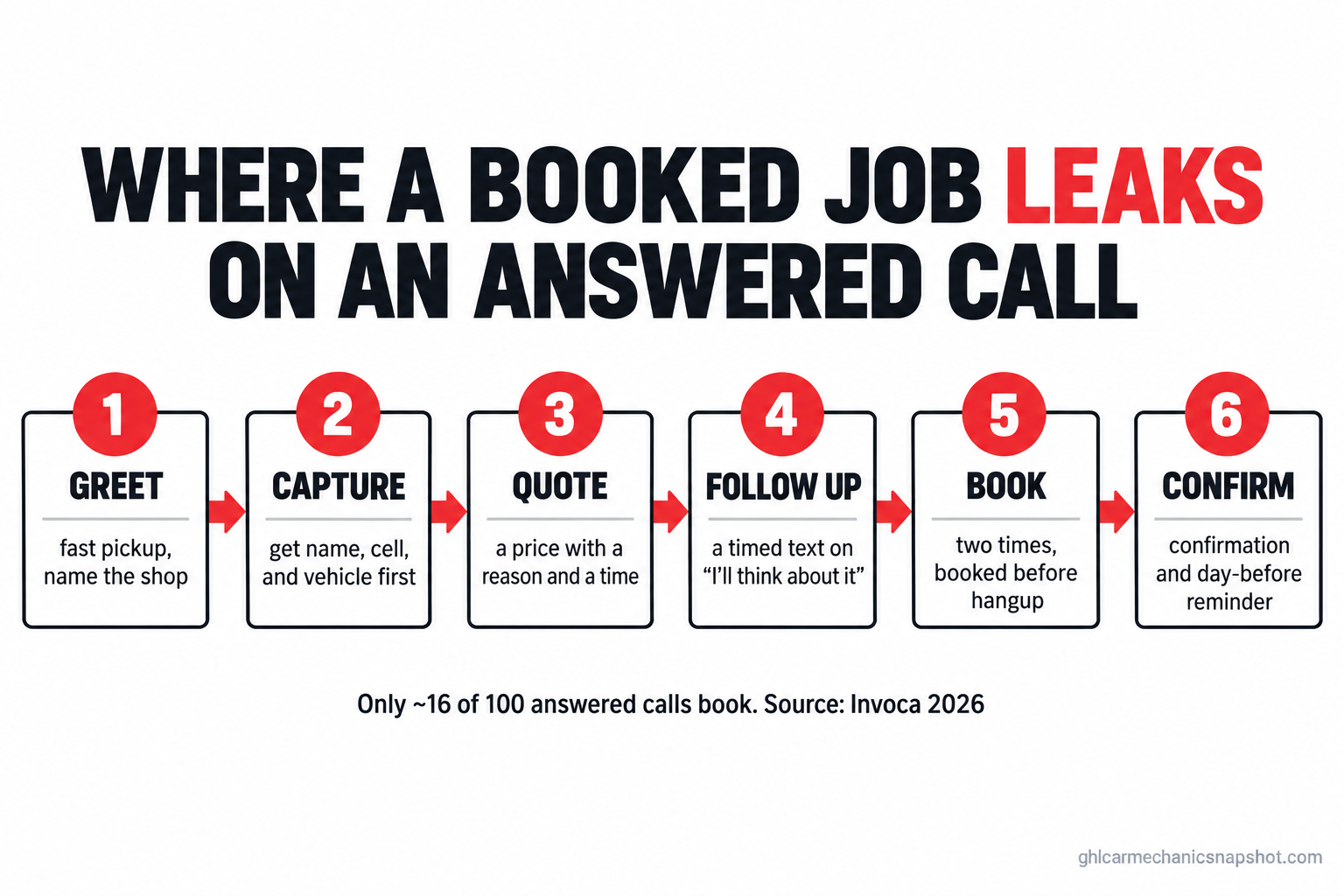
Here is the uncomfortable number. In an analysis of roughly 70 million calls and texts across ten industries including automotive, Invoca found that about 38% of calls answered by a person are actual sales leads, and only 42% of those convert on the call. That is roughly 16 booked jobs per 100 answered calls; the rest hang up unbooked, and most shops never touch them again.
You are not losing jobs because your phone is broken. You are losing them because answering politely and booking the job are two different skills, and only one fills the bay. The fix is a process, not a personality. This is also a different leak from the missed calls that ring out to nobody: a missed call is obvious, so shops deal with it. The answered-and-lost call hides, because the tally in your head says you handled it. You did not.
What a walked call actually costs you
Put a dollar figure on it. The national average auto repair labor rate hit $132 an hour in 2026, ranging from about $85 to $197 by state across more than 10,000 shops, per the Tekmetric labor rate report. A front-end grinding-noise call is a diagnostic plus brakes or a hub bearing: several billable hours and parts margin. Lose one a day to a friendly-but-unbooked call and you hand a competitor a strong week every week.
And the phone is not just another channel. For local service businesses it is the most valuable lead source there is. BIA/Kelsey’s call-commerce research found inbound phone calls are 10 to 15 times more likely to convert than an inbound web lead, because a caller is already in the buying stage. Someone filling out a form is browsing; someone calling about a grinding noise has a problem today, and that is the lead you fumble most, because it lands in the busiest part of your day.
Here is the funnel most shops never see, because they count the calls they missed, not the ones they answered and lost.
Of every 100 answered calls, about 38 are real leads and roughly 16 book, per Invoca’s 2026 benchmarks. The 22 that did not book are the pile this playbook goes after.
The six places a booked job leaks
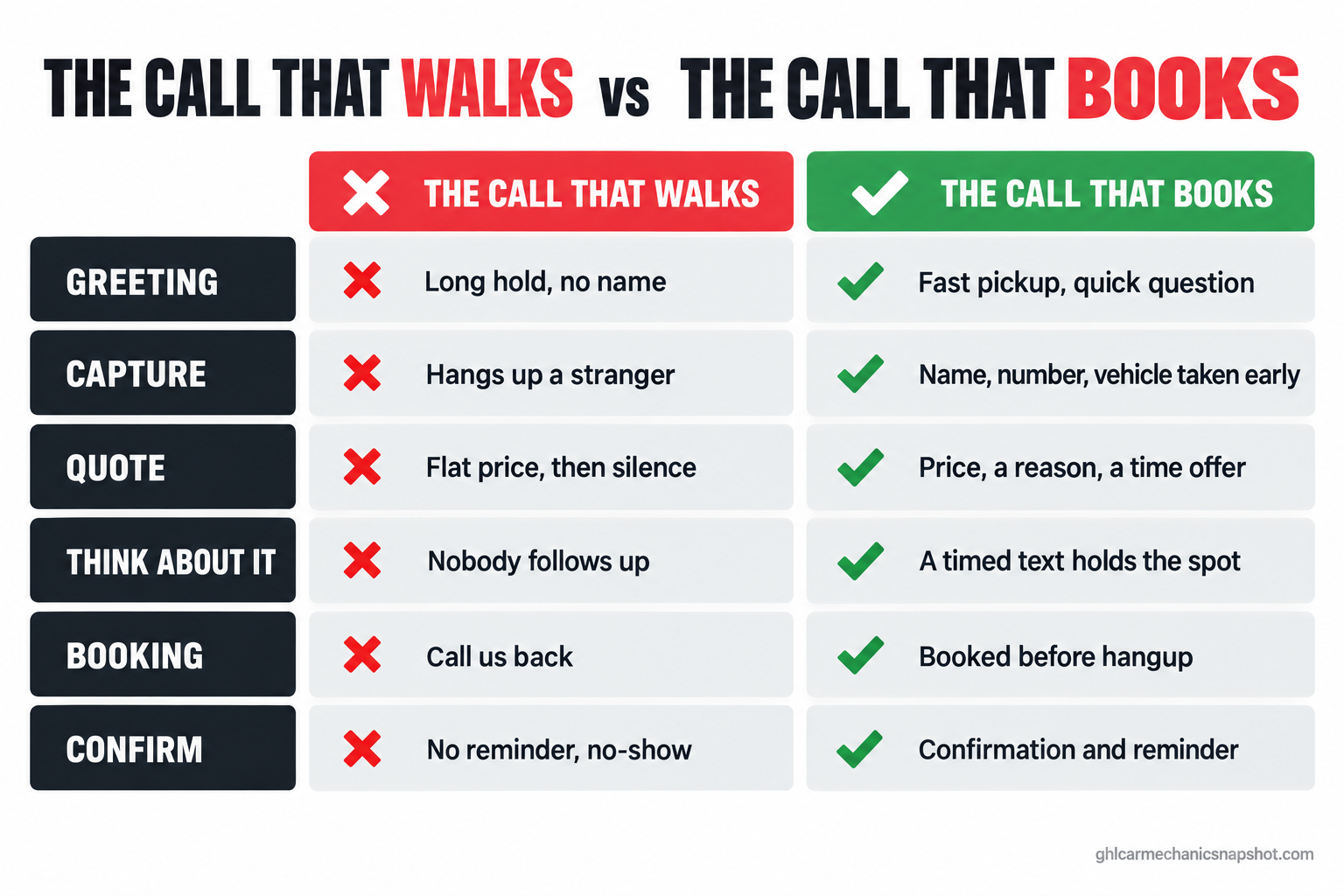
A call is a short chain, and the job falls out at whichever link you never built. Six links, in order: greet, capture, quote, follow up, book, confirm. Most shops are decent at greet and quote and have nothing for the other four. That is why the friendly call still walks. You do not need all six perfect, you need the three you skip.
| Stage | The call that walks | The call that books |
|---|---|---|
| Greeting | Long hold, no name | Fast pickup, quick question |
| Capture | Hangs up a stranger | Name, number, vehicle taken early |
| Quote | Flat price, then silence | Price, a reason, a time offer |
| “Think about it” | Nobody follows up | A timed text holds the spot |
| Booking | “Call us back” | Booked before hangup |
| Confirm | No reminder, no-show | Confirmation and day-before reminder |
Leak 1: the greeting and the hold
The call starts leaking in the first ten seconds. A caller who gets picked up fast, hears the shop name, and gets a real question back is leaning toward you. A caller who gets a flat “service” and forty-five seconds of hold music is dialing the next shop in their notes. The fix is a greeting that is the same every time and a hold that is honest and short: if you cannot get to them now, take the number or let a system text them so the thread stays open.
Leak 2: you never got the name and number
This is the leak that makes every other leak permanent. If the call ends and you have no name and no number, you cannot follow up, send an estimate, or remind them. One habit fixes it: get the name, number, and vehicle in the first minute, before the diagnosis pulls you in. You are not interrogating them, you are opening a ticket.
Leak 3: the price shopper you quoted and lost
Every shop gets the “how much for brakes” call, and most lose it the same way: a flat number, silence, then “okay thanks” and a click. A price with no context is just a number the caller takes down the street to compare, and the cheapest one wins. Instead, quote a range, attach a reason, and turn the price question into a booking. A photo-backed estimate after an inspection closes far better than a phone number ever will, the whole idea behind estimates with photos of the worn parts.
Leak 4: “I’ll think about it”
Half the calls that do not book end with “let me think about it.” Most shops treat that as a no. It is not. It usually means “I’m at work” or “I need to check with my wife.” The job is still live, and you lose it only because nobody circles back before the customer forgets your shop.
Speed is the part shops underrate. In a study of more than 2,200 companies, the Harvard Business Review found firms contacting a lead within an hour were nearly seven times more likely to have a real conversation than those who waited one more hour. A short, spaced follow-up, sent by text so it gets read, catches the undecided caller while the noise is still on their mind.
Leak 5: “call us back to schedule”
You did everything right, the customer is sold, and then you end with the four words that undo it: “just call us back to schedule.” You made booking their chore. They meant to call, then work got busy and the urgency faded. Offer two specific times, let them pick, and confirm before they hang up. “Call us back” is a maybe. “You’re down for Thursday at 8:30” is a job.
“Give us a call when you’re ready” sounds polite and costs you jobs. If you use online booking, text the link while you are still on the phone and watch them tap it, do not just recite a web address and hope.
Leak 6: booked, then a no-show
The job is booked, then Thursday at 8:30 comes and goes with an empty bay because nobody confirmed and the customer half-forgot, and that slot is gone for good. The fix is two messages: a confirmation the moment you book, and a reminder the day before with a way to confirm or reschedule in one tap. Reminders work: research on appointment reminder systems has repeatedly found they cut no-show rates. Send them by text, since SMS open rates run near 98%, per SimpleTexting’s research.
Run it at your size
The six links are the same everywhere. What changes is who does each one and where your weak link sits.
Solo operator or two-person shop. Your biggest leak is that you cannot answer while you are under a car, and the calls you catch get rushed. Your highest-value fixes are capture and an automatic text-back: get the name and number on every call, and let a system text the ones you miss and run the timed follow-up for you.
Mid-size shop, three to eight techs. Your weak link is the handoff. A caller gets a price from whoever picked up, says “let me think,” and it dies because no one owns the follow-up. Fix it with one shared place every advisor sees the open calls, and put follow-up and reminders on a timer. This is also the size where the texting and booking tools inside the system you already pay for sit unused, so check what your shop software already does first.
Multi-bay or multi-location group. Your risk is inconsistency: one location books on the call, another parks people on hold. Standardize the greeting, the capture habit, and the reminder across locations, and watch booked-rate per store. The store that answers a hundred calls and books ten is missing the same three links everywhere.
The one texting rule you can’t skip
The moment you follow up by text, federal law applies, and most of what this playbook sends is the safe kind. A follow-up about the car, a booking confirmation, and a reminder are all transactional messages, which sit on the lowest consent standard.
The trap is bolting a promotion onto a transactional text. “Here’s your reminder” is fine. “Here’s your reminder, and refer a friend for $20 off” is marketing, and one promotional line can reclassify the whole message, which needs stricter written consent. Get it wrong and the damages are real: $500 per text, up to $1,500 if a court finds it willful, under 47 U.S.C. 227. You also need to register a business number under A2P 10DLC, or carriers quietly filter your messages. Keep the follow-up about the vehicle, register your number, and honor STOP. The full breakdown is in our guide on why your service reminder is legal but the refer-a-friend line is not.
Straight answers to the objections
“My front desk is friendly, isn’t that enough?” Friendly gets you liked, it does not get you booked. Only about 16 of every 100 answered calls book, per Invoca. Friendly plus a process, capture the number, quote into a booking, follow up, confirm, is what fills the bay. You are not replacing your people, you are giving them the same steps every call.
“I already pay for Tekmetric or Shopmonkey. Do I need something else?” Maybe not, and do not buy anything before you use what you have. Most shop systems include texting, booking, and a pipeline, and the gap is usually the workflow around them, not the app. If you are still comparing, our head-to-head on Tekmetric, Shopmonkey, AutoLeap, and Shop-Ware covers where each one fits.
“Won’t the follow-up texts annoy people?” Bad ones do, helpful ones do not. A note about the noise on their own truck, sent twice with an easy out, is useful. Cap it at three and stop the second they reply.
Frequently asked questions
Answered-call conversion questions for auto shops
Why do answered phone calls still not turn into booked jobs?
Because answering and booking are two different skills. Invoca found only about 38% of answered calls are real sales leads and only 42% of those book on the call, so roughly 16 of every 100 answered calls convert. The rest hang up over a long hold, a flat price with no booking offer, or an 'I'll think about it' nobody follows up on.
What is the single most important thing to do on a service call?
Get the customer's name, cell number, and vehicle in the first minute, before you dig into the diagnosis. If the call ends without it, you cannot send an estimate, follow up, or remind them. Every other fix depends on being able to reach them.
How should I handle a caller who only asks for a price?
Do not give a flat number and go silent. Quote an honest range, say what changes it, and offer a time to look at the car and send a photo-backed estimate. The goal of a price call is a booked inspection, not a quoted number.
How many times should I follow up on a call that didn't book?
Three spaced texts: one about two hours later, one the next morning, and a soft close on day three that asks for a yes or no either way. Give an easy out and stop the moment they reply or book.
Is it legal to text customers reminders and follow-ups?
Generally yes. A follow-up about the car, a booking confirmation, or a reminder is transactional and sits on the lowest consent standard. The risk is adding a promotional line, which can reclassify the whole text as marketing, with TCPA damages of $500 to $1,500 per text. Keep messages about the vehicle, register under A2P 10DLC, and honor STOP.
Back to that 10:15 call
Run the Tuesday call again with the system in place. The phone rings, you pick up, name the shop, and before you dig into the grinding noise you take his name, his cell, and the truck. You quote the honest range and offer 2 today or 8 tomorrow. He picks 2, you text the confirmation before he hangs up, and the reminder goes out on its own the next morning. The call that used to walk is now a job on the lift, and all that changed is that you ran it like a system. For the automations that ride on top of this, see the five automations every auto repair shop should run.