
It is a slow Tuesday and two of your bays are empty. You know a customer whose Silverado is due for an oil change, another whose brakes you flagged as “watch this” three months ago, and a family whose minivan you have not seen since last winter. Every one of them would book today if something reminded them. Nothing does, so you sit there hoping the phone rings while a quick-lube down the road texts that Silverado owner and gets the job.
That empty Tuesday is not a marketing problem. It is a memory problem. Your best source of work is not a stranger who found you on Google; it is the customer already in your file who forgot they are due, and a good service reminder turns that forgotten interval into a booked repair.
Most shops fall into one of two traps: they send nothing, because the front desk is too slammed to keep a list by hand, or they blast everybody a coupon until the regulars mute them. The system below is the middle path: reminders timed to each customer’s car, written like a person and not a coupon, that fill your slow days without making a loyal customer roll their eyes.
What’s on this page
- Why the empty bay is a reminder problem
- What a forgotten customer costs you
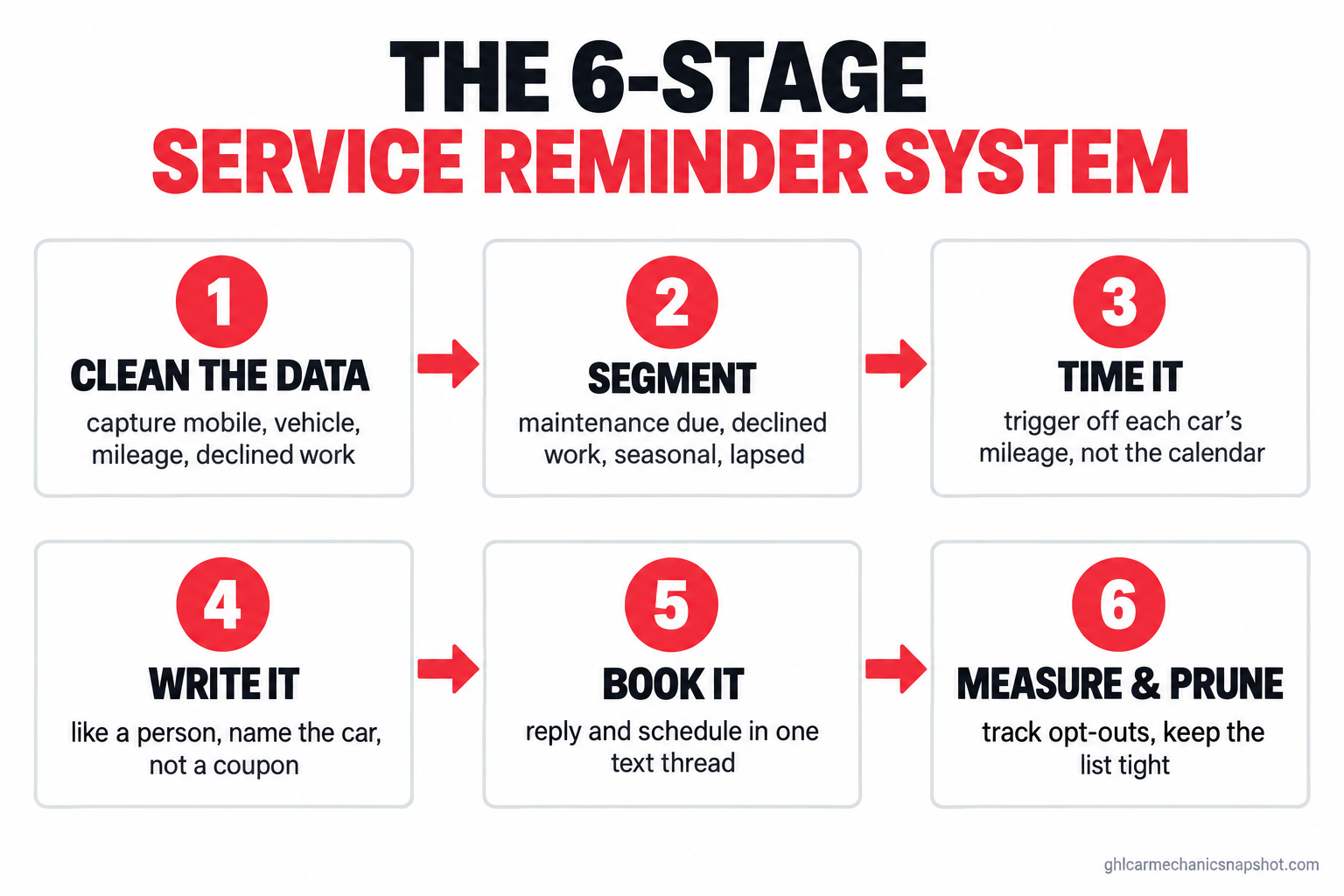
- The six stages of a service reminder system
- Stage 1: get the data clean first
- Stage 2: segment so the reminder fits the car
- Stage 3: time it to the vehicle, not the calendar
- Stage 4: write it like a person, not a coupon
- Stage 5: make replying and booking one step
- Stage 6: measure and prune
- Run it at your size
- The one rule that keeps reminders legal
- Objections
- FAQ
Why the empty bay is a reminder problem
A repeat customer is the easiest sale you will ever make, and most shops leave it on the table. According to the Harvard Business Review, acquiring a new customer is five to twenty-five times more expensive than keeping one you already have, and research by Frederick Reichheld of Bain found that lifting retention by just 5% raises profits somewhere between 25% and 95%. The customer whose car you already know is the cheapest job you will book all week.
The reason they drift is not disloyalty. Nobody keeps their maintenance schedule but you. The customer does not track that their synthetic oil is due at 7,500 miles or that the brakes you measured at 4mm are now at 2mm. Life gets busy, the light does not come on yet, and six months later they land at whatever shop happened to text them first. You lost them to a competitor’s better memory, not better work. That is the same drift behind why your best customers went back to the dealer. The fix is a system that remembers every customer’s car and reaches out the moment the work is due.
What a forgotten customer costs you
The national average auto repair labor rate hit $132 an hour in 2026, ranging from about $85 to $197 by state across more than 10,000 shops, per the Tekmetric labor rate report. A single lapsed customer who came in twice a year is easily a few thousand dollars in labor and parts. Lose a handful quietly and that is a five-figure hole you never see on a report, because a customer who stops coming does not show up as a lost sale. They just fade.
The demand is there and growing. The average vehicle on U.S. roads climbed to 12.8 years old in 2025, with passenger cars now averaging 14.5 years, according to S&P Global Mobility. Older cars need more maintenance, not less, and there are about 289 million of them on the road. The only question is whether they come to you or to the shop that reminded them.
Average vehicle age in the U.S. by type, 2025, per S&P Global Mobility. Older fleets mean more scheduled maintenance sitting in your customer file.
The six stages of a service reminder system
Buying a reminder tool is not the same as running a reminder system. Sending a text is one link in a six-stage chain: clean the data, segment, time it, write it, book it, measure it. The chain breaks at whichever link you skip, and for most shops that is the timing and the writing, which is why their reminders get muted. Build all six and reminders stop feeling like marketing and start feeling like a service.
Stage 1: get the data clean first
A reminder is only as good as the record behind it. Without the customer’s mobile number, their vehicle, the last service date, and the mileage, you cannot send anything smarter than a generic blast, and a generic blast is what annoys people. The first job is not sending; it is capturing.
So every ticket, paper or digital, ends with a mobile number, a vehicle, an odometer reading, and a note of any declined work. If you run a digital vehicle inspection workflow, most of this is captured on the tablet. If you still run paper, it is a five-second habit at the counter: confirm the number and write down the miles.
Stage 2: segment so the reminder fits the car
A blanket message to your whole list is marketing; a message to the right customer about their car is a service. The difference is segmentation, and you only need a few buckets:
- Maintenance due by mileage. Oil, filters, fluids, tire rotation. AAA recommends an oil change every 5,000 to 7,500 miles for conventional oil, longer for synthetic, and at least once a year regardless of miles, per AAA Automotive. Knowing their interval and last reading, you can predict when they are due.
- Declined work you flagged. The brakes at 3mm, the leaking strut, the cracked belt. This is the highest-value bucket, because you already sold them on the problem; they just deferred the fix.
- Seasonal work. Battery and coolant before winter, AC before summer, a pre-road-trip check in early summer.
- Lapsed customers. Anyone you have not seen in twelve to eighteen months who is overdue.
Each bucket gets a different message at a different time, which is what makes a reminder feel like it was written for one person’s car.
Stage 3: time it to the vehicle, not the calendar
The most common reminder mistake is sending on your schedule instead of the car’s. A shop decides to “do a reminder push this month” and blasts everyone at once. Half are not due for anything, so the message is noise, and noise trains customers to tune you out.
Time each reminder to the vehicle instead. Maintenance reminders fire when the car is near its interval, based on last service and average miles. Declined-work reminders fire a few weeks after you flagged the problem, while it is fresh but the customer has had time to save up. Seasonal reminders fire ahead of the season, not during the rush. A well-run system stages all of this automatically.
Stage 4: write it like a person, not a coupon
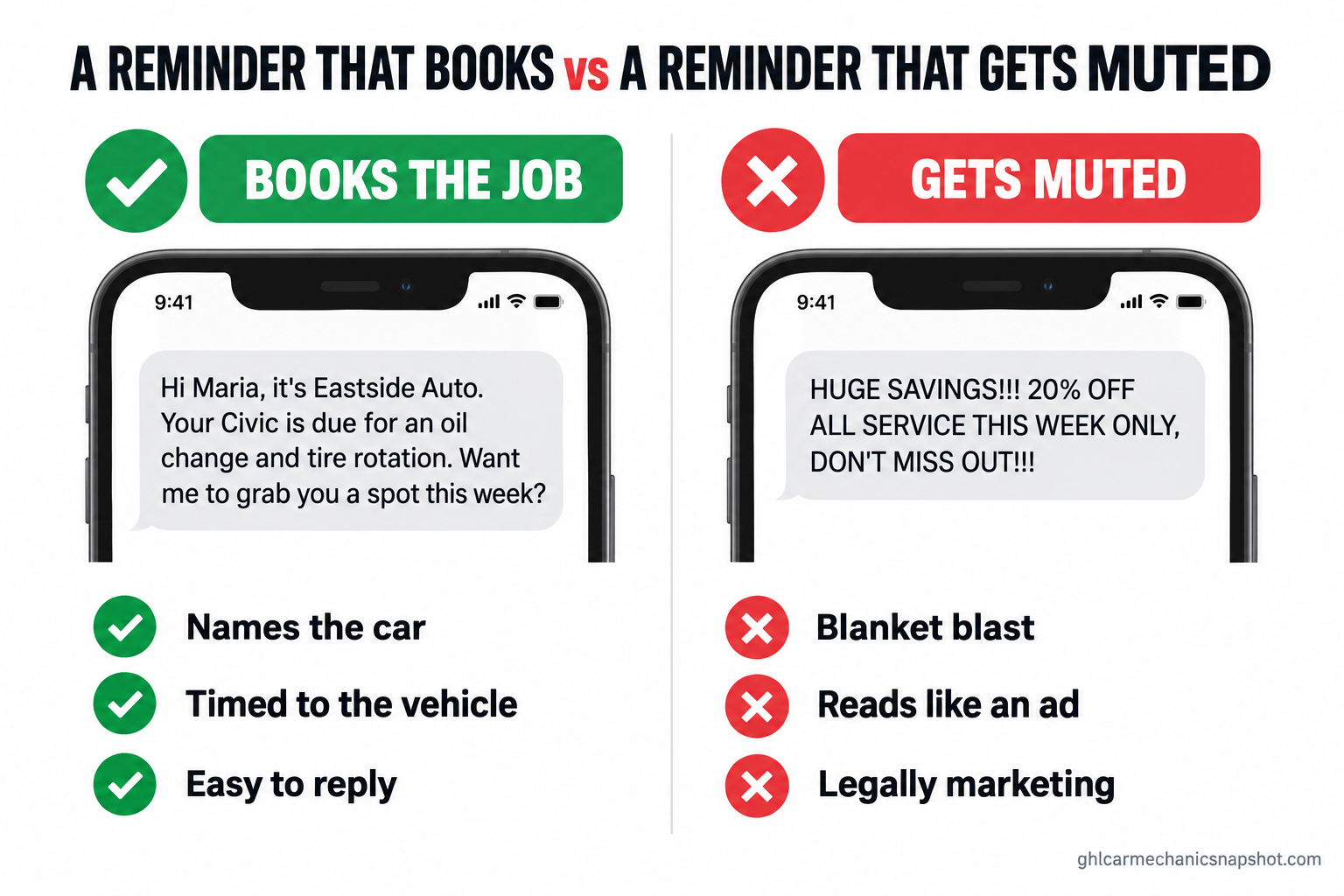
Once the timing is right, the words decide whether the reminder gets booked or muted. It should read like a text from a service advisor who knows the customer’s car, not a promo from a business that wants their money. Name the shop, the car, and the thing that is due, and make it easy to say yes or not now.
Coupons are not banned, but they are not the reminder. Lead with the service. The moment a message reads as a sale, the customer tunes it out, and, as covered below, you may have turned a legal service text into an illegal marketing one.
For the deeper playbook on the channel itself, our guide to two-way texting for auto shops covers running these conversations on one shop number in a shared inbox, not a staff cell phone.
Stage 5: make replying and booking one step
A reminder that says “call us to schedule” hands the customer a chore, and a chore is what they put off. Keep the reply and the booking in the same thread. The customer texts “sure, when can you take it?” and your advisor sends two time options or a booking link right there. No phone tag, and the same thread carries the estimate and the review request afterward.
Everything above is the retention side of the front-office system we build for shops on GoHighLevel, wired so the reminders fire and the bookings land without anyone keeping a list by hand. To see it running on your own customer file, book a free walkthrough.
Stage 6: measure and prune so reminders stay welcome
A good reminder program watches itself. Track three things: how many reminders got a reply, how many turned into a booked job, and how many people opted out. Opt-outs are your smoke alarm: a trickle is normal, a spike means you are sending too often, so fix it before you burn the list.
Pruning matters as much as sending. A customer who has ignored four reminders does not need a fifth; take them off the active list until they show up again. A tight list holds your reply rate high and lets you send for years without wearing out your welcome.
Run it at your size
The six stages are the same everywhere. What changes is who does each job and where your weak link sits.
Solo operator or two-person shop. You are the tech and the front desk, so the reminder that runs on a timer is your most valuable employee. You will never keep a list by hand under a car, so let the system watch mileage and declined work and text at the right time. Start with two buckets, maintenance due and declined work, and add seasonal later.
Mid-size shop, three to eight techs. Your weak link is the data. With several advisors writing tickets, mileage and mobile numbers get skipped, and reminders built on gaps land mistimed. Make capture non-negotiable at the counter and lean on your digital vehicle inspection workflow to log declined work automatically. This is also the size where the reminder tool inside the shop system you already pay for goes unused, so check what your software already costs before buying new.
Multi-bay or multi-location group. Your risk is inconsistency and volume. One location times reminders well; another blasts its whole list and racks up opt-outs that hurt the brand. Standardize the buckets, timing, and templates across locations, and watch opt-out and reply rates per store. The store with the worst opt-out rate is training your customers to ignore everyone.
The one rule that keeps reminders legal
The moment you text customers, federal law applies, and reminders are where shops most often trip. A genuine reminder about a car the customer brought you sits on the safer side of the line; the trap is dressing it up as marketing.
Here is the rule that matters. “Your Civic is due for an oil change” is a service message. Add “and refer a friend for $20 off” and it becomes marketing, because one promotional line can reclassify the whole text as an advertisement that needs stricter prior express written consent. Get it wrong and the damages are real: $500 per text, up to $1,500 if a court finds it willful, under 47 U.S.C. 227. A business texting from a regular number also has to be registered under A2P 10DLC, or carriers quietly filter your messages.
So keep reminders about the vehicle, get proper consent before anything promotional, register your number, and honor STOP. The full breakdown lives in our guide on why your service reminder text is legal but the refer-a-friend line makes it illegal.
Straight answers to the objections
“Won’t my regulars find the reminders annoying?” They find bad reminders annoying, not good ones. A monthly coupon blast is annoying; a text once or twice a year about their own car, timed to when it is actually due, is a service most customers thank you for. The whole system above keeps volume low and relevance high.
“I already pay for Tekmetric or Shopmonkey. Do I need something else?” Probably not. Most shop systems include some form of reminders, and the gap is usually the system around them, not the tool: clean data, segmentation, timing, and writing. Build the six stages on what you already have first, and look at something new only if your current tool cannot do them.
“My customers are older and don’t text.” Some do not, and you still call them. But plenty of older customers would rather get a text they can act on than a voicemail they half remember. Texting does not replace the phone; it catches the ones who were never going to pick up.
“Do I need to be technical to run this?” No. You make a handful of decisions: capture the data every ticket, sort customers into a few buckets, time reminders to the car, write them like a person, and check the numbers monthly. The tooling runs the triggers; the templates above are ready to steal.
Frequently asked questions
Auto shop service reminder questions
What is a service reminder system for an auto repair shop?
It is a system that watches each customer's vehicle, last service, mileage, and declined work, then reaches out automatically when something is genuinely due. It runs in six stages: clean the data, segment customers, time each reminder to the car, write it like a person, make booking one step, then measure and prune. Done right it fills slow days without annoying loyal customers.
How often should I send service reminders without annoying customers?
Time reminders to each vehicle, not your calendar, and most customers only hear from you a few times a year, every message relevant to their car. A blanket blast on a fixed schedule is what annoys people. Trigger off each car's own timeline, cap the volume, give an easy opt-out, and stop sending to anyone who has ignored several in a row.
Is it legal to text customers service reminders?
Generally yes. A genuine reminder about a car the customer brought you is a transactional service message on a safer consent standard. The risk is adding a promotional line like a discount or refer-a-friend offer, which can reclassify the whole text as marketing that needs stricter written consent. Damages run $500 to $1,500 per text under the TCPA. Keep it about the vehicle, register under A2P 10DLC, and honor STOP.
What should a service reminder say?
Name your shop, the customer's specific vehicle, and the exact service due, and make it easy to reply yes or not now. For example: 'Hi Maria, it's Renata at Eastside Auto. Your Civic is coming up on its oil change and tire rotation based on when we saw it last. Want me to grab you a spot this week?' Skip the all-caps, and lead with the service, not a discount.
Do I need new software to send service reminders?
Start with what you have. Most shop management systems and CRMs include some reminder feature, and the real gap is the workflow around it: clean data, segmentation, timing, and the message. Build the six stages on your current tool first, and only look at something new if it cannot capture the data or time messages to each vehicle.
Back to that slow Tuesday
Run the Tuesday again with the system in place. The Silverado owner got a text when his oil was actually due and is booked for this afternoon. The customer with the flagged brakes got a note a few weeks after his visit and is coming in Thursday. The minivan family got a pre-winter reminder and is on the schedule. The bays are not empty because your file is not empty, and the reminders did the remembering for you. For the automations that ride on top of this, see the five automations every auto repair shop should run and how to turn happy visits into more Google reviews on autopilot.