

It is 8:15 on a Wednesday. Your 8:00 brake job is not here. The bay is empty and your tech is leaning on the roller cabinet with nothing to turn. You booked this job three days ago and the customer sounded sure. Now the slot you blocked off for his truck is gone, and there is no getting it back, because 8:00 on Wednesday only happens once.
That empty bay is not bad luck. It is a no-show, and a no-show is the most expensive kind of lost job there is, because you already turned down other work to hold the time. Most shops treat it as a customer problem, “people are flaky,” and some are. But most no-shows are people who booked, meant to come, and then nobody reached out in between to keep it real.
What’s on this page
- Booked is not the same as showed
- Why customers actually no-show
- What a no-show really costs you
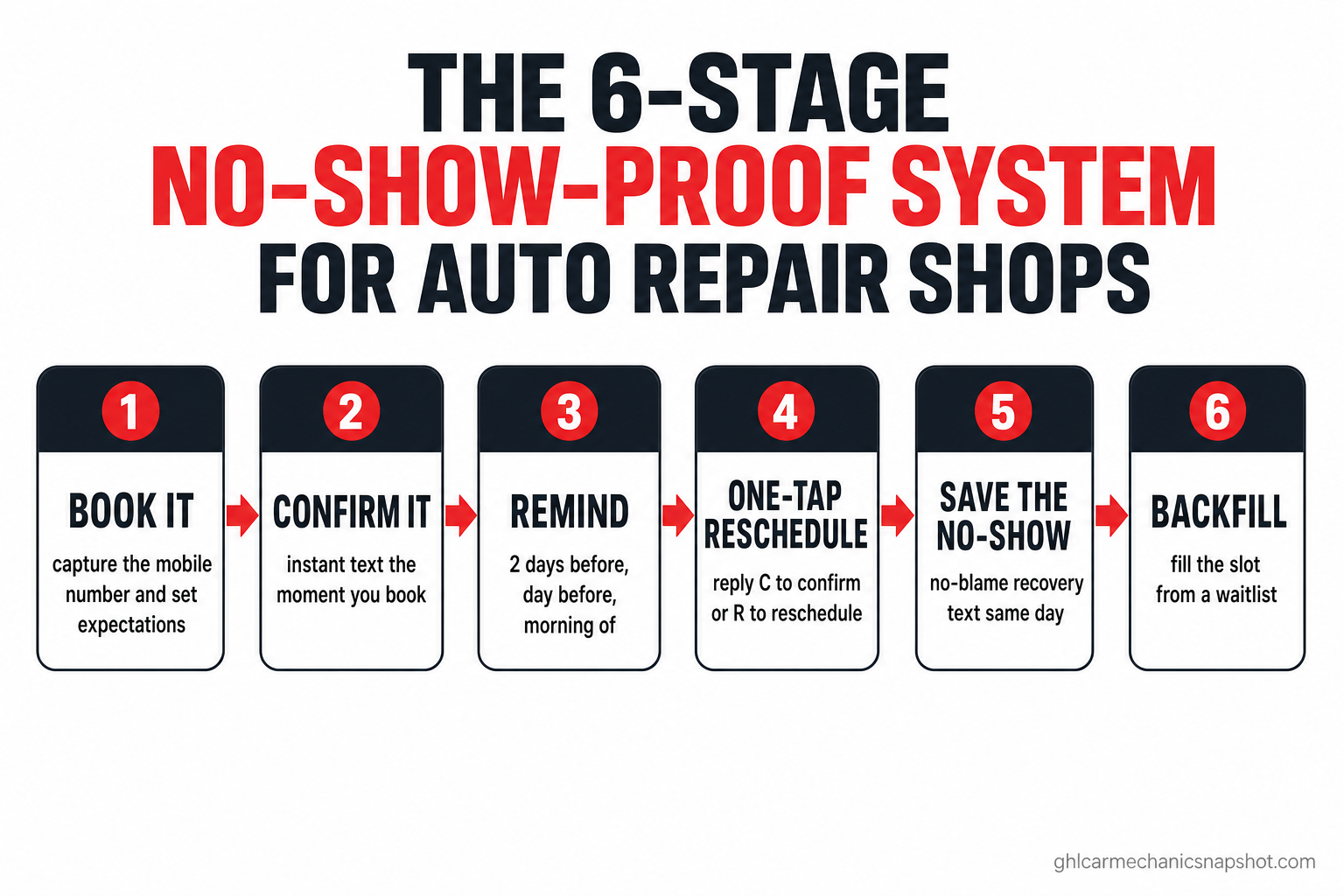
- The six stages of a no-show-proof system
- Stage 1: book it so it sticks
- Stage 2: confirm the moment you book
- Stage 3: run the reminder cadence
- Stage 4: make confirm or reschedule one tap
- Stage 5: save the no-show the same day
- Stage 6: backfill the empty slot
- Run it at your size
- The one texting rule you can’t skip
- Objections
- FAQ
Booked is not the same as showed
A missed call gets all the attention because it is obvious. For that leak, see how auto shops lose jobs to missed calls. The no-show is sneakier: the phone got answered, the job got booked, and then it evaporated.
Industry estimates put service-appointment no-shows around 15% to 25% for shops with little or no reminder process, per trade reporting like Broadly’s guide for repair shops. Call it one in five. Book twenty appointments in a week and three or four quietly do not happen, and most shops never track which or why. It is the single easiest leak to plug, because the fix is a few texts at the right time. It is also a different stage from the answered call that never books: that one is about converting the call, this one starts after the job is already on your schedule.
Why customers actually no-show
In nine years working the service desk, I saw the same five reasons a booked job goes missing, and only one is really about a flaky customer.
- They forgot. The big one. They booked Monday for Wednesday, the week got away, and nothing reminded them it was real.
- They double-booked. The dentist, the kid’s game, a work thing collided with your 8:00, and yours was the one with no reminder and no easy way to move it.
- They got cold feet about the money. You quoted a range, they said yes, and overnight it felt bigger. With nobody to talk to, the easy move is to just not show.
- Rescheduling felt like a hassle. They knew they could not make it, but changing it meant calling during your busy hours, so they put it off and never called.
- They actually flaked. A few people are just unreliable: the smallest group, and the only one you cannot design around.
Four of those five are fixable with a message the customer barely has to act on, which is what the system below automates.
What a no-show really costs you
Put a number on the empty bay. The national average auto repair labor rate hit $132 an hour in 2026, ranging from about $85 to $197 by state, per the Tekmetric labor rate report. A booked slot you held is usually two or three billable hours plus parts margin, so a single missed morning is north of $250 in labor alone. Run the week: at a 20% no-show rate on twenty booked jobs, four slots sit empty, which at a conservative two hours each is better than a thousand dollars of labor, every week. You never see it on a report, because a no-show is not logged as a lost sale. It was booked, then empty, and the money never arrived.
The demand to fill those bays is there, with the average U.S. vehicle now 12.8 years old, per S&P Global Mobility. The problem is not finding jobs, it is keeping the ones you booked from walking off the schedule. Here is the leak in picture form.
A typical week at a 20% no-show rate: of 20 booked jobs, about 4 slots sit empty, using the mid-point of the 15-25% range reported by trade sources like Broadly. That is the capacity this system goes after.
The six stages of a no-show-proof system
A no-show is a chain that breaks at the weakest link, and most shops only build one link, a reminder the day before, if that. On its own it leaks everywhere else: the shaky booking, the customer with no easy way to reschedule, the slot nobody fills after a cancel. The six stages, in the order the flow diagram walks them: book it, confirm it, remind on a cadence, make it one tap to change, save the no-show, backfill the slot. None of it is about being pushier, it is about being present when a booked job is most likely to slip.
Stage 1: book it so it sticks
A no-show is often set up at the moment of booking, and the booking is not done until you have the name, the best cell, the vehicle, and the job, and the customer has heard what to expect. “Plan on about two hours, and I’ll text you a confirmation right now” makes it concrete; a booking made in passing, “yeah, come by Wednesday,” is the one most likely to evaporate.
Stage 2: confirm the moment you book
The confirmation text is the cheapest no-show insurance there is, and it has to go out immediately, while the customer is still thinking about the appointment. Keep it plain and about the car: this is a transactional service message, the safe kind under the law, as long as you do not bolt a promotion on. SMS gets read, with open rates commonly cited near 98%, per SimpleTexting, so it lands in a way a voicemail never does.
Run these on one shop number, not a staff cell, with two-way texting for auto shops.
Stage 3: run the reminder cadence
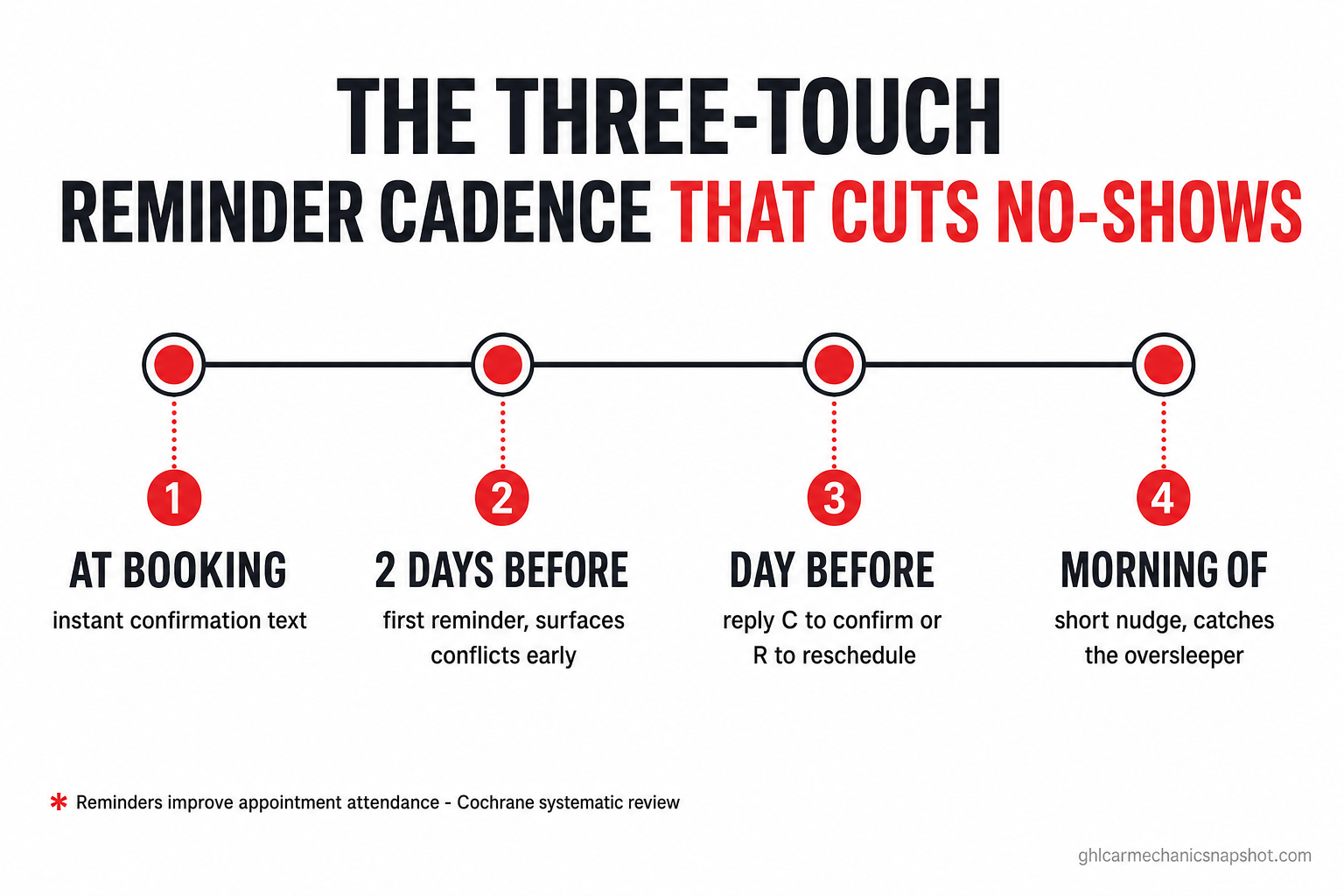
One reminder beats none, but a cadence is what moves the needle, and the research is solid. A Cochrane systematic review of randomized trials found mobile text reminders improved attendance at appointments versus no reminder, a broader systematic review of patient-reminder studies found 95% of the studies reviewed reported fewer missed appointments, and decades of appointment-reminder research keep landing there: remind people, and more of them show up.
The cadence that works for a shop is three touches. Two days out catches the conflict early, while there is still time to move the slot. The day before is the key one, close enough to be top of mind, with a clear confirm-or-reschedule choice. The morning of catches the person who slept in. Do not send a fourth: past three, you are nagging, and nagging earns a STOP.
Stage 4: make confirm or reschedule one tap
Here is where most shops accidentally cause their own no-shows. The customer knows by Tuesday night that Wednesday at 8 will not work, but changing it means calling you in the morning, and your morning is chaos, so they put it off and just do not show. They did not want to ghost you; you made the alternative harder than ghosting. Fix it by making the easy path the one you want: let them reschedule by replying a single letter or tapping a link, and when they reply R, you send two new times immediately. You would much rather move a job to Thursday than lose it, and the customer who rescheduled is still a booked job.
Stage 5: save the no-show the same day
Even with all of the above, some people will still miss, and the difference between a shop that lives with no-shows and one that does not is what happens in the next hour. Reach out the same day, with no blame in your voice, and a real share of those missed appointments turn back into booked jobs. The same open thread that carried the confirmation and reminders is where the save lands, so it does not feel like a cold call.
Stage 6: backfill the empty slot
The last stage is the one almost nobody runs, and it is pure upside. When someone reschedules or cancels, you have an open slot you had written off. Fill it. Keep a short waitlist of customers who said “whenever you can fit me in,” plus anyone with overdue declined work, and when a slot opens, text the next one in line. This is where a clean customer file pays off: if you run service reminders tied to each vehicle, you already know who is due.
Run it at your size
The six stages are the same everywhere. What changes is who runs each one and where your weak link sits.
Solo operator or two-person shop. You cannot text a reminder from under a car, so the automated cadence is your most valuable employee. Let the confirmation and three reminders fire on their own and just handle the replies. Start with the confirmation and the day-before text.
Mid-size shop, three to eight techs. Your weak link is the handoff: one advisor books, another is at the counter when the customer replies, and the message gets lost, so the reschedule becomes a no-show. Fix it with one shared place every advisor sees the day’s appointments and replies, and put the reminders on a timer. This is also the size where the reminder tools inside the system you already pay for sit unused, so check what your shop software already does first.
Multi-bay or multi-location group. Your risk is inconsistency. One location runs the full cadence at an 8% no-show rate; another sends nothing and bleeds slots daily, and you cannot see it because no one tracks show-rate per store. Standardize the cadence and templates, and watch no-show rate by store. The worst-performing location is not unlucky, it is skipping stages.
The one texting rule you can’t skip
The moment you text customers, federal law applies, and the good news is almost everything in this system is the safe kind of message. A booking confirmation, a reminder, a reschedule, and a no-show save are all transactional messages about a car the customer brought you, which sit on the lowest consent standard.
The trap is dressing a reminder up as marketing. “Reminder: your Silverado is booked for tomorrow at 8” is fine. Add “and refer a friend for $20 off” and it becomes marketing, because one promotional line can reclassify the whole message, which then needs stricter prior express written consent. Get it wrong and the damages are real: $500 per text, up to $1,500 if a court finds it willful, under 47 U.S.C. 227. You also have to register your number under A2P 10DLC, or carriers quietly filter your reminders. Keep every message about the vehicle and honor STOP. The full breakdown is in our guide on why your service reminder is legal but the refer-a-friend line is not.
Straight answers to the objections
“Won’t all these texts annoy my customers?” Not if they are about the car and timed right. A confirmation, two or three reminders, and a save text is not a lot of messages, and every one is useful: their appointment, their truck, their time. What annoys people is a coupon blast. Cap it at the cadence above and stop the moment they confirm.
“I already pay for Tekmetric or Shopmonkey. Do I need something else?” Maybe not, and do not buy anything before you use what you have. Most shop management systems and CRMs include reminders and texting, and the gap is usually the cadence and the follow-up, not the tool. Build the six stages on your current system first, and only look at something new if it cannot confirm at booking, run a cadence, and handle a reply.
“My customers are older and don’t text.” Plenty of older customers would rather get a reminder text they can glance at than a voicemail they half-hear. Texting does not replace the phone; it catches the ones a call would have missed.
Frequently asked questions
Auto shop no-show questions
What is a normal no-show rate for an auto repair shop?
Industry trade estimates put service-appointment no-shows around 15% to 25% for shops with little or no reminder process, roughly one in five booked jobs. Shops that run a structured reminder cadence with easy rescheduling typically report single-digit to low-teens rates. There is no official government figure for auto, so treat these as estimates and track your own number.
Do appointment reminders actually reduce no-shows?
Yes, and the research is strong. A Cochrane systematic review of randomized trials found mobile text reminders improved appointment attendance versus no reminder, and a broader systematic review found 95% of the studies reviewed reported fewer missed appointments. A short cadence of confirmation plus reminders helps more than a single text.
How many reminders should I send before an appointment?
Three is the sweet spot: a confirmation when you book, a reminder two days out so conflicts surface early, and a day-before message with a one-tap confirm or reschedule, plus an optional short nudge the morning of. More than that feels like nagging and earns opt-outs. Stop the moment the customer confirms.
Is it legal to text customers appointment reminders?
Generally yes. A booking confirmation, a reminder, and a reschedule are transactional messages about a car the customer brought you, which sit on the lowest consent standard. The risk is adding a promotional line like a discount, which can reclassify the whole text as marketing that needs stricter written consent, with TCPA damages of $500 to $1,500 per text. Keep messages about the vehicle, register under A2P 10DLC, and honor STOP.
What should I do when a customer no-shows?
Reach out the same day, within the hour if you can, with a no-blame text that assumes something came up and makes rebooking easy. A meaningful share of no-shows rebook if you reach out promptly and politely. Then backfill the empty slot from a short waitlist so the bay does not sit idle.
Back to that empty bay
Run that Wednesday again with the system in place. When Mr. Alvarez booked, you caught his cell and texted a confirmation. The day before, the confirm-or-reschedule text reminded him it was real, and the morning-of nudge landed at 7:00. He is in the bay at 8:00 and your tech has work to turn. The bay is full because the system was present at every moment the job might have slipped. For the automations on top of this, see the five automations every auto repair shop should run, and turn those visits into more Google reviews on autopilot.