

It is a Tuesday and a guy you have never met is at your counter asking why the alternator job is $480 when the shop two towns over quoted $390. You explain the part and the labor. He nods, pays, leaves. You never stop to ask the question that matters: is your labor rate right, or did you set it four years ago, bump it ten bucks once, and never touch it since?
Here is the short version, because you are busy. The national average auto repair labor rate in 2026 is about $132 an hour, and state averages run from roughly $100 in the cheapest states to $161 in the priciest, per Tekmetric’s 2026 labor rate data. But the state average is a starting line, not your number. Your door rate should come from your own costs and the margin you need to still be open in five years. Below is the real 2026 rate for every state, how the number is built, and how to raise yours without a fight at the counter.
What’s on this page
- The 2026 national number, and why it barely matters
- Labor rates by state in 2026
- What actually drives the rate in your zip code
- What your door rate is really made of
- Posted rate vs effective rate: where the money leaks
- How to set your door rate in six steps
- What a shop your size should charge
- How to raise your rate without losing customers
- The legal side of posting and charging your rate
- Straight answers to the objections
- FAQ
The 2026 national number, and why it barely matters
Start with the headline so we can get past it. The average shop labor rate in the United States is about $132 an hour in 2026, per Tekmetric’s state report. A separate benchmark, Tekmetric’s Shop Index, puts the national average effective rate near $134.92, with the top quarter of shops at $154.06.
That number is useful for one thing: knowing whether you are wildly out of line. Charge $95 an hour in 2026 and you are leaving money on the floor. Charge $240 and you had better be a specialist. Beyond that sanity check, the average tells you almost nothing about your shop, because it blends a one-bay shop in rural Mississippi with a Euro specialist in San Jose.
The useful comparison is your state, then your town, then your own books. Let’s go in that order.
Labor rates by state in 2026
Here is the 2026 average by state, from Tekmetric’s report dated June 2026. Read it as a benchmark for where shops in your state cluster, not a price you must hit.
| State | Avg rate | State | Avg rate | State | Avg rate |
|---|---|---|---|---|---|
| Alabama | $124 | Louisiana | $132 | Ohio | $125 |
| Alaska | $161 | Maine | $110 | Oklahoma | $129 |
| Arizona | $145 | Maryland | $141 | Oregon | $150 |
| Arkansas | $116 | Massachusetts | $133 | Pennsylvania | $115 |
| California | $156 | Michigan | $130 | Rhode Island | $134 |
| Colorado | $151 | Minnesota | $137 | South Carolina | $130 |
| Connecticut | $141 | Mississippi | $125 | South Dakota | $120 |
| Delaware | $141 | Missouri | $120 | Tennessee | $127 |
| Florida | $138 | Montana | $135 | Texas | $141 |
| Georgia | $137 | Nebraska | $127 | Utah | $135 |
| Hawaii | $142 | Nevada | $152 | Vermont | $110 |
| Idaho | $136 | New Hampshire | $128 | Virginia | $136 |
| Illinois | $135 | New Jersey | $140 | Washington | $152 |
| Indiana | $123 | New Mexico | $141 | West Virginia | $100 |
| Iowa | $123 | New York | $125 | Wisconsin | $125 |
| Kansas | $120 | North Carolina | $123 | Wyoming | $134 |
| Kentucky | $126 | North Dakota | $135 |
Source: Tekmetric, Average Auto Repair Labor Rates by U.S. State, 2026 data. Figures are shop averages and blend independents with dealers and specialty shops.
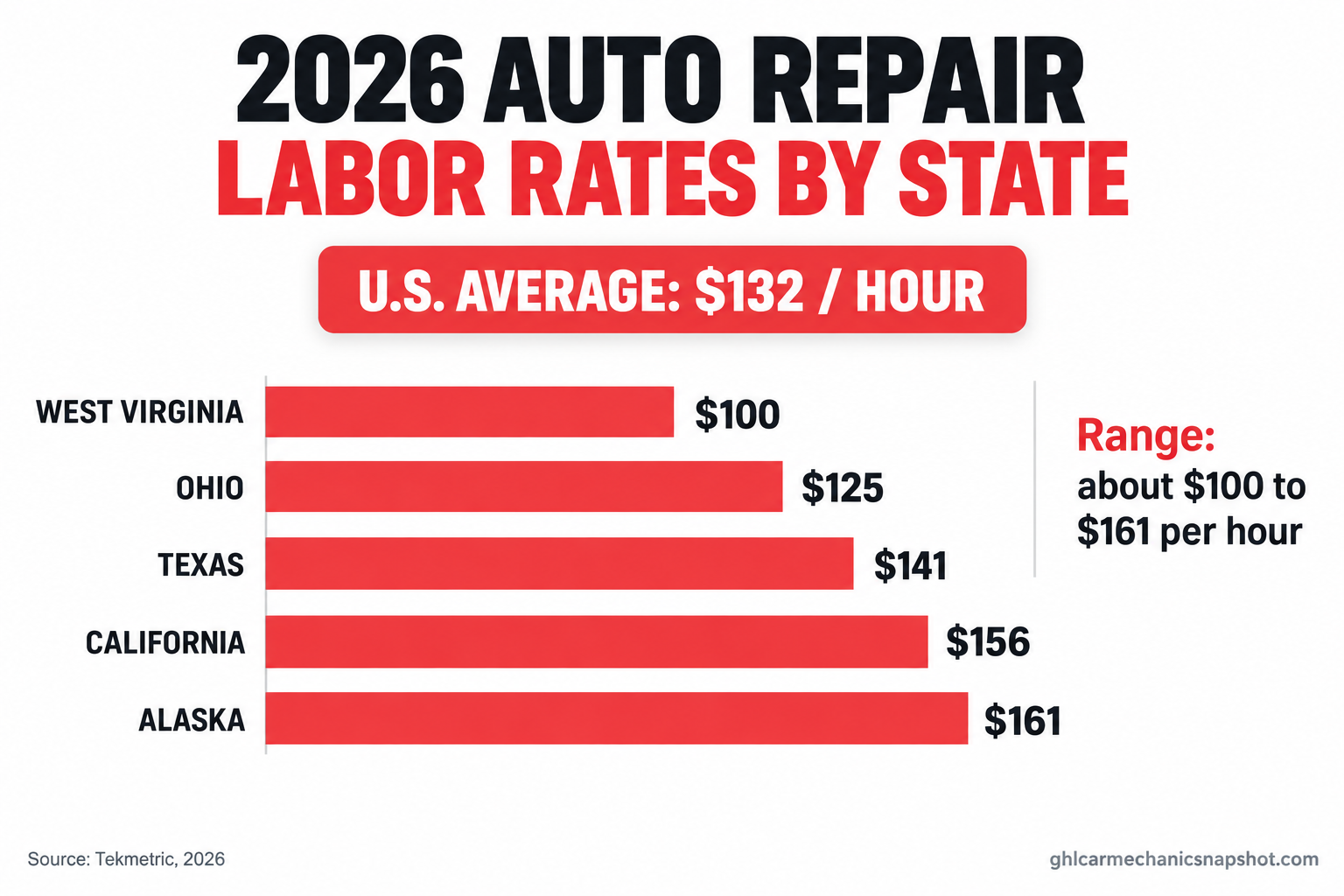
The spread is the story. West Virginia and Arkansas sit near the bottom; Alaska, California, Nevada, Washington and Colorado at the top. Most of the country lands between $120 and $145.
A sample of 2026 state averages against the national $132, US dollars per hour. Source: Tekmetric, 2026.
What actually drives the rate in your zip code
A customer who thinks your rate is “just what you decided to charge” has it backward. Four things set the going rate in your area, and only one is in your head.
Cost of living. The big one. A shop in a high-rent, high-wage metro pays more for everything, so the rate has to be higher just to break even. Tekmetric’s read is that state differences are “primarily driven by local cost of living and competition,” which is why the coasts and mountain west top the list.
Technician wages. You cannot keep a good tech on a bad rate. The national median wage for automotive technicians was $23.88 an hour in 2024, about $49,670 a year, per the U.S. Bureau of Labor Statistics, and good techs in tight markets cost more.
Competition and density. Eight shops in three miles pulls rates together; two shops in forty miles gives you room.
Shop type and expertise. Dealers charge the most, for overhead and factory training, and specialists charge more than general repair. A general independent with ASE-certified techs and the tooling to diagnose a modern car can charge more than the quick-lube down the street, and should.
What your door rate is really made of
Your posted labor rate is not a number you pick to feel competitive. It is three costs stacked up with a margin on top, using the method in WickedFile’s 2026 guide.
Overhead per billed hour. Total monthly overhead (rent, utilities, insurance, software, admin pay, everything that is not the tech) divided by the hours you actually bill. Overhead of $40,000 across 1,000 billed hours is $40 an hour baked in before you make a dime.
Technician cost per billed hour. Not just the wage. A tech paid $35 an hour who is productive 80 percent of the time costs about $43.75 per billed hour, closer to $50 with payroll taxes and benefits. That gap fools a lot of owners.
Margin. What is left is gross profit on labor, and it carries you through a slow February. Healthy shops target a 15 to 25 percent profit margin; high performers push 65 to 70 percent gross profit, per WickedFile.
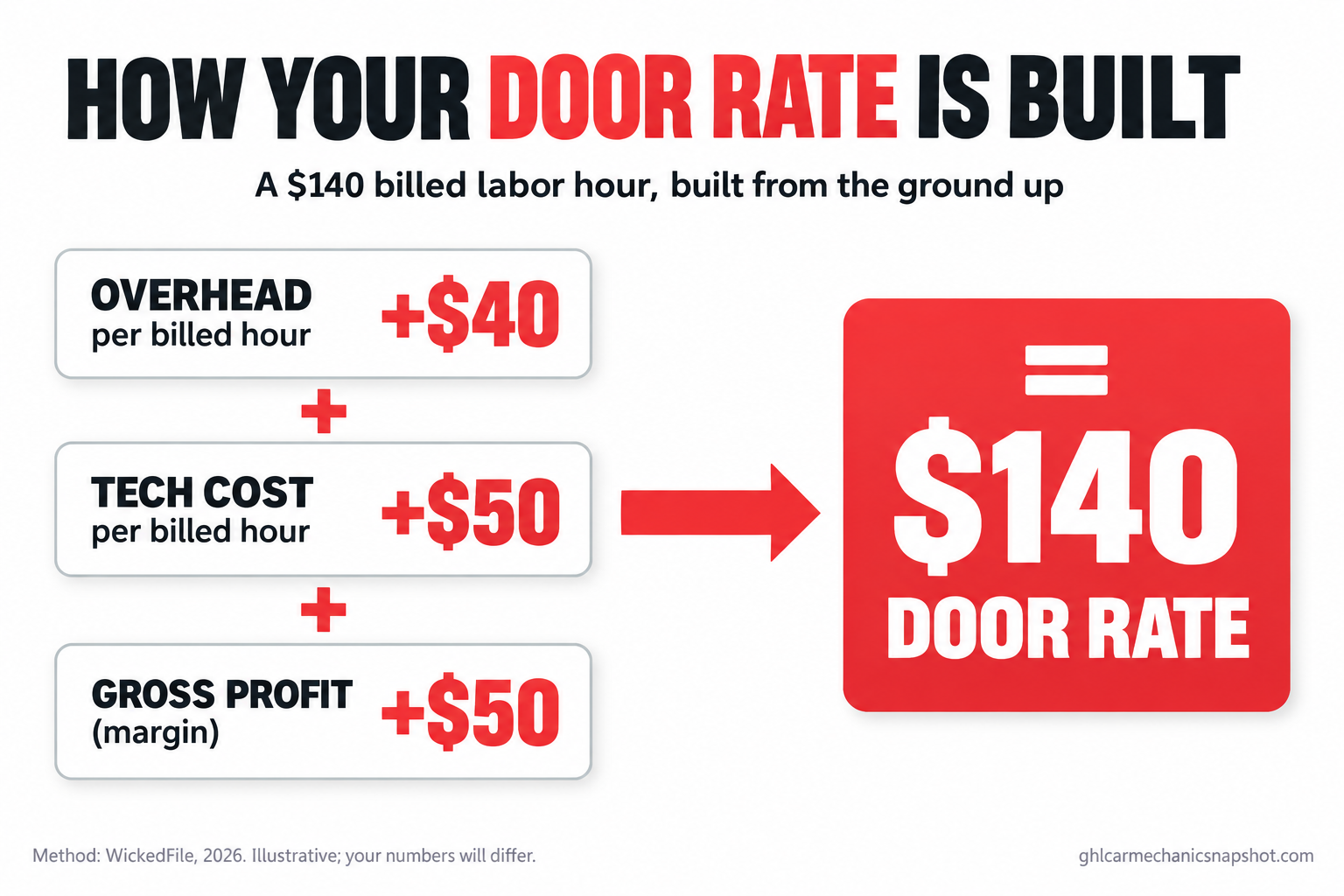
Run those numbers: overhead of $40 plus tech cost of about $50 is $90 before profit, and a 20 percent margin puts you at roughly $112 an hour. Charge $105 there and you are running a hobby, not a shop.
Posted rate vs effective rate: where the money leaks
Here is the number almost no owner tracks, and it tells the truth. Your posted rate is what is on the wall. Your effective rate is total labor sales divided by total billed hours. The gap between them is pure leak.
Say your door rate is $150 but your effective rate is $115. That $35 an hour disappears into:
- Discounts. The “I’ll knock off an hour for you” you hand out to be nice.
- Comebacks. Work redone for free when something was not right the first time.
- Unbilled diagnostic time. The 40 minutes chasing a gremlin that never hits the ticket.
- Underpriced jobs. Flat-rate quotes that took longer than the book said.
A healthy shop keeps its effective rate within 5 to 10 percent of its door rate, per WickedFile. If yours is 20 percent below, raising the posted number does not fix it; you are leaking out the back. Track it monthly; it is the most honest metric in the building.
How to set your door rate in six steps
Sit down with last month’s books and run the worksheet.
- Add up true monthly overhead. Rent, utilities, insurance, software, admin and owner pay, marketing, loan payments. Everything that is not the tech’s wage.
- Find your billed hours. The labor hours you invoiced last month, not the hours you were open.
- Overhead per billed hour = total overhead divided by billed hours.
- Tech cost per billed hour = tech pay divided by productivity rate, plus taxes and benefits. A $35 tech at 80 percent with burden lands near $50.
- Pick your target margin. Use the gross-margin formula: target rate = total labor cost per hour divided by (1 minus target gross margin). At $45 of labor cost and a 68 percent target, that is $45 / 0.32 = about $140.
- Benchmark and adjust. Compare to your state average, three to five local competitors, and the nearest dealer. If your math says $140, the dealer charges $165 and competitors sit at $135, you can land at $140 with a straight face.
A number you can defend with math is one you can hold at the counter.
What a shop your size should charge
The worksheet gives a different answer by size. Here is honest guidance for three profiles in a mid-cost state near the $132 average, not prices to copy.
Solo or 1-2 bays, owner plus one tech. Your overhead per billed hour is actually high, because few billed hours have to carry the rent. Do not let the “I’m just a small shop” story talk you into a low rate; small shops often need a rate at or above the local average to survive. Realistic 2026 door rate in a $132 state: $130 to $145.
Mid-size, 4 bays, 3-4 techs. This is where discipline pays. You have the volume to spread overhead, but effective-rate leak gets expensive across more hours. Bill your diagnostics, tighten discounting, and your rate can sit a touch above the local band. Realistic rate: $140 to $160.
Larger or multi-location, 6+ bays. Overhead is bigger but so is volume, and you likely have specialization or dealer-level tooling to justify a premium. Your constraint is consistency across advisors, not the rate. Realistic rate: $150 to $180+.
These are the bands the math tends to land in. Run your own numbers and let your costs set the floor.
How to raise your rate without losing customers
Most owners are underpriced and terrified to raise, picturing every customer walking. They don’t; price-shoppers are a small minority who were never loyal. Here is how to move your rate up five to fifteen dollars without a revolt.
Do it in one clean move, not nickels. One honest $10 move lands better than four quiet two-dollar creeps.
Tell your regulars before they find out. A short, plain heads-up does more for goodwill than any discount. Steal this text, sent through your shop’s system:
Hi [First Name], it’s [Shop Name]. Quick heads-up: starting [date] our shop labor rate moves to $[new rate]/hr, first time in [X] years. Same techs, same guarantee, same careful work on your [vehicle]. Thanks for trusting us with it. Reply STOP to opt out.
Have the counter answer ready. When someone asks why:
“We moved our rate this year for the first time since [year]. Parts, insurance and keeping good techs all went up, and we’d rather raise the rate a little than cut corners on your car. You’re still looking at [price], and that includes [guarantee / free rechecks].”
Lead with the guarantee, not the apology. You are charging what the work is worth. A clear warranty, a clean waiting area and a tech who explains the job are worth more than ten dollars an hour to everyone except the shopper you did not want.
The legal side of posting and charging your rate
Your rate does not live in a vacuum. Several states require you to post your labor rate, give a written estimate before work starts, and get authorization before you exceed it. We covered the state-by-state detail in whether a shop can charge more than the estimate. The short version: put your rate in writing, give an estimate, get a yes before the number moves.
One more trap, the day you start texting rate changes. A plain service text is fine, but mix one promotional line into it and the whole message is reclassified as marketing under the federal Telephone Consumer Protection Act, which needs prior written consent and STOP handling. Damages run $500 per text, up to $1,500 for willful violations, per 47 U.S.C. 227. Keep rate-change texts transactional. Full breakdown in why your service reminder is legal but your referral line isn’t.
Straight answers to the objections
“My competitor charges less, so I have to match him.” No, and he may be going broke slowly. You have no idea what his effective rate or margin is, and matching a posted rate without knowing his books is how two shops race to the bottom. Fix it right the first time while he doesn’t, and your rate can be higher while your customers stay.
“I’m not in a high-cost state, so I can’t charge much.” Your state average is a benchmark, not a ceiling. West Virginia’s average is near $100, but a well-run shop there with good techs and tight diagnostics can and should charge above it, because the average is dragged down by shops cutting corners. Your costs set your floor, not your zip code.
“Won’t a higher rate scare off customers?” It scares off price-shoppers, the least loyal slice of your base. Your bread-and-butter customers chose you for trust, and rarely care about a ten-dollar move if the work is good. The ones you lose were mostly ones you were losing money on anyway.
“Do I need fancy software to track effective rate?” No, but you need better than memory. Your shop management system reports labor sales and billed hours; divide one by the other monthly. The harder part is collecting the rate you post, which is where front-office follow-up, estimate delivery and reminders stop billed hours from leaking, as covered in why answered calls never become booked jobs.
Frequently asked questions
Auto repair labor rate questions
What is the average auto repair labor rate in 2026?
About $132 per hour nationally, per Tekmetric's 2026 state report, with a separate effective-rate benchmark near $134.92. State averages run from roughly $100 in the lowest states to about $161 in the highest.
Which states have the highest and lowest auto repair labor rates?
In 2026, Alaska (about $161), California ($156), Nevada ($152), Washington ($152) and Colorado ($151) sit near the top; West Virginia ($100), Maine and Vermont ($110) and Pennsylvania ($115) sit near the bottom. High-rate states are generally high cost-of-living states.
How do I calculate my own shop's labor rate?
Add overhead per billed hour (total overhead divided by billed hours) to technician cost per billed hour (wage divided by productivity, plus taxes and benefits), then apply a target margin: target rate equals total labor cost per hour divided by (1 minus your target gross margin). Then benchmark against your state average and local competitors.
What is the difference between posted rate and effective labor rate?
Posted rate is the number on your wall. Effective rate is total labor sales divided by total billed hours. The gap comes from discounts, comebacks, unbilled diagnostic time and underpriced jobs. A healthy shop keeps it within 5 to 10 percent of the posted rate.
How often should I raise my labor rate?
A shop that has not moved its rate in two or more years is almost certainly underpriced given rising wages, parts and insurance. Review it yearly against your costs and local band, and raise in one clean move rather than small creeping bumps.
Will I lose customers if I raise my labor rate?
Mostly you lose price-only shoppers, a small and disloyal share of your base. Regulars who chose you for trust rarely leave over a modest, well-explained increase. A $10 per hour raise on 1,000 billed hours a month is about $120,000 a year, which wins even after a few shoppers walk.
Back to the counter
Picture that customer again, asking why the alternator was $480. The honest answer is not “because that’s my rate.” It is “because my rate covers a tech I trust, a shop that’ll still be here when your warranty matters, and work I’ll stand behind.” That is a number you can say out loud without flinching, and the number the math gives you.
So pull last month’s books and run the six steps. If your door rate is below what your costs demand, raise it, tell your regulars plainly, and hold the line. Then make sure you collect it: if you want the missed calls, stalled estimates and no-shows to stop leaking your billed hours, book a walkthrough and we will show you how the follow-up gets handled automatically.