
It is Thursday afternoon and a Camry is on the lift for a $600 brake job the customer signed off on that morning. Your tech pulls the caliper and finds it seized, one rotor scored past spec. Real work, a real safety issue. So he fixes it, does it right, and the ticket comes back at $1,050. The customer shows up at five, looks at the invoice, and says the words that turn a good repair into a fight: “I approved six hundred.”
Here is the part most owners never think about until it happens to them. In a lot of states, if you did not get the customer’s okay before that extra $450 of work, you may have lost the legal right to collect the excess at all, plus a complaint to the state repair board. You did honest work. You just skipped the one step the law cares about most.
What’s on this page
- What getting this wrong actually costs you
- The two rules behind every estimate law
- How much can you bill over the estimate? A state-by-state look
- The five ways shops break the authorization rule
- Steal these: estimate and overage scripts
- Run it at your size
- Straight answers to the objections
- FAQ
What getting this wrong actually costs you
Put a number on the exposure. The national average labor rate hit $132 an hour in 2026, ranging from about $85 to $197 by state, per Tekmetric’s 2026 state labor rate index. An unauthorized overage is rarely small: two extra hours plus parts on that seized caliper is a few hundred dollars, and if your state says you cannot collect it without prior consent, that comes straight out of your margin on a job you already did.
The bigger cost is trust. A AAA survey found two out of three US drivers do not trust auto repair shops in general, with unnecessary services (76%) and overcharging (73%) the top reasons, per the AAA auto repair trust release. Even if you are honest, a $450 add-on they did not approve reads exactly like the overcharging they already expected, and that customer does not come back. It is also one of the easiest complaints to file with your state, and entirely avoidable with one text.
The two rules behind every estimate law
Strip away the detail and every auto repair estimate law rests on the same two rules.
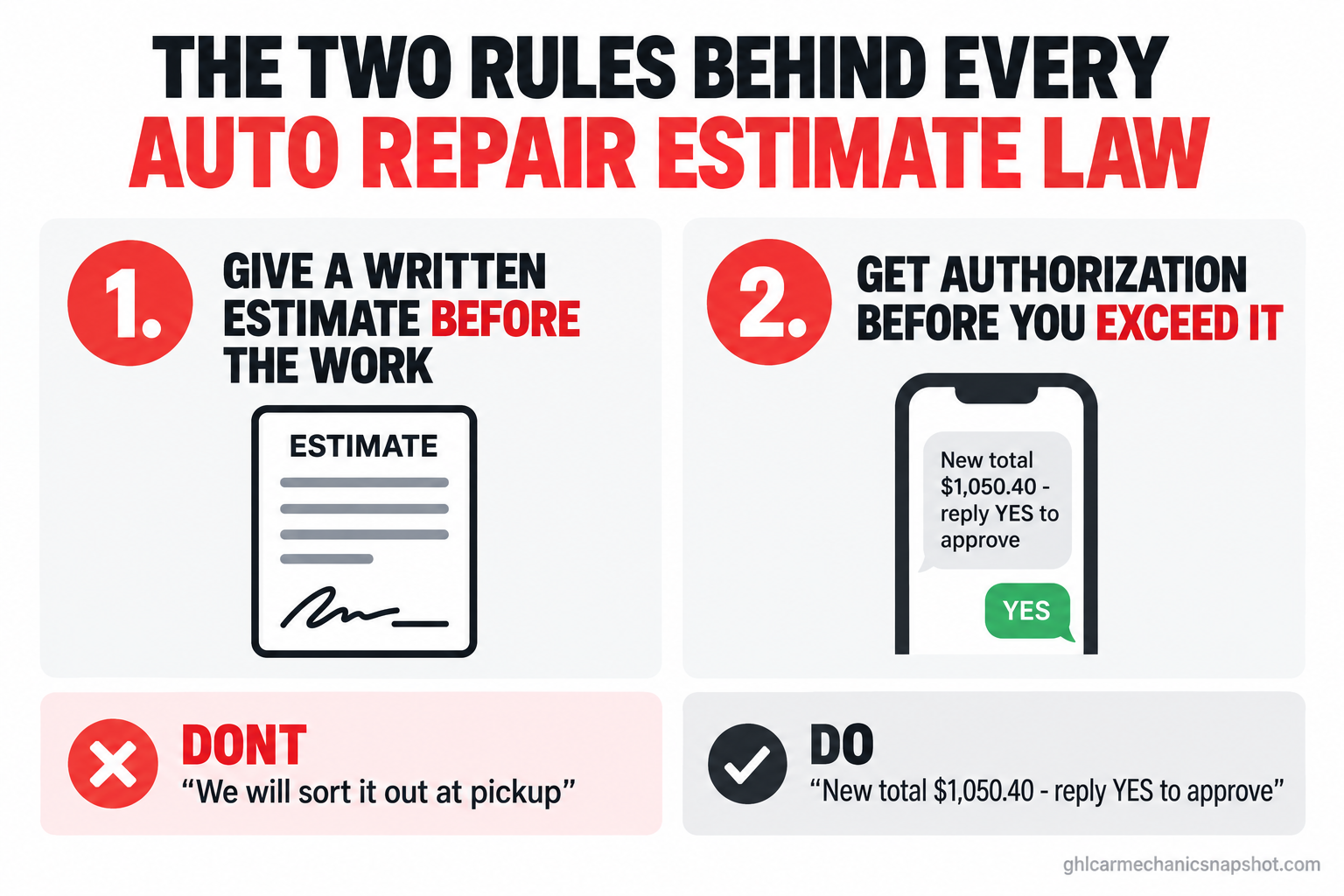
Rule one: give a written estimate before the work. Most states require the estimated price for parts and labor in writing before you start, at least when the customer asks or the job crosses a dollar threshold. Florida requires one once the repair will exceed $150, under Florida Statute 559.905. California requires it before any work begins.
Rule two: get authorization before you exceed it. This is the one that bites. Once you have an approved estimate, you cannot keep working and add the extra to the bill. If the cost is going to run past the estimate, you stop, tell the customer the new number, and get a yes first. How far past you can go before that call is mandatory changes from state to state, and it is smaller than most owners think.
There is no federal law forcing a written estimate for everyday repairs. The Federal Trade Commission advises customers to authorize repairs in writing, per its guide to taking your car to the shop, but the hard rules that decide whether you collect are set by your state. That is why a shop in Los Angeles and one in Dallas play by different books.
How much can you bill over the estimate? A state-by-state look
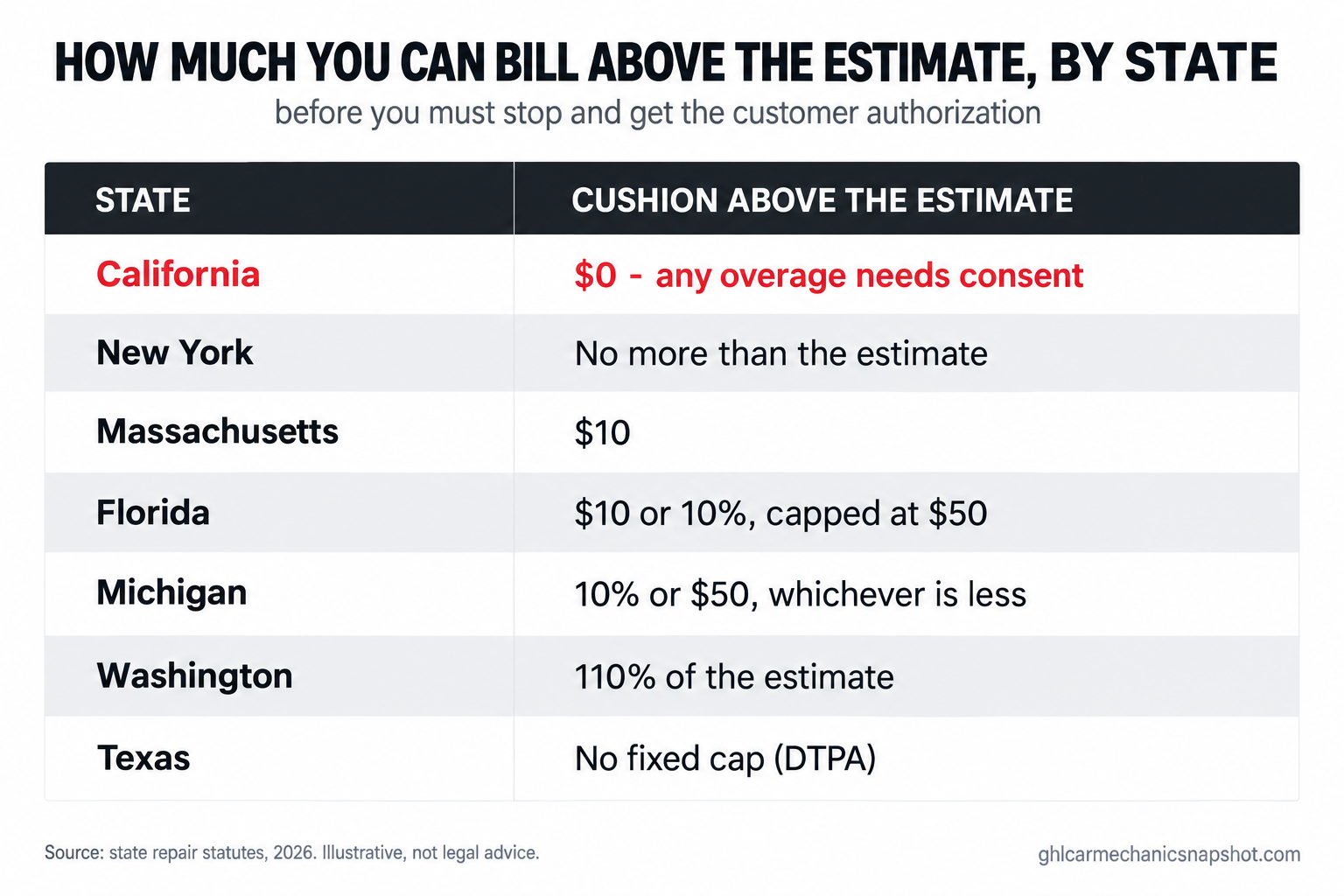
Here is the rule that matters day to day: on an approved estimate, how much can the bill climb before you are legally required to stop and get a new okay? The answer ranges from “not a dime” to “about ten percent.”
| State | Written estimate required | How far over the estimate before you must get authorization |
|---|---|---|
| California | Yes, before any work | $0. Any charge over the estimate needs the customer’s prior consent |
| New York | On request, before work | No fixed cushion. You may not charge more than the estimate without permission |
| Massachusetts | Yes, customer-signed | $10 over the authorized price |
| Florida | Yes, if repair exceeds $150 | The greater of $10 or 10%, but not more than $50 |
| Michigan | Yes | 10% or $50, whichever is less, if no waiver was signed |
| Washington | On request, over $100 in writing | 10% (you may not bill more than 110% of the estimate) |
| Texas | No specific repair statute | No fixed cap. The Deceptive Trade Practices Act still bars billing for unauthorized work |
California is the strictest, and the one most shops underestimate. Under Business and Professions Code 9884.9, no charge can be made beyond the estimated price without the customer’s consent, obtained before you do the extra work. The upside: the statute lets that consent come by phone, email or text if you document it, as the Bureau of Automotive Repair explains at bar.ca.gov. California labor also runs $155 to $200 an hour in much of the state, so a “small” overage there is real money.
Florida gives a little room and a hard ceiling. The overage rule sits in Florida Statute 559.909, not the estimate section; the FDACS consumer page covers the details. Massachusetts is tighter: under the Attorney General’s 940 CMR 5.05, exceeding by more than $10 without authorization is an unfair or deceptive act that opens a Chapter 93A claim. Michigan allows the lesser of 10% or $50 when no waiver is signed, per the Secretary of State’s auto repair law guide, and Washington keeps it simple under RCW 46.71.025: no more than 110% of the estimate without authorization first.
New York publishes no fixed percentage. Its rule, in the DMV’s Know Your Rights in Auto Repair, is stricter in spirit: no more than the estimated price without permission, with phone approvals documented by date, time and who gave them. Texas is the outlier, with no repair-specific statute. Repairs fall under the Deceptive Trade Practices Act, which still makes it unlawful to charge for work the customer never agreed to and allows up to treble damages for knowing violations, per the State Bar’s Texas Law Help. No fixed cushion does not mean no rules. The standard is “did the customer authorize this,” and a surprise bill fails it.
Most a shop can add to an approved $600 written estimate before it must stop and get the customer’s authorization, in dollars, by state. Computed from each state’s statute linked above (Washington’s 10% cap equals $60 on a $600 job). Texas sets no fixed cap and is governed by the DTPA. This is an illustration, not legal advice.
The five ways shops break the authorization rule
Almost nobody gets sued over the written estimate. They get in trouble on the authorization, usually one of these five.
1. The verbal go-ahead you cannot prove. You called, the customer said “yeah do it,” you did it. At pickup they say they never approved that amount, or approved “the brakes” but not the extra $200. With no record it is your word against theirs, and in a strict state the burden is on you. A verbal okay keeps the job moving; it is worthless as evidence.
2. The vague overage text. “Your car needs a couple more things, we’ll take care of it” is not authorization, because it names no number. The customer can honestly say they had no idea it meant another $450. The message that protects you names the exact amount and asks for a yes you can save.
3. No written estimate at all. On a walk-in that turns into a big job, the ticket starts as a scribble and never becomes a real estimate. In a state with a dollar trigger, once the job crosses the threshold you were required to put it in writing, and every later argument starts from a hole.
4. Working past the estimate because the customer is unreachable. They dropped the car and went dark, the job is apart, and you keep going because you need the bay. Understandable, and still a violation in most states. The law has no “we couldn’t reach them” exception, only a “stop until you reach them” rule.
5. The “we’ll sort it at pickup” habit. This is the culture problem behind the other four. Treat the estimate as a rough opening number and the price as whatever the job becomes, and you are one unhappy customer away from a complaint. The estimate is a ceiling with a small, state-defined amount of give. Everything above needs a fresh yes.
Steal these: estimate and overage scripts
Here is copy to adapt. None of this is legal advice, and if you are unsure, a short call with an attorney in your state costs far less than one lost dispute. But these patterns keep you on the right side of the two rules and double as a written record.
The written estimate confirmation (text or email, before work):
Hi Maria, this is Wes at Northside Auto. Your written estimate for the front brake job on the Camry is $612.40, parts and labor, taxes included. Reply YES to approve and we’ll get started. This is the authorized amount; if we find anything that would change it, we’ll stop and check with you first.
That last sentence sets the expectation that an overage means another conversation, so the message below is never a surprise. Attaching photos of what you found makes the approval easier, the point of photo-backed estimates that close more work.
The authorization message (the one that saves you):
Hi Maria, quick update on the Camry. With the calipers off we found the driver-side caliper seized and one rotor scored past spec, both safety items. Fixing them adds $438, bringing the new total to $1,050.40. Reply YES to approve at $1,050.40, or call the shop and we’ll walk you through it. We won’t touch the extra work until we hear back.
It has everything a dispute needs: the finding, the added amount, the new total, a clear ask, and a promise not to proceed. That is a documented authorization in every state on this page. Save the reply to the ticket.
The customer-unreachable hold message:
Hi Maria, we’ve paused the Camry because we found extra work we need your okay on before we continue. Please call or reply and we’ll go over it. The car is safe and set aside; nothing else happens until we hear from you.
This keeps you compliant when you cannot reach them: you stopped, you documented it, and you billed nothing you were not authorized to do. And when the customer picks up, a front desk that can pull up the saved yes ends most disputes before they start.
Run it at your size
The two rules are the same whether you have one bay or twenty. What changes is where it leaks.
Solo operator or two-person shop. You are under the car and at the counter, so the estimate gets skipped when you are slammed and the overage call never gets made. Your highest-value habit: no wrench turns on extra work until you have stopped, texted the new number, and seen a yes. The cheapest insurance you will ever buy.
Mid-size shop, three to eight techs. Your leak is the handoff. The tech finds more work, the advisor is buried, and either the work gets done before anyone calls or the car sits waiting on an approval nobody sent. Fix the seam: the moment a tech logs extra work, the advisor is prompted to send the overage message, and the job is held until the customer replies. Most shop platforms can already log authorizations, so check what your auto shop software includes before you buy anything new.
Multi-bay or multi-location group. Your risk is inconsistency: one location documents every overage, another treats the estimate as a suggestion, and you will not know which until a complaint lands. Standardize the scripts across every store, make the saved approval a required field before a ticket can close, and audit it. The location closing lots of tickets above 110% with no saved yes is your next complaint, and it is a training problem, not a software one.
Straight answers to the objections
“My customers trust me. I’ve done business on a handshake for 20 years.” Good, and the documented text does not change that relationship, it protects it. The saved yes is not there for the regulars who love you. It is there for the one customer in a hundred who has a bad day, whose spouse opens the bill, or who forgot the call. One saved message ends that fight. A handshake does not survive it.
“Stopping to text kills my turnaround. The car’s apart, I need to finish it.” Turnaround does not help if you cannot bill for the work. In most states the choice is “get the yes or lose the excess.” The overage text takes 30 seconds and usually gets a yes back within minutes, because the customer wants their car fixed.
“I already do this verbally. I always call before extra work.” Calling is the right instinct, and not enough by itself in a dispute. If it is not written down with the amount and the yes, it did not happen as far as a complaint file is concerned. Keep making the call, then send a one-line text confirming the number for the record. If you text customers at all, read up on the texting laws that govern service messages, because the estimate rules and the TCPA are two separate books.
Frequently asked questions
Auto repair estimate and authorization law questions
Can a mechanic legally charge more than the estimate?
Only within a small, state-defined cushion, and only with the customer's authorization beyond it. California and New York require permission for any amount over the estimate. Florida allows the greater of $10 or 10%, capped at $50; Massachusetts allows $10; Washington allows 10%. Past that cushion you must stop and get a documented yes before doing the work. Charging over without authorization can cost you the right to collect the excess and draw a consumer complaint.
Is a written estimate required for auto repairs?
It depends on your state and the size of the job. There is no federal law requiring one for everyday repairs. Many states require a written estimate before work begins or on request, and some trigger it at a dollar amount, such as Florida at $150. California requires one before any work starts. Even where it is not required, putting the estimate in writing is the best protection against a billing dispute.
What counts as valid authorization to exceed an estimate?
A saved record that names the added amount or new total and shows the customer said yes before the extra work was done. A text saying 'the new total is $1,050, reply YES to approve' is strong evidence. A vague 'your car needs a few more things' is not, because it names no number. A verbal okay is legal in many states but nearly useless in a dispute, so confirm it in a saved message.
What happens if I exceed the estimate without authorization?
In strict states like California you can lose the legal right to collect the amount above the estimate, even if the extra work was real and necessary, and the customer can complain to the state repair board. In Texas the Deceptive Trade Practices Act allows up to treble damages for knowing violations. An unauthorized surprise bill is the fastest route to a complaint, a chargeback, and a lost customer.
Does texting the customer for approval satisfy the law?
Yes, in the states that address it, as long as the message contains what your state requires. California's statute expressly allows consent by phone, email or text. It has to name the added amount or new total and capture a clear yes, and you have to save it. Texting customers also puts you under the TCPA and A2P 10DLC rules, separate from repair law, so keep the message about the vehicle. Keep the estimate and the saved yes on the repair order until your state's complaint window closes.
Back to that seized caliper
Run the Thursday scene again with the workflow in place. The tech finds the seized caliper and flags it instead of just fixing it. The advisor sends one text naming the finding, the added $438 and the new $1,050.40 total. Maria replies YES two minutes later, and that reply saves to the ticket. When she looks at the invoice there is nothing to argue about, because she approved the number and you can show her where. Same repair, same $1,050, completely different afternoon. For the automations that make the yes happen on every ticket, see the five automations every auto repair shop should run.