
A guy brings in a 2016 Camry for an oil change on a Monday. Your tech is under it anyway, so he writes up what he sees: rear brakes at 3mm, a weeping water pump, a cabin air filter like a forest floor. You print the estimate, the customer looks at the brake number, and says the line you hear ten times a week. “Let me hold off on that for now, just do the oil.”
So you do the oil. He pays, he leaves, and that brake job, water pump, and filter go nowhere, because nobody writes them down anywhere that matters. Three months later his brakes are grinding and he books the dealer, because they texted him a reminder and you didn’t. You found the work and earned the trust to recommend it, then let it walk out the door for free.
That is declined work, the quietest leak in the shop. Missed calls get the attention because a silent phone feels like a problem. Declined work feels like a normal Monday. But the brake job you flagged and never chased is money you already did the hard part to earn, and it’s the same gap that sends your best customers back to the dealer. This is the six-stage system for turning “not today” into a booked repair: the real text copy, the timing, where it breaks, and the one compliance line that trips up half the shops that try it.
What’s on this page
- What all that deferred work actually costs you
- The six-stage declined work recovery system
- Stage 1: flag it at the counter
- Stage 2: log it so it can’t vanish
- Stage 3: the 72-hour nudge
- Stage 4: the due-date reminder
- Stage 5: the re-offer (and where it gets legal)
- Stage 6: the last call, then measure it
- Run it at your size
- The one texting rule you can’t skip
- Objections
- FAQ
What all that deferred work actually costs you
Put real numbers on it. Americans delay vehicle maintenance to the tune of nearly $25 billion a year, per the Auto Care Association’s Factbook, reported by The Shop. That’s not money that vanished, it’s work that still needs doing, waiting for whoever follows up first. And it’s common: a Consumer Reports survey found 40% of car owners had deliberately put off repairs in the past year. A big chunk of what you recommend gets deferred, not refused, and almost none of it gets a second ask.
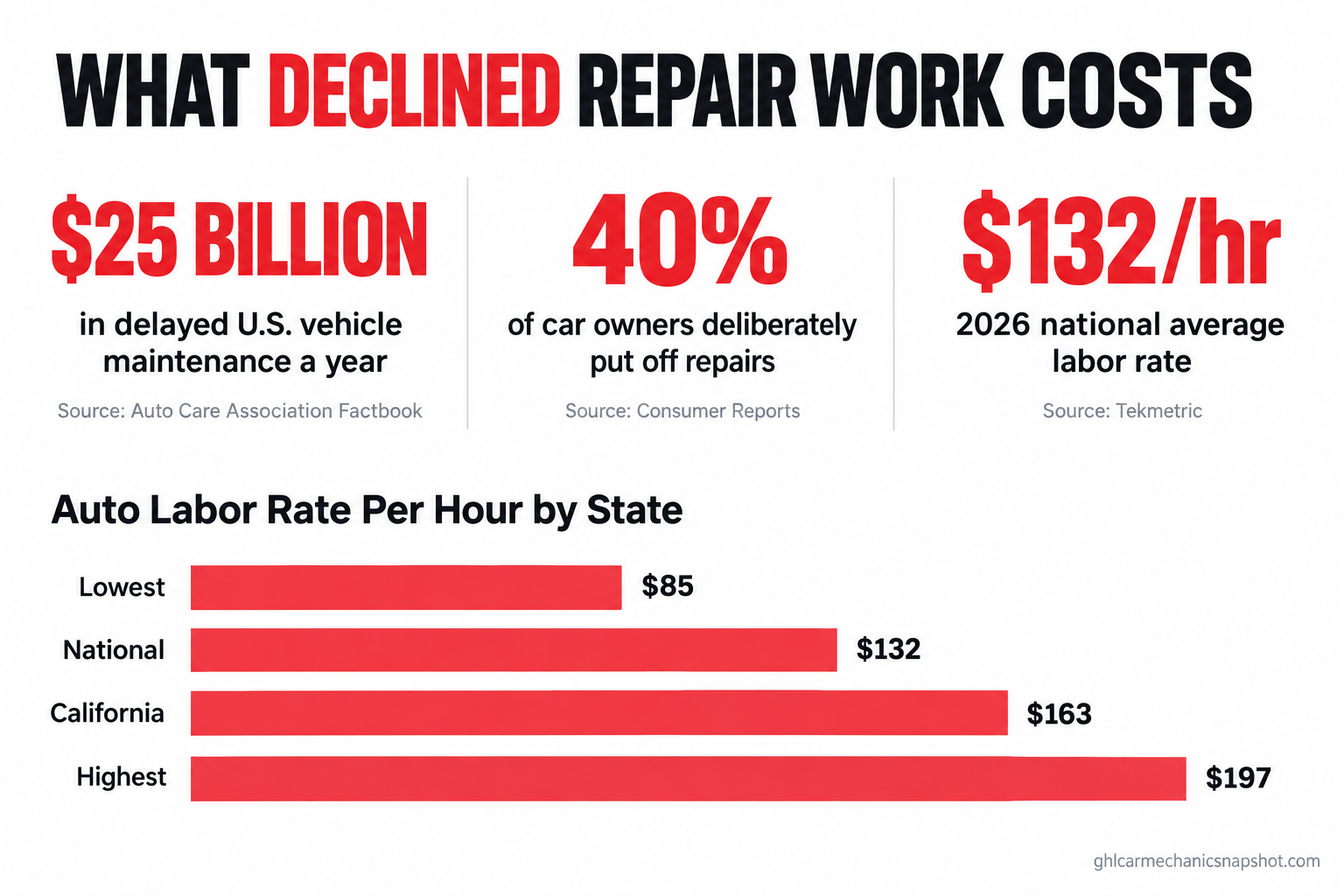
Now price one recovered job. The national average auto repair labor rate hit $132 an hour in 2026, ranging from about $85 to $197 by state, per the Tekmetric labor rate report. A deferred brake job is two or three billable hours plus parts margin, and a water pump is more. Recover one declined job a day and you’ve added a strong week of booked hours from work you already found. Here’s what an hour of that labor is worth by state.
Auto repair labor rate per hour, 2026, by state, per the Tekmetric labor rate report. Every declined job you recover is billed at your rate, and you already did the diagnosis for free.
The six-stage declined work recovery system
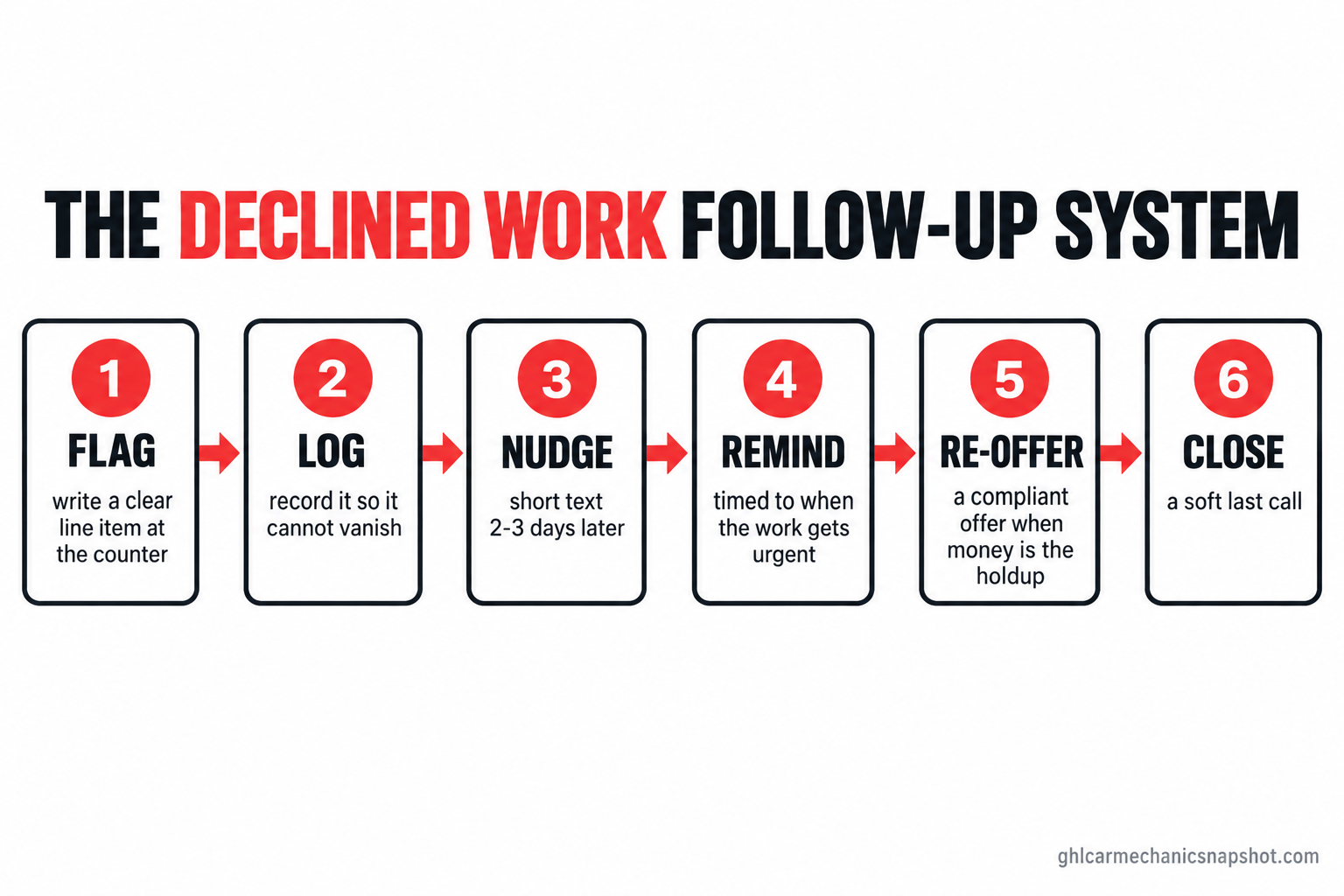
The system is a short chain, and the work falls out at whichever link you never built. Six stages, in order: flag the work clearly, log it so it can’t vanish, nudge the customer a few days later, remind them when it gets urgent, re-offer with care when money is the holdup, and close with a soft last call. Most shops do a decent job at the recommendation and have nothing for the five stages after it, which is why the work you found still walks. You don’t need all six perfect. You need the ones you’re skipping, and for most shops that’s everything after “flag.”
Stage 1: flag it at the counter
Recovery starts before the customer leaves. When the tech finds worn brakes, that has to become a clear line item, not a mumbled “you’ll want to look at those soon.” Write what it is, how bad, and why: “Rear brake pads at 3mm, replace within 60 days or next 2,000 miles, safety item.” Specific is what the customer remembers and what makes your follow-up believable later. This is where photo-backed estimates earn their keep: a photo of the worn pad next to a new one is the raw material for every follow-up that comes next.
Stage 2: log it so it can’t vanish
This is the stage that makes or breaks the whole thing, and it’s the one shops skip. A declined line item has to land somewhere you’ll see it again: a declined-work list, a pipeline stage, a tag on the customer, anything but a paper ticket in a drawer. If it only lives in the repair order you handed over, it’s gone the moment they pull out.
Capture the name and cell, the vehicle, the work declined, the severity, and roughly when it becomes urgent. That last piece lets you time the follow-up instead of blasting everyone at once. A shop on paper can start with a spreadsheet, but the real win is software that holds the declined item and surfaces it on a schedule, so the follow-up fires whether or not anyone remembers.
Stage 3: the 72-hour nudge
The first follow-up goes out two to three days after the visit, while you’re still fresh in the customer’s mind. Keep it short, keep it about the car, give an easy way to say yes. It’s not a sales pitch, it’s a helpful note from the shop that just worked on their vehicle, which is why it’s welcome and legal to send.
It names the person, the shop, the exact finding, and the reason, and ends with one clear ask. No discount, no hype, no pressure, just a mechanic looking out for a customer. If you’ve set up two-way texting, the reply lands back in the same thread and your advisor books it without a phone call. The failure mode here is the generic blast: “Hi, it’s time for service at Main Street Auto!” sent to everyone reads like spam. The nudge works only because it names the real finding on the real vehicle. Generic reminders train customers to ignore you, which poisons every message after.
Stage 4: the due-date reminder
If the nudge doesn’t book it, you wait. The reminder is timed to when the work gets urgent, not to your calendar. Brakes at 3mm get a reminder around 60 to 90 days out, when they’re starting to make noise and the customer is beginning to hear it. A deferred fluid service or filter rides the next oil-change interval. Logging the due date in Stage 2 is what lets this land when the customer is most ready to say yes.
This is where text beats every channel, because a reminder only works if it gets opened. SMS open rates run as high as 98%, well above email’s roughly 20%, per SimpleTexting’s research. It’s the same service-reminder discipline that keeps regulars booked, pointed at a job the customer already deferred.
Message open rate by channel, SMS as high as 98% versus roughly 20% for email, per SimpleTexting.
Watch the timing, though. Fire a brake reminder a week after the visit and it’s annoying, because nothing changed since they told you no. Send it four times and you earn a STOP, which kills every future message to that number. Time it to urgency, space it out, give an easy out.
Stage 5: the re-offer (and where it gets legal)
Sometimes the honest reason the work got deferred is money, and a small offer can move it, like a free brake inspection on the recheck or a waived diagnostic fee if they book this month. Used right, it’s the push a price-sensitive customer needed. Used wrong, it turns your safe follow-up into a legal problem, because a promotional line reclassifies a transactional text as marketing. So run it the safe way: keep routine reminders about the vehicle for everyone, and send promotional offers only to customers who gave express written consent to marketing. Mix the two and every follow-up becomes a marketing message with real exposure.
Stage 6: the last call, then measure it
If the nudge, reminder, and re-offer all go quiet, you send one soft last call, then let the job rest. It’s low-pressure on purpose: it gives the customer a clean yes or no and closes the loop without nagging. Most of your recovered work comes from Stages 3 and 4, but a plain final message catches the ones who meant to book and forgot.
Then measure it. Track two numbers: jobs declined, and jobs recovered. Pull the list once a month and count. When you see you flagged forty jobs and recovered six that would otherwise have walked, you know the system works and you can see where it’s leaking, almost always Stage 2. What gets measured gets recovered.
Run it at your size
The six stages are the same everywhere. What changes is who owns each one and where your weakest link sits:
Solo operator or two-person shop. You’re the tech, the advisor, and the follow-up, and the follow-up always loses to the car on the lift. You’ll never sit down at 5pm and text twelve people about deferred brakes. So automate Stages 3 through 5: log the item once at the counter and let the system fire the nudge and reminder on a timer. You do the diagnosis, the software does the chasing.
Mid-size shop, three to eight techs. Your weak link is ownership. A tech flags the brakes, the advisor prints it, nobody owns the follow-up, and it dies in the handoff. Fix it with one shared declined-work list every advisor sees, and put the follow-up on a timer. This is also the size where your shop software may already have a deferred-work report you’ve never opened.
Multi-bay or multi-location group. Your risk is inconsistency. One location follows up on every declined job, another records none, and you can’t see the gap until you look at recovered revenue per store. Standardize the flag-and-log habit, automate the follow-up, and track recovered work per store. The store recovering two of forty is missing the same stage, usually the logging.
The one texting rule you can’t skip
The second your follow-up goes out by text, federal law applies, and most of this system sits on the safe side of it. A note that the brakes are at 3mm, a reminder the work is due, a booking confirmation: all transactional, because they’re about a vehicle you serviced. The trap is Stage 5. “Your brakes are at 3mm” is fine. “Your brakes are at 3mm, and take $30 off this month” is a marketing text, and sending it without the right consent carries real damages: $500 per text, up to $1,500 if willful, under 47 U.S.C. 227. You also need to register your business number under A2P 10DLC or carriers quietly filter your texts. Keep routine follow-ups about the car, send offers only to a consented list, and honor STOP on the first reply. The full breakdown is in the guide on SMS compliance for auto shops.
Straight answers to the objections
“Won’t the follow-up texts annoy my customers?” Bad ones do. Helpful ones don’t. A text about the worn pad on their own truck, timed to when it’s getting urgent and sent with an easy out, reads as a shop looking out for them. A generic “time for service!” blast reads as spam. The difference is specificity and timing. Cap it at a nudge, a reminder, and a last call, and stop when they reply.
“I already pay for Tekmetric or Shopmonkey. Do I need something else?” Maybe not, and don’t buy anything before you use what you have. Most shop systems already track deferred jobs and send texts. The gap is rarely the software, it’s the workflow: nobody set up the timed follow-up, so the report just sits there. If the automation is clunky or missing, that’s when a dedicated follow-up layer earns its place.
“I’m not technical. Isn’t this a lot to set up?” The habit is the hard part, not the tech. Flagging and logging a clear line item is a counter habit you can build this week with a spreadsheet. Once the item is logged, software does the rest.
“What if the customer already got the work done elsewhere?” Then your text costs you nothing. “Glad you got it handled” keeps you top of mind, and now you know to close that item. Far more often the work is still undone and your reminder is the only one they got. The downside of silence is the whole job.
Frequently asked questions
Declined and deferred work follow-up questions for auto shops
What counts as declined work in an auto shop?
Any service you recommended that the customer didn't approve on the visit: worn brakes they deferred, a fluid service they skipped, a part you flagged that still drives fine. It's different from a no-show. The customer got your recommendation and said 'not right now,' which makes it the warmest lead you have.
How soon should I follow up on a declined repair?
Send a short nudge two to three days after the visit, framed around the specific finding on their car. If that doesn't book it, send a reminder timed to when the work gets urgent, which for brakes is usually 60 to 90 days out. Then one soft last call before you let it rest.
Is it legal to text customers about work they declined?
Generally yes. A follow-up about a vehicle you serviced is transactional and sits on the lowest consent standard. The risk starts when you add a promotional line like a discount, which reclassifies the whole text as marketing under the TCPA, with damages of $500 to $1,500 per text. Send offers only to a consented list, register under A2P 10DLC, and honor STOP.
Where should I keep track of declined jobs?
Anywhere you'll see them again on a schedule. Your shop management system may already have a declined-jobs or deferred-work report. If not, a spreadsheet or a dedicated follow-up tool works. The one place that fails is the printed ticket you hand the customer, because that record leaves with them.
Does declined work follow-up really recover enough to matter?
For most shops it's some of the highest-return work they can do, because you already did the diagnosis for free and earned the right to recommend it. At a 2026 average labor rate of $132 an hour, recovering even one deferred job a day adds a strong week of booked hours.
Back to that Camry
Run the Monday visit again with the system in place. The tech flags the rear brakes at 3mm as a written line item with a photo, the customer defers, and this time it doesn’t vanish. It gets logged with his number and a 60-day due date. Two days later a short text goes out, no pressure, and he doesn’t reply. Nine weeks later, when the pads start to sing, a reminder lands: “you’re probably starting to hear them, want Thursday or Friday?” He books. The job you found in October is on your lift in December, billed at your rate, instead of at the dealer who texted him first. Nothing changed except that you held onto work you’d already earned. For the automations that run alongside this one, see the five automations every auto repair shop should run.