

It is a slow Tuesday and you finally do the thing everyone told you to do. You pull your customer list, 900 numbers collected over eight years, and send one text: “Your friends at the shop miss you. Book any service this month, refer a friend, you both get $20 off.” Twenty minutes of work. Feels like marketing you should have been doing all along.
That one text can be the most expensive thing you do all year. Not because it annoys anyone. Because of one line in it.
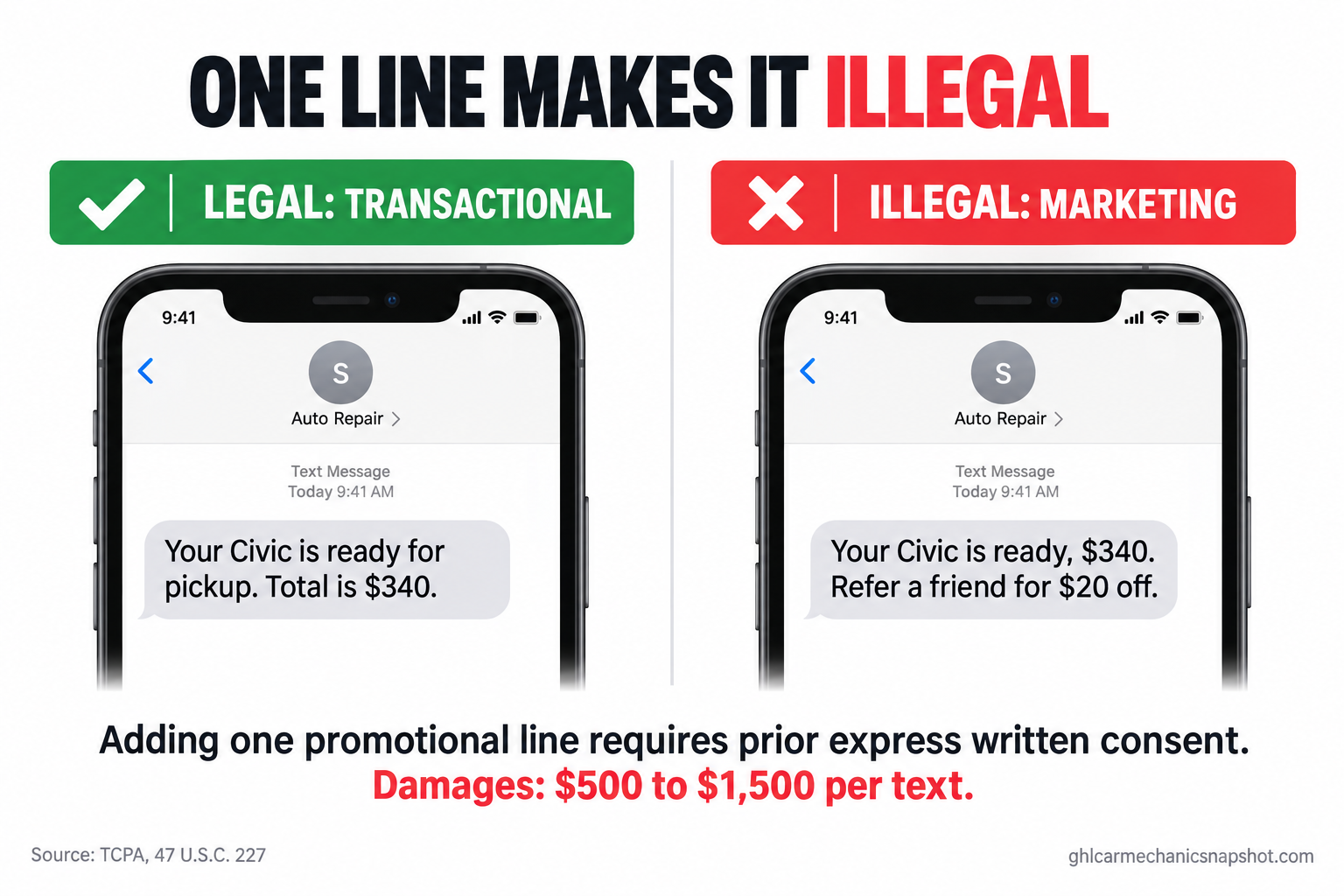
Here is the short version, because you are busy. A plain service text (“Your Civic is ready, invoice is $340”) is transactional and generally legal to send. Add a promotional line and the whole message is reclassified as marketing under federal law, and marketing texts need a stricter written consent you probably do not have for those 900 numbers. Get it wrong and the damages are $500 per text, up to $1,500 if a court finds it willful, per message, no cap. On top of that, carriers now block business texts unless you have registered.
What’s on this page
- What one non-compliant blast costs
- The three rulebooks you are under
- Rule 1: the line that flips a legal text into an illegal one
- Rule 2: what “consent” actually has to look like
- Rule 3: STOP, and the 10-business-day clock
- Rule 4: register or get blocked (A2P 10DLC)
- Written estimates and authorization for overage
- Steal these: compliant copy
- Your shop, your size
- Straight answers to the objections
- FAQ
What one non-compliant blast costs
Start with the number, because it is the whole reason to care. The Telephone Consumer Protection Act, the federal law that governs texting customers, sets statutory damages at $500 for each offending message, and up to $1,500 per message when a court finds the violation willful, under 47 U.S.C. 227. No cap, and the customer does not have to prove any harm. Each text is its own violation.
Now do the math on that Tuesday blast. If even a fraction of those 900 numbers never gave the right consent, you have hundreds of violations, each worth $500 to $1,500 to a lawyer who files these for a living.
Here is what a single careless blast can add up to, before a court ever weighs the willful multiplier.
Minimum statutory exposure at $500 per message if every recipient lacked valid consent, before any willful multiplier. Illustrative math from the per-text figure in 47 U.S.C. 227. Real cases turn on how many recipients actually lacked consent.
You will rarely see the full number, since most disputes settle. The point is the shape of the risk. This is a category of law built to be expensive on purpose, so the fix is worth twenty minutes.
The three rulebooks you are under
“Texting customers” is governed by three different rulebooks at once, written by three different bodies. Most owners have heard of none of them.
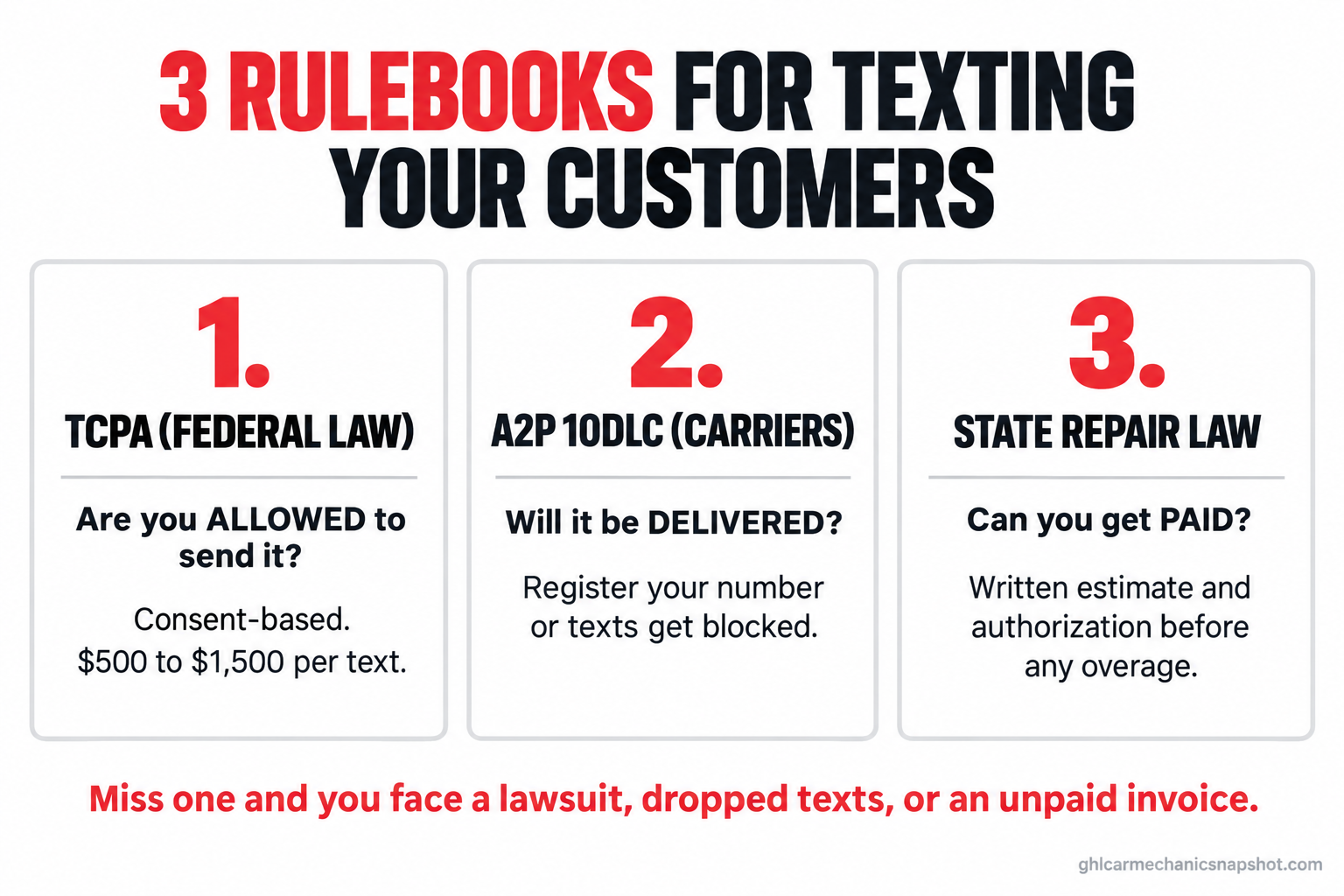
- The TCPA (federal law). Governs whether you are allowed to send a message, based on consent. This is the one with the $500-per-text teeth.
- Carrier rules (A2P 10DLC). Governs whether your text is delivered at all. The big carriers require every business texting from a 10-digit number to register first.
- State auto repair law. Governs how you get approval for work and money. A text is not automatically a valid written estimate or authorization for extra charges.
Miss any one and you are exposed on a different flank: a lawsuit, dead-on-arrival messages, or an invoice you cannot legally collect.
Rule 1: the line that flips a legal text into an illegal one
This is the most important idea here, so read it twice.
Texts fall into two buckets. A transactional message is about a job the customer already brought you: “Your brakes are done, pick up after 4.” A marketing message tries to sell something new: “Spring AC special, $89 this month.” Transactional messages ride on a lower consent standard. Marketing messages need the strict written kind.
Here is the trap. When one message does both jobs, the law does not average them out. A message that mixes an informational purpose with any promotional purpose is treated as telemarketing, so the whole thing needs marketing-level consent, per firms that defend these cases like Blank Rome and Hunton. One promotional sentence pulls the entire text across the line.
So this is fine to your reminder list:
“Hi Maria, your Civic is ready for pickup. Total is $340. We’re open till 6.”
And this, to the exact same list, is a marketing message that likely needs consent you do not have:
“Hi Maria, your Civic is ready, $340. Refer a friend this month and you both get $20 off.”
Same customer, same car, one added sentence, completely different footing.
Rule 2: what “consent” actually has to look like
A phone number scribbled on a repair order is not consent to market.
For a plain reminder about a job in progress, the bar is low: the customer gave you the number for that purpose. For marketing texts the standard is specific. Prior express written consent means a signed agreement (an e-signature or checked web box counts) where the customer clearly agrees to receive marketing texts at that number, the message names your business, and the language makes clear they are not required to agree in order to buy from you, per the FCC rules at 47 CFR 64.1200.
What that rules out: a number given years ago for a specific repair is not consent to market; a pre-checked box or consent hidden in fine print does not count; and consent to reminders is not consent to offers, because they are two separate permissions.
Rule 3: STOP, and the 10-business-day clock
Opting out used to be a gray area. Not anymore. Since April 11, 2025, a federal rule requires you to honor an opt-out sent “in any reasonable manner” and to process it within 10 business days, per Nixon Peabody and BCLP.
“Any reasonable manner” is what trips people up. You cannot force one exact magic word. The FCC named keywords you must treat as an opt-out, including stop, quit, end, cancel and unsubscribe, and a plain reply like “please stop texting me” counts too. Any real texting platform handles this automatically.
Rule 4: register or get blocked (A2P 10DLC)
This one is not a lawsuit risk. It is a “your texts silently stop working” risk, happening right now to shops that never set it up.
A2P 10DLC is the carriers’ system for business texting: any business sending from a 10-digit number through software. You register your brand (verified by your EIN) and your campaign through The Campaign Registry. Since February 1, 2025, the major US carriers block 100% of unregistered A2P traffic, per compliance guides from Infobip and JustCall. Not slowed. Blocked.
If you set up a texting number a while back and never registered, a chunk of your reminders may be dropped before they reach anyone, and you would never know. Registration takes about 10 to 15 minutes and is usually approved within a week. Whatever tool you pick, confirm it is registered before you rely on a text going out.
Everything above is the front-office layer we build for shops on GoHighLevel, with consent logging, automatic STOP handling and 10DLC registration handled at setup. If you would rather have texting, reminders and review requests wired up correctly than assemble the rules yourself, book a free walkthrough and we will show you how it is put together.
Written estimates and authorization for overage
Texting law is only half your compliance picture. The other half is about getting paid. Your state sets rules on written estimates and how much you can charge above one, and a text does not automatically satisfy them.
In California, a shop must give a written estimate and get authorization before starting work, and cannot exceed that estimate by more than the authorized amount without additional authorization, under Business and Professions Code 9884.9; any verbal go-ahead must be documented with the person’s name, date, time and amount. Florida requires a written estimate once a repair exceeds $100, and approval before exceeding the estimate by more than $10 or 10 percent, whichever is greater, under Florida Statute 559.905. Texas has no repair-specific cap, but its deceptive trade practices law still makes it unlawful to bill for work the customer never agreed to, per Texas Law Help.
Texting an approval for extra work is a great habit, because it gives you a timestamped record. But the text has to contain what your state requires: the specific additional amount and a clear yes, saved. A thumbs-up to “that ok?” is not a documented authorization.
Steal these: compliant copy
Here is copy you can adapt. This is not legal advice, and if you are unsure, a short call with an attorney in your state is cheaper than a TCPA suit. But these are the patterns that keep you on the right side of the lines above.
A clean service reminder (safe for your reminder list):
“Hi [Name], this is [Shop] on [Street]. Your [Vehicle] is due for its [service]. Reply here or call [number] to book. Reply STOP to opt out.”
No offer, no discount, no refer-a-friend. It stays transactional.
A marketing opt-in message (the one-time invitation to join your deals list):
“Hi [Name], it’s [Shop]. Want our seasonal service deals by text? Reply YES to join. Msg frequency varies, msg and data rates may apply, reply STOP to opt out. You don’t have to join to book service with us.”
Consent to marketing cannot be a condition of doing business. Only people who reply YES go on the offers list.
A promotional text (send ONLY to people who opted in above):
“[Shop] here. Winter prep special: battery test plus coolant check, $[price] through [date]. Book at [link]. Reply STOP to opt out.”
An opt-out confirmation (your tool should send this automatically):
“You’re unsubscribed from [Shop] texts and won’t get more. Reply START to rejoin. For service, call [number].”
A documented overage authorization (for the estimate law above):
“Hi [Name], while working on your [Vehicle] we found [issue]. Fixing it adds $[exact amount] to your approved estimate of $[original], new total $[new total]. Reply YES to approve this amount, or call [number]. We won’t proceed until you confirm.”
Save that thread. It names the exact number and captures a clear yes, which is what your state wants to see if the bill is questioned.
Your shop, your size
The rules are the same at every size. What changes is where the risk sits and what to do first.
Solo operator on paper tickets. You are texting from your cell. Your risk is zero record of consent and no automatic STOP. First move: get a proper business texting number, register it, put one consent checkbox on your intake. You need a clean, logged reminder system, not a marketing program.
Mid-size shop, two to eight techs. You likely have software with texting built in, so read what that software actually costs before upgrading a tier just for texting. Your risk is the friendly upsell. First move: reminders stay clean, offers go only to the opted-in list, every overage gets a documented dollar-amount text. Confirm the platform is 10DLC-registered.
Multi-location group. Every location that texts is its own compliance surface, and one location’s sloppy blast is the whole group’s lawsuit. First move: centralize on one registered brand, standardized consent language, and one approved template library so no location free-writes a message that mixes reminder and offer.
Straight answers to the objections
“My customers would never sue me. We’re friendly.” Probably true of your regulars. TCPA suits are rarely brought by the friendly regular; they come from professional plaintiffs and the lawyers who specialize in them, and it takes one number that belongs to someone who knows the law. Clean lists also get read; messy ones get filtered.
“I already text everyone from my cell and it’s fine.” “Fine” means “nothing has gone wrong yet,” not “compliant.” From a personal phone you cannot prove consent, cannot honor STOP automatically, and your texts are unregistered, so carriers may already be filtering them.
“Isn’t a plain reminder enough? Why bother with marketing at all?” For many shops, clean reminders plus review requests are the whole game, and that is genuinely lower-risk. The mistake is running marketing by accident, one promo line at a time on a reminder list, which gives you all the exposure and none of the intended benefit.
“Do I need to be a compliance expert?” No. A properly set up texting tool registers your number, logs consent, honors STOP, and keeps reminder and offer audiences separate. Your job is to keep reminders clean, use two checkboxes, and document overages with a real dollar amount.
Frequently asked questions
Auto shop texting compliance questions
Is it legal to text my auto repair customers?
Yes, done right. Plain transactional messages about a job the customer brought you (their car is ready, their invoice, a reminder for service they asked about) ride on a low consent standard and are generally fine. Marketing texts (offers, specials, refer-a-friend) need prior express written consent, and you need A2P 10DLC registration for any business texting from a 10-digit number to be delivered at all.
What turns a reminder text into an illegal marketing text?
Adding any promotional content. A message that mixes an informational purpose with a promotional one is treated as telemarketing, so the whole text needs marketing-level written consent. 'Your car is ready' is transactional; 'your car is ready, and refer a friend for $20 off' is marketing. Keep reminders clean and send offers only to a list that opted in.
How much can a TCPA violation cost my shop?
Statutory damages are $500 per offending text and up to $1,500 per text for willful violations, under 47 U.S.C. 227. There is no cap and the customer does not have to prove harm. Because each message is its own violation, a single blast to a list without proper consent adds up fast.
What is A2P 10DLC and do I really need it?
It is the carrier registration system for business texting from regular 10-digit numbers. You register your brand (verified by your EIN) and your campaign through The Campaign Registry. Since February 2025 the major US carriers block 100% of unregistered business texts, so without it your reminders may never arrive. Registration takes about 10 to 15 minutes and is usually approved within a week.
How do I have to handle a customer who replies STOP?
Since April 2025 you must honor an opt-out sent in any reasonable manner and stop within 10 business days. You cannot require one exact keyword; stop, quit, end, cancel, unsubscribe and plain requests like 'stop texting me' all count. A real texting platform detects these, confirms, and removes the number automatically.
Does a text approval count as legal authorization for extra work?
It can, if it contains what your state requires. Strict states like California and Florida require a written estimate and additional authorization before you exceed it. A compliant overage text names the exact additional dollar amount and captures a clear yes you can save. A vague 'is that ok?' with a thumbs-up does not.
Back to that Tuesday text
Pull that draft back up before you hit send. The reminder half was fine. It was the refer-a-friend line, dropped onto a list that only agreed to reminders, that turned twenty minutes of good intentions into real exposure.
The fix is not to stop texting. The fix is boring and permanent: keep reminders clean, build a separate offers list with a real checkbox, register your number, let the software honor STOP, and document every overage with an exact amount. Do that once and you can text with both hands, knowing every message is one you are allowed to send and one that will arrive. For the automations that ride on top of it, see the five automations every shop should run.