
You are three tabs deep on a Tuesday night, cold coffee by the keyboard, trying to decide between four shop software demos that all looked great with a rep talking over them. Each quoted a number that sounded fine. None of those numbers is what you will actually pay. One charges for every login. One hides two-way texting two tiers above the plan you saw. One will not let you try it without a sales call.
Here is the short version, because you open in the morning. For a 2-to-6 bay independent shop in 2026, Tekmetric and Shop-Ware give you unlimited users at a flat rate, Shopmonkey has the friendliest screen but charges per seat, and AutoLeap builds the system for you but will not show a price or a free trial until you talk to sales. The right pick is not the cheapest sticker. It is the one whose real, all-in bill matches how you run the counter. Below is the honest head-to-head.
What’s on this page
- Which bill are you actually comparing?
- What the wrong pick quietly costs you
- The four tools at a glance
- Tekmetric, Shopmonkey, AutoLeap and Shop-Ware in detail
- The eight things that actually decide it
- What a shop your size should pick
- The layer none of these fully own
- Straight answers to the objections
- FAQ
First, which bill are you actually comparing?
Get clear on what you are buying, because “shop software” is really two products wearing one name. The first is a shop management system: repair orders, estimates, labor guides, parts, invoicing and digital inspections. All four are this, and they do the core job well. The second is the customer communication layer: two-way texting, reminders, missed-call follow-up, declined-work chasing and reviews. Every one bolts some of that on, but they gate it differently and none was built for it first. That gap is why a shop pays for a top tier it barely uses, just to unlock the one text feature it wanted.
So hold two questions. Which system runs my bays best, and which handles the customer contact I am doing from a cell phone and a sticky note. The answer is rarely the same tier. For every vendor’s real number and hidden fee, see our full cost teardown. This piece is about which one fits.
What the wrong pick quietly costs you
The sticker is the smallest number here. The expensive part is the mismatch: a plan without texting so your advisor keeps quoting from a personal phone, or per-seat software you ration so a tech shares the writer’s screen. Both cost real money that never shows up as a line item. Start with what your time is worth. The national average shop labor rate hit $132 an hour in 2026, ranging from about $85 to $197 by state, per Tekmetric’s 2026 labor rate report. Every hour you spend fighting software, or answering a call it should have caught, is billable time out the bay door.
Then there is speed. The classic Lead Response Management study, later confirmed by Harvard Business Review across 2,241 companies, found a lead contacted within five minutes is 21 times more likely to qualify than one contacted after thirty. That “lead” is a person in a parking lot deciding whether to call you or the shop down the street. The software that texts them back first wins the brake job.
The four tools at a glance
Here is the honest snapshot before the detail. Prices are published or widely reported 2026 monthly figures, month to month; annual billing runs roughly 10 percent lower. Confirm the live number on each vendor’s page before you sign.
| What you’re comparing | Tekmetric | Shopmonkey | AutoLeap | Shop-Ware |
|---|---|---|---|---|
| Entry plan (monthly) | ~$199 | ~$199 to $215 | ~$199 | ~$249 |
| Top standard tier | ~$439 | ~$449 to $499 | ~$449 | ~$799 |
| User model | Unlimited | Per seat (+$20 ea) | Unlimited RO focus | Unlimited |
| Two-way texting | Scale (top) | Basic (entry) | Pro (mid) | Pro (limited on entry) |
| Digital inspections | From entry | From Clever (mid) | From entry | Across platform |
| Google reviews | Native feature | Higher tiers | Elite (top) | Higher tiers |
| Free trial | Demo only | Demo, trial unclear | Demo only | Demo only |
| Best fit | Growing / multi-shop | Small, simple shops | Hands-off setup | High-volume shops |
Sources: Tekmetric pricing and G2; Shopmonkey pricing and Capterra; AutoLeap on Capterra; Shop-Ware on GetApp. Verified September 2026.
Tekmetric: flat-rate seats, texting up top
Tekmetric runs three tiers, Start at $199, Grow at $349 and Scale at $439 a month, plus custom Enterprise, dropping to roughly $179, $309 and $409 annually, per Tekmetric’s pricing page. The headline that matters most: every plan includes unlimited users and unlimited repair orders. Hire a third tech, add a weekend writer, none of it changes your bill. Digital inspections with photos are in from the entry plan, and the reporting is strong.
Here is where it bites. Two-way texting lives on Scale, the $439 top tier, per the plan breakdown on G2. Start and Grow give you the management system, but the moment you want to text an estimate back and forth, you are on the flagship plan, and multi-location and marketing cost extra. The common regret is buying Grow, finding texting is a tier up, and going back to a personal cell. There is no free trial.
Shopmonkey: the easiest screen, priced per seat
If you or your advisor is not a “computer person,” Shopmonkey feels least like a fight. It is consistently the easiest to learn, and two-way texting and email are included from the Basic plan, so unlike Tekmetric you are not forced up a tier to text a customer.
The catch is the seat meter. Shopmonkey runs Basic around $199 to $215, Clever around $359 and Genius around $449 to $499 a month, and each tier includes a fixed number of licenses: three on Basic, four on Clever, five on Genius. Every login past that is about $20 a month, per Capterra and the vendor’s own pricing page. An owner, a writer and four techs is six logins, so on Basic that is three extra seats, roughly $60 a month on top, climbing as you hire. Digital inspections also wait until Clever.
So Shopmonkey is cheapest when your team is small and stays small, and gets expensive as headcount grows. That is the opposite shape from Tekmetric and Shop-Ware, where the tenth login is free.
AutoLeap: done-for-you, but you have to ask
AutoLeap’s pitch is that you do not set it up, they do. A consultant migrates your data and configures the system for your shop. Published tiers land near Essentials $199, Pro $349 and Elite $449 a month, per Capterra, with strong parts and inventory workflows that reviewers rate highly.
Two things sit behind the sales call. First, two-way texting is on Pro and the integrated Google review engine is on Elite, so the two features most owners want are split across the upper plans, same trap as Tekmetric. Second, there is no self-serve free trial, and the pricing page acknowledges a setup fee without stating the amount. You cannot comparison-shop a number nobody will show you until you are on a call.
Shop-Ware: built for volume, priced for it
Shop-Ware starts higher and is unapologetic about who it is for. Tiers run Startup around $249, Pro $379, Master $499 and Ultimate near $799 a month, per GetApp. Like Tekmetric, it includes unlimited users on every plan, its photo-and-video inspections run across the platform, and the analytics are the deepest of the four, with an AI-assisted parts matrix that saves a busy parts desk real time.
The tradeoffs are the entry price and a couple of things that ride on top. Two-way texting is limited on Startup and only goes unlimited from Pro up. The labor guide is not baked in: you plug in Mitchell 1 ProDemand or ALLDATA as a separate subscription. And multi-location migrations can carry setup fees. A two-bay shop that buys in at Startup expecting the Master-tier demo usually leaves disappointed, because the value shows up at volume.
The eight things that actually decide it
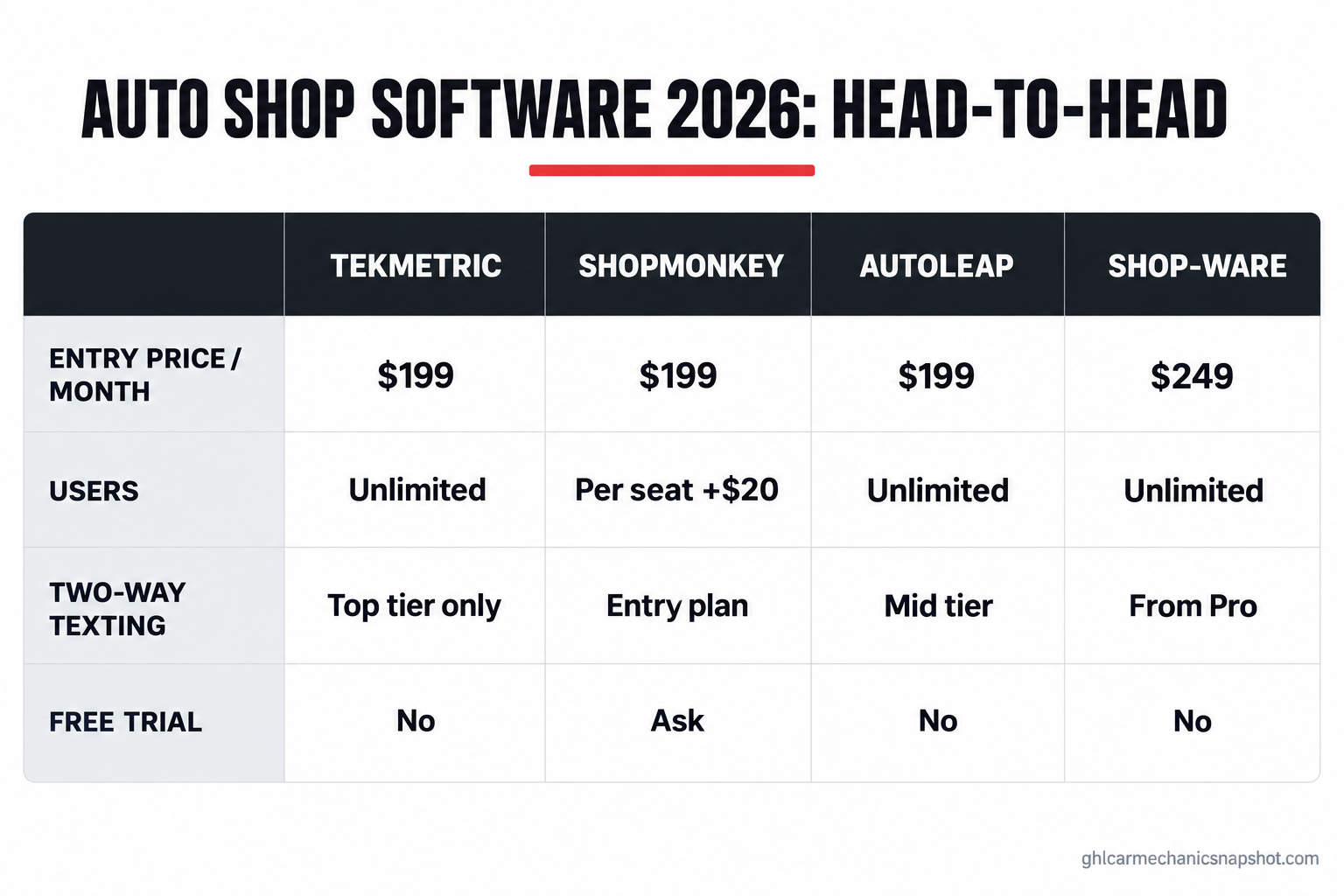
The table above lays out all eight criteria across the four tools. These are the ones that actually change a decision.
User model. The biggest cost swing. Tekmetric and Shop-Ware are unlimited users; Shopmonkey is per seat past its tier limit, about $20 each. Count every login before comparing a price.
Two-way texting, and where it hides. How estimates get approved without phone tag. Entry plan on Shopmonkey, mid Pro tier on AutoLeap, unlimited from Pro on Shop-Ware, top Scale tier only on Tekmetric.
Free trial and onboarding. Tekmetric and AutoLeap have no self-serve trial, so you commit off a demo, and AutoLeap will not name its setup fee. Get the all-in number in writing.
The features you buy it for are often gated up. Digital inspections raise approvals because a customer can see the worn pad, the reason photo-backed estimates close more jobs; they are in from entry everywhere except Shopmonkey (Clever). Native Google reviews sit on Tekmetric, but on AutoLeap’s top Elite plan. Parts, CARFAX and QuickBooks are covered by all four, with the watch-out that Shop-Ware’s labor guide is a separate ProDemand or ALLDATA subscription.
Where each one breaks. Tekmetric and AutoLeap make you climb a tier for texting, Shopmonkey’s bill grows with headcount, and Shop-Ware asks a small shop to pay a big-shop floor. Each is a dealbreaker only if it does not match your shop.
Lowest monthly plan that includes two-way texting, US dollars. Shopmonkey includes it on Basic; AutoLeap on Pro; Shop-Ware unlimited from Pro; Tekmetric on the top Scale tier. Sources as linked above, September 2026.
If texting is non-negotiable, and for a modern shop it is, your real entry price is not $199. It is whatever plan unlocks the text thread, which reshuffles the ranking.
What a shop your size should pick
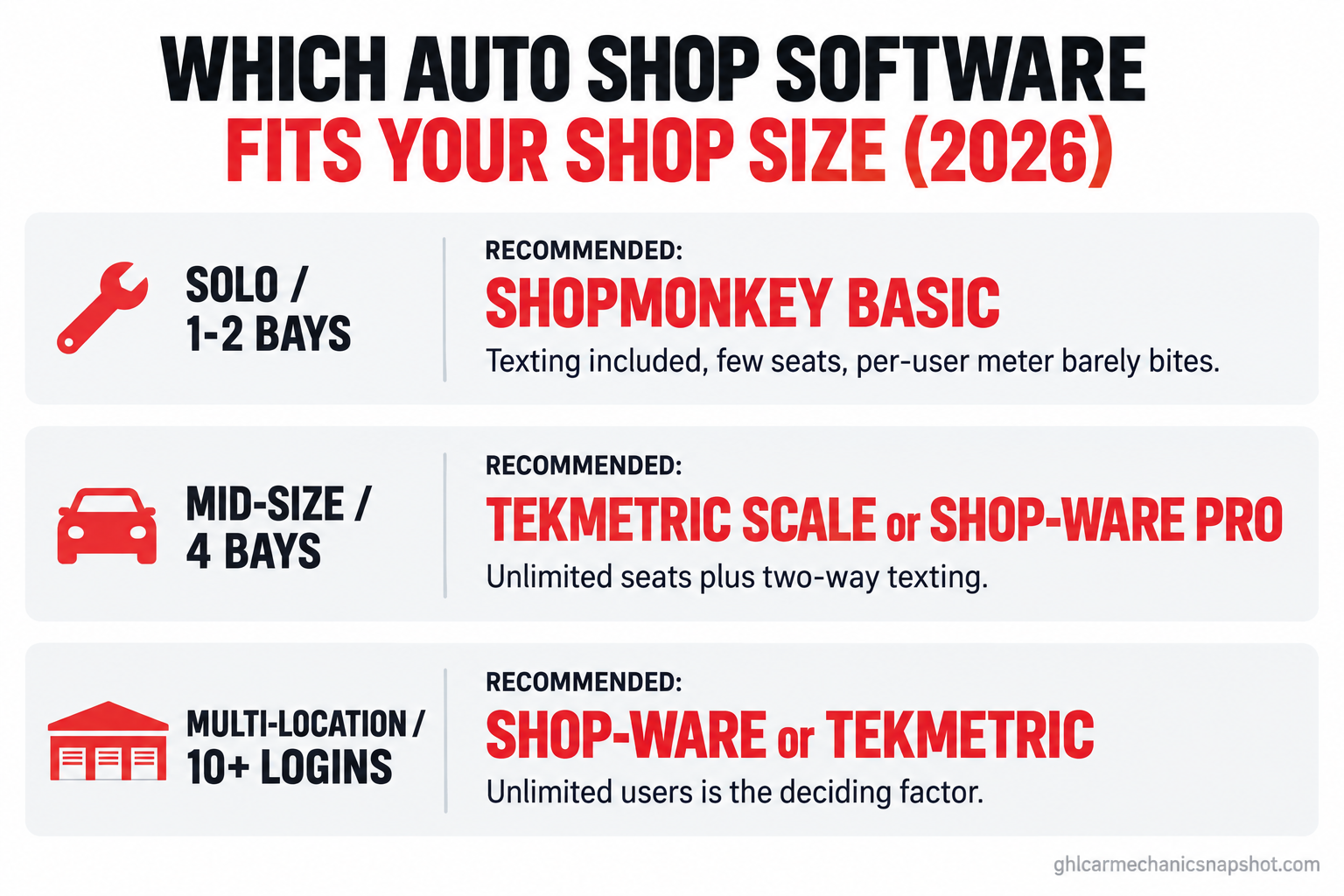
The framework gives three answers depending on how you run.
Solo or 1-to-2 bays, two or three logins. You want the lowest real cost and least setup friction. Shopmonkey Basic is a strong fit: texting is included and with a couple of seats the per-user meter barely bites. Tekmetric Start works if you can live without texting for now. Avoid Shop-Ware here, you would be paying a volume floor you are not using yet.
Mid-size, 4 bays, five or six logins, texting and reviews are must-haves. This is where the seat model flips the math. On Tekmetric or Shop-Ware those logins are free, so you compare the tier that includes texting: Tekmetric Scale or Shop-Ware Pro. On Shopmonkey you would be on Clever or Genius plus extra seats. Price all three at your real headcount, not the sticker. Here is where advertised and actual diverge most.
Multi-location, ten-plus logins. Unlimited users becomes the deciding factor. Shop-Ware and Tekmetric are built for this, though Tekmetric’s multi-location and marketing add-ons are extra per shop. A per-seat model at this scale gets punishing fast. Get the all-in, per-location number in writing.
The layer none of these fully own
Notice the pattern across all four. The repair-order side is solid everywhere. The part that keeps costing more, that keeps hiding a tier up, is the customer contact: texting, reminders, missed-call follow-up, declined-work chasing and reviews. These are management systems first, and communication is the bolt-on. It is also where shops leak the most money. A missed call at a busy shop is rarely just a missed call, it is a job that went down the street, as we broke down in how shops lose jobs to missed calls. The five automations every shop should run all sit on that side.
There is a compliance cost buried here too. When you text customers you are under the federal TCPA, where damages run $500 per text and up to $1,500 for a willful violation, per 47 U.S.C. 227. Slip one promotional line into a service reminder and the whole message reclassifies as marketing that needs prior written consent, a trap we cover in the auto shop texting compliance guide. Whatever you pick, the texting has to handle consent, STOP and A2P 10DLC, or the cheap setup gets expensive fast.
This is the case for owning the communication layer instead of renting it at a top tier. A platform like GoHighLevel runs texting, reminders, reviews and follow-up as a flat cost that does not care how many techs you hire, alongside whichever system runs your parts and ROs. It is the model our Car Mechanic system is built on: front-office automation as a fixed asset you own, not a rising rental. You still need one of the four for repair orders. What changes is whether your follow-up is a feature you rent or a system you keep.
Straight answers to the objections
“I already pay for one of these. Did I pick wrong?” Probably not. If it runs your repair orders well, switching rarely pays off. The sharper question is whether you are paying for its top tier mainly to unlock texting and reviews, while still doing half your customer contact from a personal phone. If so, the communication layer is where you overpay. For a same-brand look, we keep pages like Car Mechanic vs Tekmetric.
“Isn’t the cheapest one just the worst one?” No, and this is the trap. More money often buys management capability you will use. But the “cheapest” plan that forces you to a $439 tier just to send a text is not cheap at all. Cheapest sticker and lowest real cost are different numbers.
“Do I have to be technical to run any of this?” No, and if a tool makes you feel like you do, that tells you something. Shopmonkey has the gentlest learning curve, and AutoLeap sets it up for you. The day-to-day should be a text that sends itself and an estimate you approve with a tap.
“Can’t my management system just do the texting and follow-up too?” Partly, and that is why shops overpay. It can text, once you are on the right tier. It usually cannot run the layered follow-up, the missed-call recovery, the reactivation of a year-gone customer, the way a dedicated automation platform does. That is the difference between a feature and a system.
Frequently asked questions
Auto repair software comparison questions
Which is cheapest, Tekmetric, Shopmonkey, AutoLeap or Shop-Ware?
On sticker, Tekmetric, Shopmonkey and AutoLeap all start near $199 a month and Shop-Ware near $249. The real cheapest depends on how many logins you need (Shopmonkey charges about $20 per seat past its tier limit, while Tekmetric and Shop-Ware are unlimited) and whether you need two-way texting (included on Shopmonkey's entry plan, gated higher on the others).
Which auto shop software includes two-way texting on the cheapest plan?
Shopmonkey includes two-way SMS and email from its entry Basic plan. AutoLeap puts it on the mid Pro tier, Shop-Ware offers limited texting on Startup and unlimited from Pro, and Tekmetric includes it only on its top Scale tier at about $439 a month.
Do any of these offer a free trial?
All four lean on guided demos. Tekmetric and AutoLeap have no self-serve free trial, so you decide off a demo. Shopmonkey's trial availability is inconsistent across sources, so ask directly. Because you often cannot try before you buy, get the all-in monthly and first-year number, setup fees included, in writing first.
Does any of them replace my need for a follow-up and review system?
Not fully. All four run repair orders well, but customer follow-up (missed-call text-back, declined-work chasing, reminders, review routing) is a bolt-on that often sits in the upper tiers. Many shops run a dedicated automation platform for that layer alongside their management system, so follow-up is a flat cost they own rather than a top-tier feature they rent.
Is it safe to text customers from these systems?
Yes, as long as the texting handles consent, STOP and opt-out and walks you through A2P 10DLC registration. The risk is TCPA: damages run $500 per text and up to $1,500 for a willful violation, and mixing one promotional line into a service reminder reclassifies the whole message as marketing.
Back to those three open tabs
Close two of them. The choice was never about which system writes a repair order, because all four do that fine. It is about which real bill fits your shop: unlimited seats if you are growing a team, texting in the plan you can afford, and a follow-up layer that does not quietly cost you jobs you already earned.
So do the two-minute version tonight. Write down your login count and whether texting is a must-have, then price the tier that includes it, not the one in the ad. Tekmetric or Shop-Ware if seats are climbing, Shopmonkey if the team is small and the screen has to be simple, AutoLeap if you would rather someone else set it up. Then decide, separately, who owns your follow-up. If you want a hand mapping that layer so it is a fixed cost you keep, book a walkthrough and we will price it with you.