

You finally took the week: your daughter’s wedding, or the first fishing trip in three years. You came back to a voicemail box that filled by Tuesday, three estimates gone cold, two no-shows nobody confirmed, and a Google rating that did not move because nobody asked a happy customer for a review. The bays ran, but the front half of your business, the part that turns a phone call into a booked repair, sat dark the whole time.
That did not happen because you took a week off. It happens every day you are under a car. You are the system: the phone, the quote follow-up, the review ask, the reminders, it all lives in your head and runs off your cell phone. When your attention moves, those jobs stop. It is a design problem, and you can fix it.
What’s on this page
- Why your shop stalls when you look away
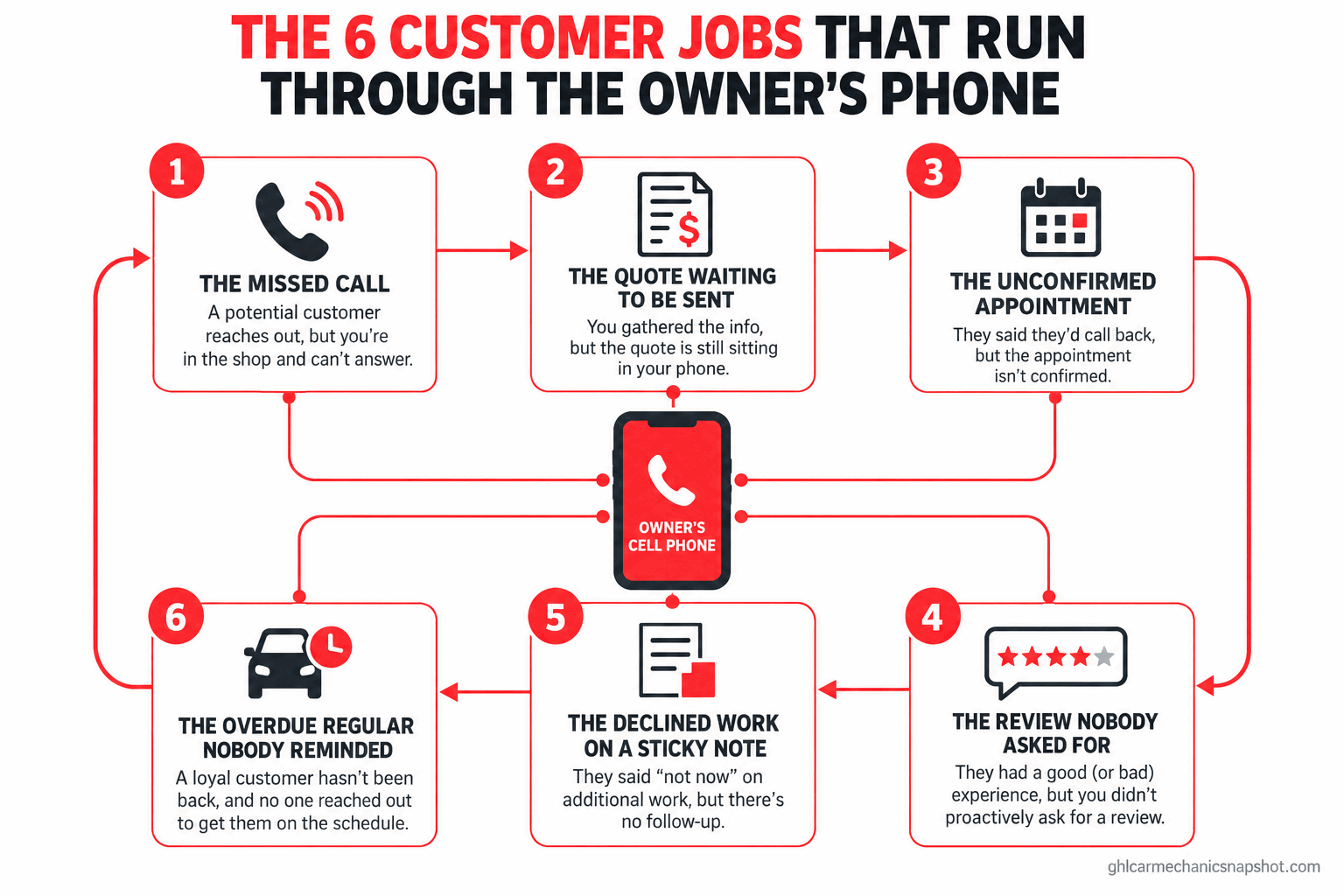
- Job 1: the phone when your hands are full
- Job 2: the quote that waits to be sent
- Job 3: appointments nobody confirmed
- Job 4: the review ask you forget to make
- Job 5: the declined work on a sticky note
- Job 6: the regular you never nudged
- Steal these: the six messages
- Fix it at your size
- The compliance line that rides along
- Objections
- FAQ
Why your shop stalls when you look away
Start with the stakes. The national average repair order is about $704, per the Tekmetric Shop Index built on more than 10,000 shops, so every dropped job is a $700 event, not “a missed call.” You cannot catch them by being faster, because a person cannot answer the phone with their hands in a timing cover. Harvard Business Review found companies that reached a new lead within an hour were about seven times more likely to qualify it as those who waited longer. A driver with a dead car calls three shops, and the one that texts back first wins it.
And it feels personal, because you carry it. SCORE data compiled by Patriot Software found only 57% of owners take vacations, and 67% of those who do still check in daily. The shops that dig out stopped being the system and built one. Here are the six to move off your phone.
Job 1: the phone when your hands are full
A first-time caller has a problem and a credit card. You are under a car, and the phone rings out. They do not leave a voicemail. They dial the next shop on Google, and you never knew they called.
This is the most expensive job you run on memory, because it needs you free the second the phone rings. Call analytics firm Marchex found as many as 21% of calls into auto service businesses go unanswered, dropped, or mishandled, per this write-up. Miss four first-time callers in a week at a $704 ticket and roughly $2,800 walked.
The fix that runs without you: an automatic text back the instant a call is missed, from your shop number, before the caller pulls up the next shop. The lead is caught, and you reply when your hands are free. See how shops lose jobs to missed calls and why answered calls still never book.
How it breaks: texting from a landline that can’t send texts, and sending the auto-reply with no opt-out.
Job 2: the quote that waits for you to hit send
This one hides, because the job is not lost yet. You diagnose, build the estimate, and call. No answer. The estimate sits, and work that would have paid this week slides into next. Do that with three jobs at once and your cash runs a week behind labor, and the follow-up never happens because the only person who can send it is you.
Switch it to text with photos and the yes comes back in minutes, because when customers see the worn pad or split boot they approve far more work. See two-way texting so estimates stop dying at “I’ll call you back”.
The fix that runs without you: the estimate goes out as a text link with photos and one approve button, and if it is not opened within a couple hours, an automatic nudge fires. The system chases it, not you.
How it breaks: a heavy PDF that won’t open on a phone, a link that expires, and no automatic second nudge.
Job 3: tomorrow’s appointments nobody confirmed
You booked the 9am and planned the morning around it. At 9:15 the bay is empty, the tech is on your clock, and the customer is not picking up. You cannot fill a 9am slot at 9:20: a paid hour and a repair order gone, because the only reminder was you, and you forgot.
No-shows run around 15% to 20% of booked appointments by most benchmarks, and the fix is a confirmation, not nagging. The clearest proof is from medicine, where a Cochrane systematic review found text reminders clearly improve attendance.
The fix that runs without you: a two-step confirmation with one-tap replies, the day before and the morning of. Someone who taps “reschedule” is a rebooking, not a lost car, and your waitlist gets an automatic message to backfill the slot. Full system: the confirmation setup that fills the bay anyway.
How it breaks: a reminder that fires at 2am because it ignores shop hours, and a confirmation with no reschedule option.
Job 4: the review ask that only happens when you remember
A customer is thrilled. You saved them from a dealer quote twice your price, and they tell you so at the counter. That is the moment a five-star review is there for the taking. Then the phone rings, the next car pulls in, and you forget to ask, like you do with nineteen of twenty. That is why your rating crawls while the shop down the road pulls ahead.
Reviews are the top of your funnel. A new customer checks your star count and how recent they are, and a rating that stopped six months ago reads as a shop that is coasting. The ask cannot depend on your memory in a rush, because it loses every time.
The fix that runs without you: an automatic review request a few hours after the ticket is paid, with a direct link to your Google profile. Anyone who signals they are unhappy routes to you privately first, so you fix it before it becomes a public one-star. See more Google reviews on autopilot.
How it breaks: asking before the car is paid for, and blasting the ask to someone who just had a bad experience.
Job 5: the declined work on a sticky note
Every week you recommend real work that gets put off. “Not today.” “Next paycheck.” You write it on the ticket, mean to circle back, and never do, because that only exists in your head. That deferred work is a list of people who already trust you and told you to remind them later.
The money here is enormous and it grows while you ignore it. Americans are sitting on tens of billions of dollars of put-off maintenance, per this report, and cars are older than ever, 12.8 years on average as of 2025 per S&P Global Mobility. The sticky note is the problem, not the memory behind it.
The fix that runs without you: follow-up timed to the work, logged automatically when it is declined. The customer who passed on brake pads in March gets one message in June, naming what was flagged and an easy way to book. It is the highest-trust lead you will ever text. See the follow-up system for declined work.
How it breaks: following up too fast or too often, and the real landmine, tacking a discount onto the reminder, which legally turns the whole message into marketing.
Job 6: the regular who needed a nudge you never sent
This is the quietest loss. A customer who came in twice a year just stops, and because you are slammed, you never notice one missing car. Your base erodes a customer at a time while the schedule still looks fine, right up until the slow month when it does not. The dealer and the quick-lube chains are relentless about reminding people, and that first reminder comes from one of them, not you.
You go silent for the same reason every other job fails: the only person sending the reminder is you, and you are fixing cars. See why your best customers went back to the dealer and service reminders that don’t annoy your regulars.
The fix that runs without you: a service reminder tied to mileage or time since last visit, so your customer hears from you first. It fires when the work is due for that specific car, not a blast to everyone on one calendar.
How it breaks: one generic cadence for everybody, ignoring what each vehicle actually needs, so the message becomes noise.
The lead that waited
The longer a new lead sits before anyone reaches it, the less it is worth.
Relative likelihood of qualifying a new lead by how fast it was contacted, indexed so a lead reached after 24-plus hours equals 1. Firms reaching a lead within the hour were about 7x more likely to qualify it than those who waited one more hour, and more than 60x more likely than those who waited a day. Source: Harvard Business Review, “The Short Life of Online Sales Leads”.
You cannot win that chart by hand. Automation wins it, answering in seconds whether you are free or not.
Steal these: the six messages
You do not need a copywriter, just six messages that fire on their own. Swap in your shop name. Every automated message needs a clear opt-out, so keep the STOP line.
1. Missed-call text-back:
This is [Mike] at [Eastside Auto], sorry we missed your call. What’s going on with your vehicle and we’ll get you sorted? Reply STOP to opt out.
2. Estimate sent:
[Eastside Auto]: your estimate for the [2016 Silverado] is ready, with photos. Tap to review and approve: [link]. Questions? Reply here. Reply STOP to opt out.
3. Estimate nudge, if unopened after a couple hours:
Just making sure you saw the estimate for your [Silverado]: [link]. Happy to walk through any of it. Parts are ready to go once you give the OK.
4. Appointment confirmation, day before and morning of:
Reminder: your appointment at [Eastside Auto] is [tomorrow at 9:00am]. Reply C to confirm or R to reschedule. Reply STOP to opt out.
5. Review ask, a few hours after the ticket is paid:
Thanks for trusting [Eastside Auto] with your [Silverado]. If we did right by you, a quick Google review helps a small shop like ours: [link]. If anything was off, reply here first. Reply STOP to opt out.
6. Deferred-work follow-up, timed to the job:
Hi [Dana], back in [March] we flagged your [front brake pads] as getting low but held off. Want us to take a look and get you scheduled? Book anytime: [link]. Reply STOP to opt out.
Notice what is not in any of them: a discount or a “refer a friend.” Add one and a service text becomes a marketing text, and the rules change hard.
Fix it at your size: solo, mid, and large
The six jobs are the same for every shop. Which one bleeds you worst, and what you fix first, depends on how you run.
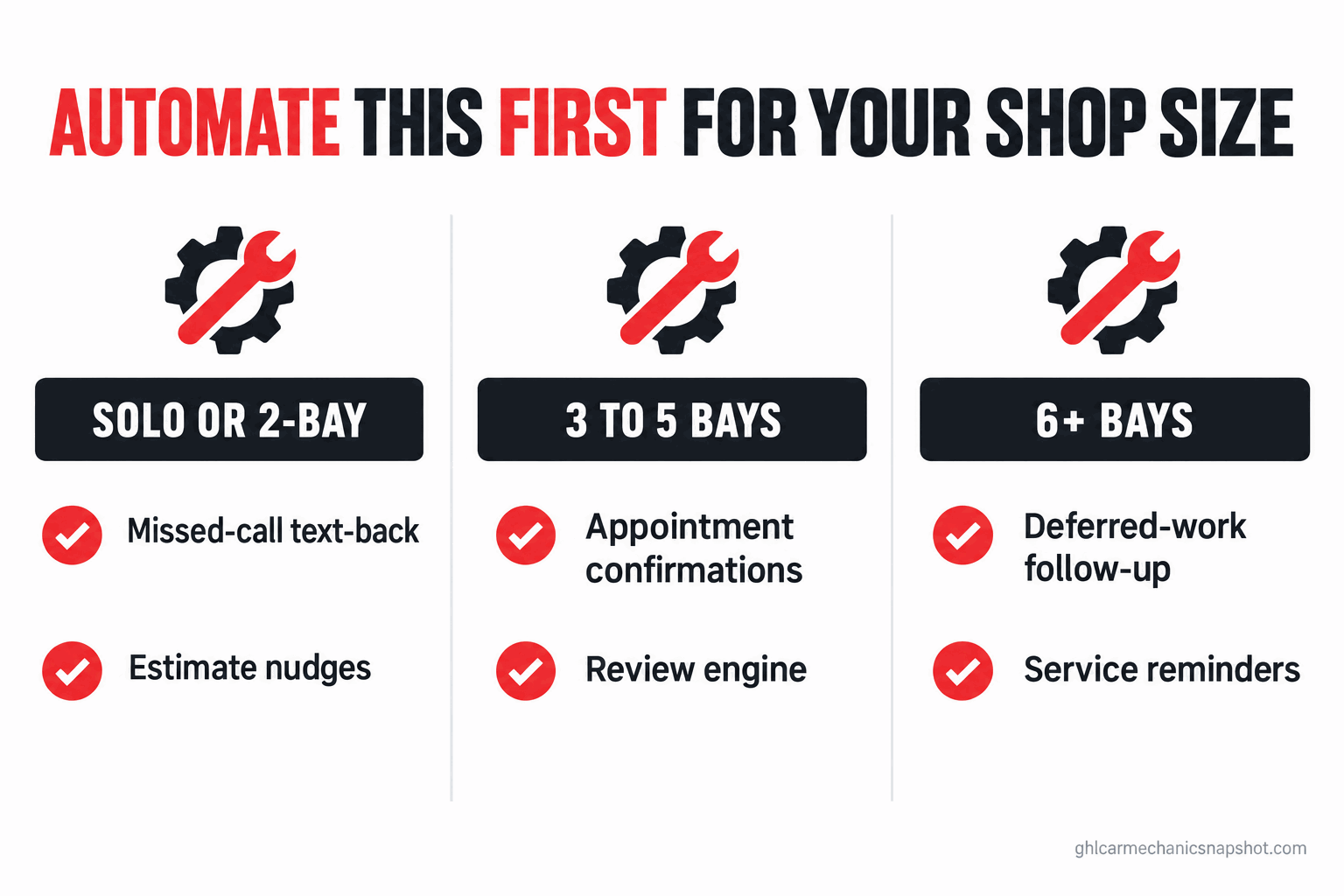
Solo or two-bay owner-operator. You are the tech, the writer, and the owner, so you are the system in the most literal way. Your worst jobs are 1 and 2, so start with missed-call text-back and estimate nudges, since there is no staff to cover for you.
Mid-size, three to five bays with a service advisor. One advisor cannot work the counter, the phone, and the follow-up at once, so your worst jobs are 3 and 4: no-shows that strand a tech and review asks that never get made in the rush. Confirmations recover capacity you already pay for, and a review engine runs the ask you keep forgetting.
Larger, six-plus bays with a manager. You answer most calls, so your losses drift downstream to jobs 5 and 6, deferred work nobody circles back to and regulars aging out. Both are customers who already trust you, so recovering a slice is the cheapest revenue you have. And if the business runs out of your head, the shop is worth less the day you sell it.
The compliance line that rides along
Every one of those messages is a text to a customer, so the TCPA applies. Get it wrong and statutory damages run $500 per text, up to $1,500 if willful, and a few hundred bad texts can become a number that ends a small shop.
The rule that catches good owners: a transactional service message like “your car is ready” sits in a safer bucket than marketing. Mix in one promotional line, “refer a friend for $20 off,” and the whole message is reclassified as marketing, which needs prior express written consent and an honored STOP. We wrote a whole piece on this trap: your service reminder text is legal until your refer-a-friend line makes it illegal.
Two guardrails. Keep service and promo messages on separate lists, and register your shop number for A2P 10DLC, the carrier program for business texting, or your texts get filtered as spam. A good setup handles the STOP and the separation for you: compliance that depends on you remembering is compliance that fails.
Straight answers to the objections
“I don’t trust a robot to talk to my customers.” You should not, and a good setup does not pretend to be you. It catches the moment and starts the conversation when you cannot. The missed-call text goes out in seconds, then you reply as yourself the minute your hands are free. The robot buys you time; you still do the talking.
“I’m not technical. This sounds like a second job.” It is the opposite. Right now you are the system, the most exhausting job there is, because it runs on you remembering everything. The idea is to build it once and let it run, which is why done-for-you installs exist. And your older customers are not a reason to skip it: “your car’s ready, pick up before 6” respects their time better than three missed calls and a voicemail.
“I already pay for Tekmetric. Isn’t this covered?” Your management system is great at running the repair already in your bay: the ticket, the inspection, the invoice. These six jobs live in the layer in front of that, turning a call or cold estimate into a booked car. If yours covers one well, use it.
The week you take off, done right
Picture the same week again. You are at the wedding, phone in your pocket. A first-time caller gets a text back before you have poured coffee. An estimate comes back approved off its nudge. Appointments confirm themselves, nobody no-shows, two happy customers leave reviews, and a regular who was due books for the week you are back.
You did not do any of it. The system did, because you finally built one instead of being one. Take the six repeatable jobs off your memory and put them somewhere that does not need a day off. Start with the one bleeding you worst.
Why does my auto shop fall apart when I'm not there?
Because the front half of your shop, the part that turns calls and quotes into booked repairs, runs through you. The phone, the follow-up, the confirmation, the review ask, and the reminders all depend on you being free and remembering. The repairs get done by your techs, but those six customer-facing jobs stop the moment your attention moves. The fix is automation that runs whether you're there or not.
What's the first thing I should automate in my shop?
Start with missed-call text-back and estimate nudges, the leads you lose most while your hands are busy. A missed-call text fires the instant a call goes unanswered, so a caller gets a reply before they dial the next shop, and nudges chase a sent quote so it stops aging out in a bay. Both cost nothing in staff time.
How fast do I really need to respond to a new lead?
Fast enough that no person could keep up by hand. Harvard Business Review found that reaching a lead within an hour made a firm about 7x more likely to qualify it than waiting one more hour. A driver with a dead car calls several shops, and the first to answer or text back usually wins the job.
Is it legal to text my customers automatically?
Yes, for transactional service messages like confirmations and estimate approvals, as long as each includes a clear opt-out. The trap is mixing in anything promotional: add a discount or referral offer and the whole message becomes marketing under the TCPA, which needs prior express written consent and an honored STOP. Damages run $500 per text, so keep service and promo texts on separate lists and register for A2P 10DLC.
Won't automated texts annoy my regular customers?
Only if they're built lazily. Annoyance comes from blasting everyone on one cadence. Done right, a reminder fires when the work is genuinely due for that vehicle, a confirmation gives a one-tap reschedule, and a review ask routes unhappy customers to you privately first. Relevant, well-timed messages read as good service, not spam.