

You sent the texts. You saw the “sent” checkmark. Then nothing. Nobody booked, nobody replied, the bay stayed as empty as the week before. So you decided what most owners decide: customers do not read texts anymore, and you went back to calling people.
Here is the part nobody told you. A lot of those texts never reached a single phone. They were blocked by the cell carriers before they ever rang, because your shop’s number was not registered in a system called A2P 10DLC. No bounce, no error, no warning. The message just vanished into the gap between your software and the customer’s phone.
This is the plumbing underneath every reminder, every “your car is ready,” every review request. Get it wrong and your best automation sends into a void. Get it right once and it works for years. Here is the whole thing, in plain shop English.
What’s on this page
- Why your texts are disappearing
- What A2P 10DLC actually is
- Step 1: register your brand (the EIN trap)
- Step 2: your trust score and the daily cap
- Step 3: register your campaign
- Step 4: opt-in consent
- Step 5: sample messages and content rules
- What it costs
- Sole proprietor or standard brand
- Steal these: copy that passes review
- Objections
- FAQ
Why your texts are disappearing
Start with the one fact that changes everything. Since February 2025, the major US carriers block 100% of unregistered A2P traffic, per the Telnyx 10DLC FAQ. “A2P” means application-to-person: any text your business sends through software, not you thumb-typing on your cell. Carriers used to throttle unregistered traffic. Now they reject it, silently. Your software shows “sent.” The phone never buzzes.
This hits your shop harder than most local businesses, because texting is how a repair order moves: the estimate that needs a yes, the “your Civic is ready,” the reminder about the brakes they declined. When those do not land, you do not lose a text. You lose the job, and never find out why.
There is a second cost if you dodge all this and blast from a personal phone. Texting without proper consent is its own federal problem: the Telephone Consumer Protection Act sets damages at $500 per text, up to $1,500 if willful, under 47 U.S.C. 227, with no cap. Registration and consent are two different rulebooks and you are under both. We cover consent in the auto shop texting law guide; this article is about getting delivered at all.
What A2P 10DLC actually is
Think of it as a license plate for your shop’s texting number. “10DLC” just means a 10-digit long code, the normal local number your software texts from. The carriers make any business using one identify itself first, through The Campaign Registry.
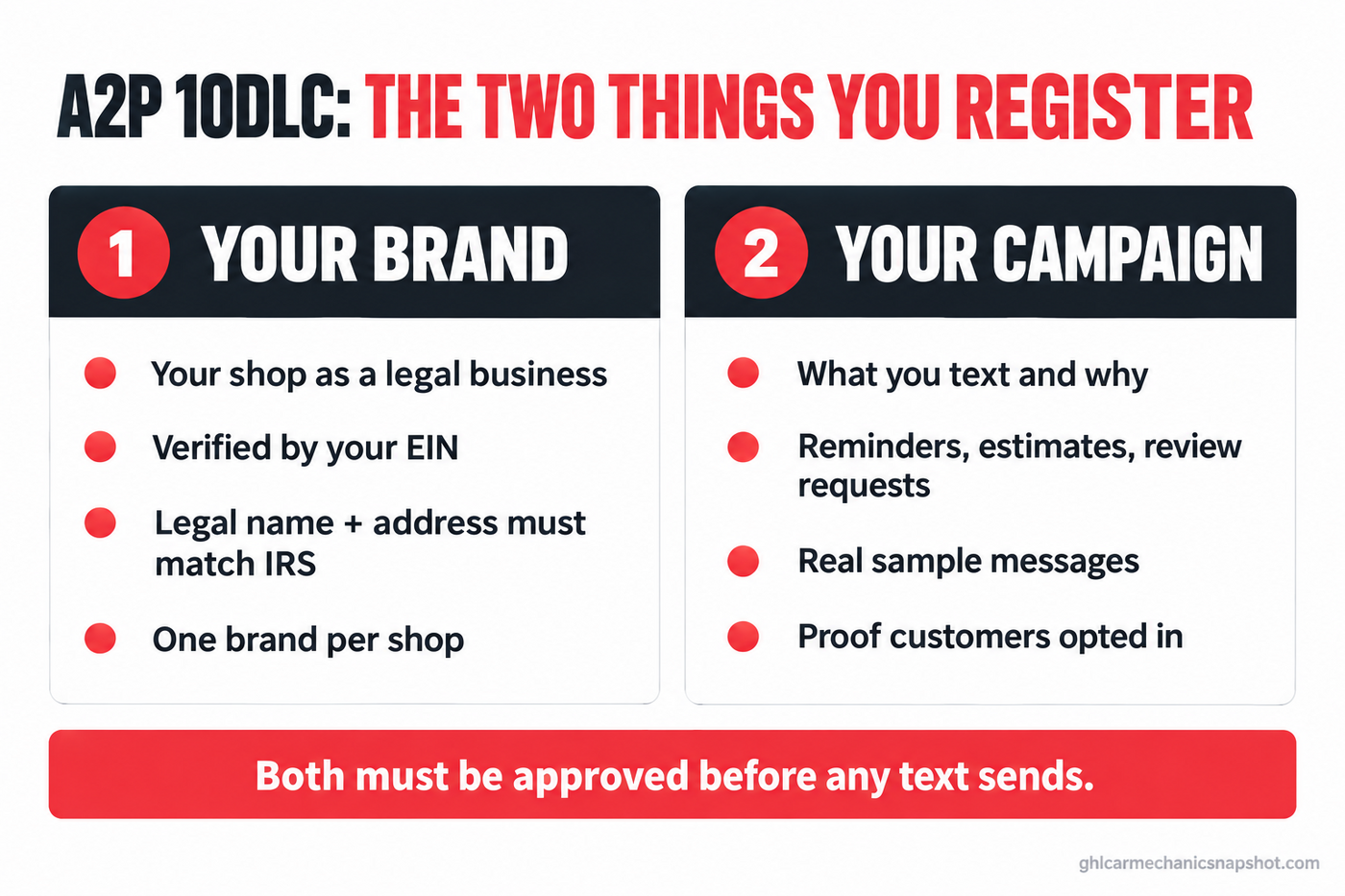
You register two separate things, and this is where people trip because the words sound alike:
- Your brand. Your shop as a legal business, proven with your EIN, legal name, and address, which the registry checks against IRS records. One brand per shop.
- Your campaign. The texting you do and why: reminders, estimates, review requests. You describe the use case, hand over sample messages, and show how customers agreed to be texted. Most shops need one.
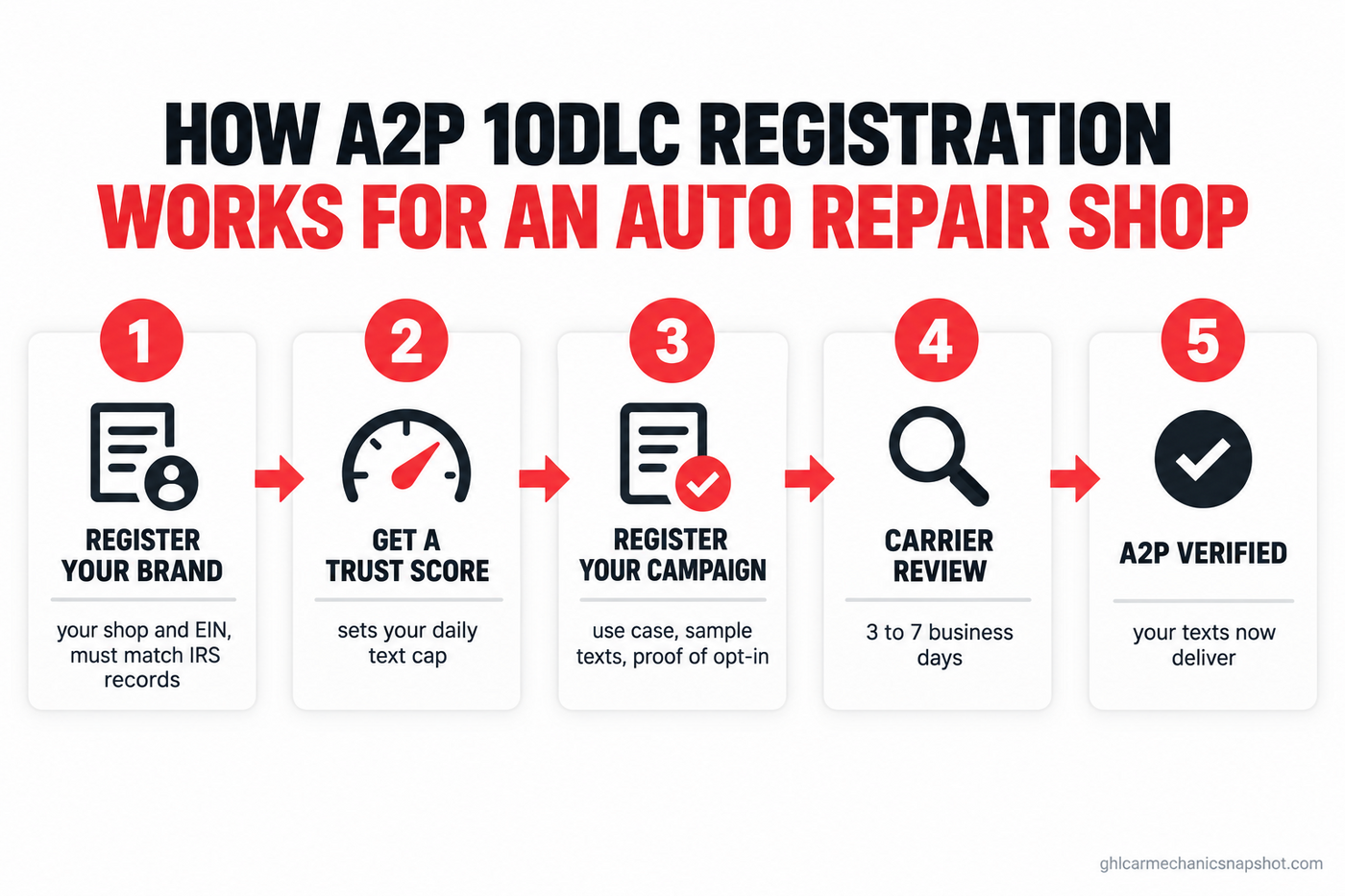
Your texting software, whether a standalone tool or a platform like GoHighLevel, submits both to the registry and reports back. Nothing sends until both are approved and your number is linked to them.
Step 1: register your brand (the EIN trap)
Brand registration is where most shops get rejected, almost always for the same fixable reason: the details you type do not exactly match the IRS records.
The official HighLevel registration flow asks for your legal business name, EIN, business type, industry, address, and an authorized contact. The trap is “exactly.” If the IRS has you as “Mike’s Auto Repair LLC” and you type “Mikes Auto Repair,” the match can fail and your brand bounces.
Get it right the first time: pull out your CP-575, the IRS letter you got when your EIN was issued, or your latest tax return. Copy the name character for character, punctuation and entity type included, and use the address the IRS has.
If your shop is a sole proprietorship with no EIN, there is a separate Sole Proprietor path (covered below). It works, but it caps your daily sends low, so most real shops are better off getting an EIN (free from the IRS) and registering as a standard brand.
Step 2: your trust score and the daily cap
Once your brand is approved as a standard brand, the registry gives it a trust score from 0 to 100. It sets how many texts the carriers let you send per day, and T-Mobile enforces a hard daily cap based on it.
T-Mobile daily message-segment caps by brand type and trust score, shared across all campaigns under one EIN. Figures reported by a2p.guide and the JustCall trust score guide.
For a single shop sending a few hundred reminders a day, even a middling score is plenty. You only sweat the cap if you run a big list or several locations off one EIN. If your score comes back low (a clean, small, new shop sometimes does), raise it with paid external vetting, about $41.50 for a standard vet, per a2p.guide.
Step 3: register your campaign
With the brand approved, you register the campaign. For a repair shop this is almost always a mixed or customer-care use case covering reminders, estimates, and follow-up.
The platform asks for a use case, a plain-English description, two or three sample messages, and your opt-in details (next section). In GoHighLevel you pick Chat Widget setup (if your widget collects consent) or Manual setup (form, paper ticket, QR code, or counter). You also need a live website that names your business, matches the brand, and has reachable Privacy and Terms pages.
Campaign review usually takes three to seven business days, sometimes two weeks. A campaign in “pending” is normal; do not panic-submit a second one, which can cost another vetting fee. If rejected, fix and resubmit the same campaign.
You can see why a lot of owners never finish this. It is not hard, just fiddly, and every field is a place to get rejected and wait another week. This is one of the pieces we wire up for shops on GoHighLevel, set correctly at install.
Step 4: opt-in consent, the thing that gets you rejected
If the EIN mismatch is the top brand rejection, bad opt-in is the top campaign rejection. The registry wants proof your customers actually agreed to be texted, and the rule that catches shops is that consent cannot be forced. If a customer has to agree to texts in order to book or buy, that is not “freely given” and your campaign gets rejected. Your SMS checkbox has to be optional and unticked by default.
The registry also reads your Privacy Policy. A vague line like “we may share your information with trusted partners” is a classic flag, because it reads like you might sell the number. You need a clear sentence that you do not sell or share customer phone numbers, the most-cited fix in HighLevel’s own rejection guide.
Opt-in is not just a registry hoop. It is the same consent the TCPA requires, per the FCC at 47 CFR 64.1200, so doing it right clears the carriers and keeps you out of the $500-per-text zone.
Step 5: sample messages and content rules
Your samples do two jobs: show the registry what you send, and follow the carrier content rules.
First, every message identifies your shop and offers a way out. A sample with no business name and no opt-out gets rejected on sight. Name the shop and include STOP language; a bare “Your car is ready” fails.
Second, your content cannot touch the categories carriers lump together as SHAFT: sex, hate, alcohol, firearms, tobacco, plus a few like cannabis and high-risk loans, per the CTIA messaging principles. Rarely an issue for a shop, but a “win a case of beer with your tune-up” promo can trip the alcohol filter.
What it costs
This surprises owners. A2P 10DLC is not a subscription trap: a few one-time fees plus a couple of dollars a month.
Typical one-time A2P 10DLC fees in 2026. Brand registration about $4.50 and the optional standard external vet about $41.50 per a2p.guide; campaign vetting around $15 per provider fee tables. Monthly campaign fees of roughly $1.50 to $10 are separate.
A realistic standard-brand shop is looking at roughly $20 up front (brand plus one campaign vet), maybe $60 with external vetting to lift a low score, then a few dollars a month, plus the per-message carrier fees your plan already includes. Against one booked repair you would otherwise lose to a blocked text, it is not a close call. The expensive part is never the fee. It is running blind for a year and only finding out when you tally the reminders that never landed.
Sole proprietor or standard brand
The right path depends on how your shop is set up.
| Sole Proprietor path | Standard Brand path | |
|---|---|---|
| Who it fits | A one-person shop with no EIN | Any shop with an EIN (LLC, S-corp, etc.) |
| What you need | SSN and a mobile number to verify | EIN, legal name, address matching IRS |
| Daily cap (T-Mobile) | About 1,000 segments | 2,000 to 200,000 by trust score |
| Campaigns / numbers | 1 campaign, 2 or fewer numbers | Multiple campaigns and numbers |
| Best for | Testing the water, tiny list | A real reminder and review program |
Solo operator on paper tickets. With no EIN, the Sole Proprietor path gets you texting fast at a 1,000-a-day cap, fine for a small list. But an EIN is free from the IRS and moves you to the standard path with real headroom, so do that first. Your bigger job is getting a proper business texting number instead of your cell. See two-way texting for a small shop.
Mid-size shop, two to eight techs. You almost certainly have an EIN and software that texts, so take the standard path and one well-written campaign. Your real risk is not the cap, it is a sloppy opt-in or vague privacy policy burning weeks. If you are weighing platforms, read what auto shop software actually costs before paying for a tier just to unlock texting.
Multi-location group. Every location rides under a brand, and caps are shared across the whole EIN. Centralize on one registered brand with standardized consent language and one approved template library, so no location free-writes a sample that flags the shared campaign.
Steal these: the copy that passes review
Copy you can adapt for registration and the consent you collect. Not legal advice, but these are the patterns that clear the registry.
The opt-in checkbox for your web form and counter tablet (optional, unticked):
“☐ Text me about my vehicle and service reminders from [Shop Name] at this number. Msg and data rates may apply. Msg frequency varies. Reply STOP to opt out, HELP for help.”
Keep it separate from the submit button; nobody should have to check it to book.
The privacy policy SMS line the registry wants to see:
“We do not sell or share your phone number with third parties for marketing. SMS opt-in and consent are never shared with anyone. Reply STOP to unsubscribe at any time.”
A sample message that clears content review (customer-care use case):
“Hi [Name], it’s [Shop] on [Street]. Your [Vehicle] is due for its [service]. Reply here or call [number] to book. Reply STOP to opt out.”
The campaign description field (what you write for the reviewer):
“Appointment reminders, repair estimates, vehicle-ready notifications, and review requests sent to existing customers who opted in via our website form or in person. Customers consent by checking an optional box or replying YES. We honor STOP immediately.”
Plain, specific, matches the samples. That is what gets approved.
Straight answers to the objections
“I’ll just text from my cell, then I don’t need any of this.” A personal cell dodges registration and breaks everything else: no consent log, no automatic STOP, no delivery reporting, and the moment you use any app it becomes A2P traffic that gets filtered anyway. You also carry the full TCPA risk at $500 a text. It feels free until the first problem.
“My texts were working fine last year, why worry now?” “Working fine” and “being delivered” are different things. Plenty of shops saw decent delivery in 2024, then fell off a cliff after the February 2025 full-blocking date without noticing. If you have not confirmed your registration, assume you are affected.
“Do I need to be technical to do this?” No, but you need to be exact. The hard part is matching your legal details to IRS records and writing a clean opt-in. A good platform walks you through the fields and flags problems before you submit, or you have it set up for you.
Frequently asked questions
A2P 10DLC registration questions for auto repair shops
What is A2P 10DLC and does my auto shop really need it?
It is the carrier registration system for any business texting from a regular 10-digit number through software. You register your brand (your shop, verified by its EIN) and your campaign (what you text and why). Since February 2025 US carriers block 100% of unregistered business texts, so without it your reminders may never reach the phone. Any shop that texts through a tool needs it.
Why are my business texts not being delivered?
Usually an unregistered number: the carriers block the traffic silently with no bounce. Other causes are hitting your daily send cap, a number not linked to your approved campaign, or content that trips a filter. If you never registered, start there.
What does A2P 10DLC registration cost?
Small and mostly one-time. Brand registration is about $4.50, campaign vetting around $15, and an optional external vet to raise a low trust score about $41.50. After that it is roughly $1.50 to $10 a month per campaign, plus per-message carrier fees. A typical standard-brand shop is $20 to $60 up front.
Why does my A2P brand or campaign keep getting rejected?
The top brand rejection is a legal-name or EIN mismatch with IRS records, so copy those from your CP-575 letter exactly. The top campaign rejection is weak opt-in: a forced or pre-checked SMS box, or a vague privacy policy. Make the checkbox optional and unticked, say clearly you do not sell or share numbers, and match your samples to the use case you picked.
How long does A2P 10DLC approval take?
About a week from a clean submission: a day or two for the brand, three to seven business days for the campaign, sometimes two weeks when the registry is busy. A campaign in pending is normal, so do not submit a duplicate. Every rejection restarts the clock.
Does registering fix my TCPA and consent obligations too?
No, they are two separate rulebooks and you are under both. A2P 10DLC decides whether the carriers deliver your text. The TCPA decides whether you were legally allowed to send it, with damages of $500 to $1,500 per text sent without proper consent. The upside: doing opt-in properly for registration is the same consent the TCPA wants, so you solve both at once.
Back to those disappearing texts
Pull up that batch you thought flopped. The customers were not ignoring you. For a lot of them the message never arrived, because the number it came from was a stranger to the carriers. The fix is not sexy: match your brand details to the IRS, write one clean campaign with real opt-in, use samples that name your shop and offer STOP, and confirm the verified label before you rely on a send.
Do that once and it fades into the background. Your reminders land, your estimates get answered, your review requests actually reach people, and you stop blaming customers for texts they never got. For the automations that ride on a registered number, see the service reminder system and how to cut no-shows.