

You watched the Shopmonkey demo on a Tuesday afternoon with a loaner on the lift and the phone going to voicemail. It looked clean. Photos on the estimates, a color-coded board, and the rep quoted $399 a month for the middle plan. Then you went live, added your third tech and a service writer, and the statement came in higher than the number you signed off on. Nobody lied to you. You priced the plan, and Shopmonkey does not bill by the plan. It bills by the seat.
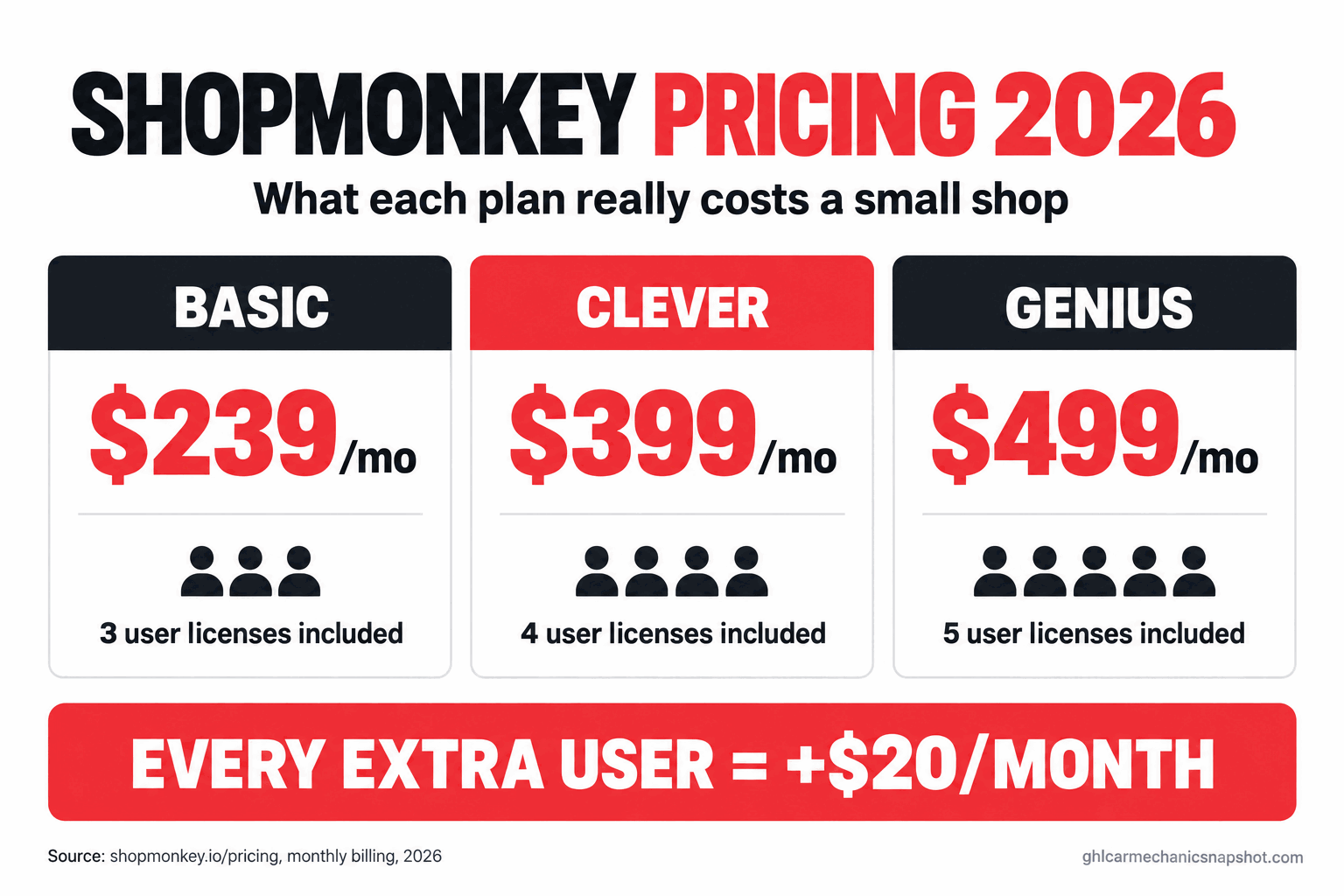
Here is the short version, because you have cars waiting. Shopmonkey publishes three standard plans at roughly $239, $399 and $499 a month for Basic, Clever and Genius, dropping to about $215, $359 and $449 on annual billing, with a custom-quoted Multi-Shop tier, per Shopmonkey’s own pricing page. Each plan includes a fixed number of user licenses (3, 4 and 5), and every seat past that runs $20 a month. That per-seat line is the number most owners miss, and it is where the sticker and the bill split apart.
What’s on this page
- What Shopmonkey costs
- The per-seat trap
- What each plan leaves out
- The fees off the pricing page
- What your size actually pays
- How it compares
- The layer you rent twice
- The compliance cost
- Objections
- FAQ
What Shopmonkey actually costs in 2026
Shopmonkey is a cloud shop management system. It runs repair orders, estimates with photos, invoicing, scheduling, parts ordering and payments in one place, across three standard plans plus a custom Multi-Shop tier.
The headline numbers are Basic at $239, Clever at $399 and Genius at $499 a month month-to-month, falling to roughly $215, $359 and $449 on an annual commitment, per Shopmonkey’s pricing page and the Capterra listing. Paying monthly costs about 10 percent more than paying for the year up front.
Shopmonkey standard monthly plans, US dollars, month-to-month billing. Annual billing is roughly 10 percent lower ($215 / $359 / $449). Multi-Shop is a custom quote. Source: Shopmonkey pricing.
That reads like every quote in this category, but the monthly number is not the number you pay. Two things decide your real bill: how many people log in, and which features you need. Both push you up, and neither shows on the clean three-column chart the rep walks you through.
The per-seat trap nobody circles on the quote
This is what separates Shopmonkey from a flat-rate tool, and it is the most important thing to understand before you sign. Shopmonkey charges per user license. Each plan includes a set number of seats, and every seat past that is $20 a month, on every tier, per Shopmonkey’s pricing page and the Third Gear Shop review.
Here is what that means in the bay. Basic gives you 3 users, Clever 4, Genius 5. Count who needs to log in: you, your service writer, and each tech who touches a repair order or inspection. A four-bay shop with four techs, a service advisor and the owner is already at six. On the Clever plan, which includes four, that is two extra seats at $20 each, so $40 a month on top of the $399, every month, busy February or dead August.
That $40 does not sound like much until you see the shape of it. A flat-rate tool costs the same whether you have two techs or ten. A per-seat tool is a tax on hiring: the more people you bring on, the more your bill climbs, forever, with no ceiling. So before you pick a tier on price, count every login, subtract the seats the plan includes, multiply the rest by $20, and add it to the monthly number. That is your real starting subscription, and it goes up the day you hire your next tech.
What each plan does not include
The features are stacked, so the thing you actually want often lives a tier or two above where the price looked comfortable.
Diagrams and procedures sit on Genius. Shopmonkey’s HD wiring diagrams and repair procedures are a Genius feature, not something Basic or Clever turn on, per Shopmonkey’s pricing page. If you counted on in-system diagrams for diagnostics, that is the $499 plan.
Review harvesting and automated follow-ups are Genius too. The Google Reviews Manager and the automated estimate follow-ups, the marketing features most owners are shopping for, are listed under Genius. A shop that wants the software to chase reviews and nudge unapproved estimates is looking at the top tier, which resets the “is this cheaper than the others” question.
QuickBooks Desktop is an extra. The integration carries an additional fee on Clever and up, and is not part of Basic, per the pricing page. Confirm it if your bookkeeper lives in QuickBooks.
Multi-location is a different animal. The moment you open or buy a second shop, you are off the standard plans and into the Multi-Shop tier, a custom quote with bulk licensing and “call for pricing” on the readers. Genius is a single-location plan. Do not assume two shops is just Genius times two.
The fees that never make the pricing page
The advertised tier is what everyone compares. These costs decide your actual statement.
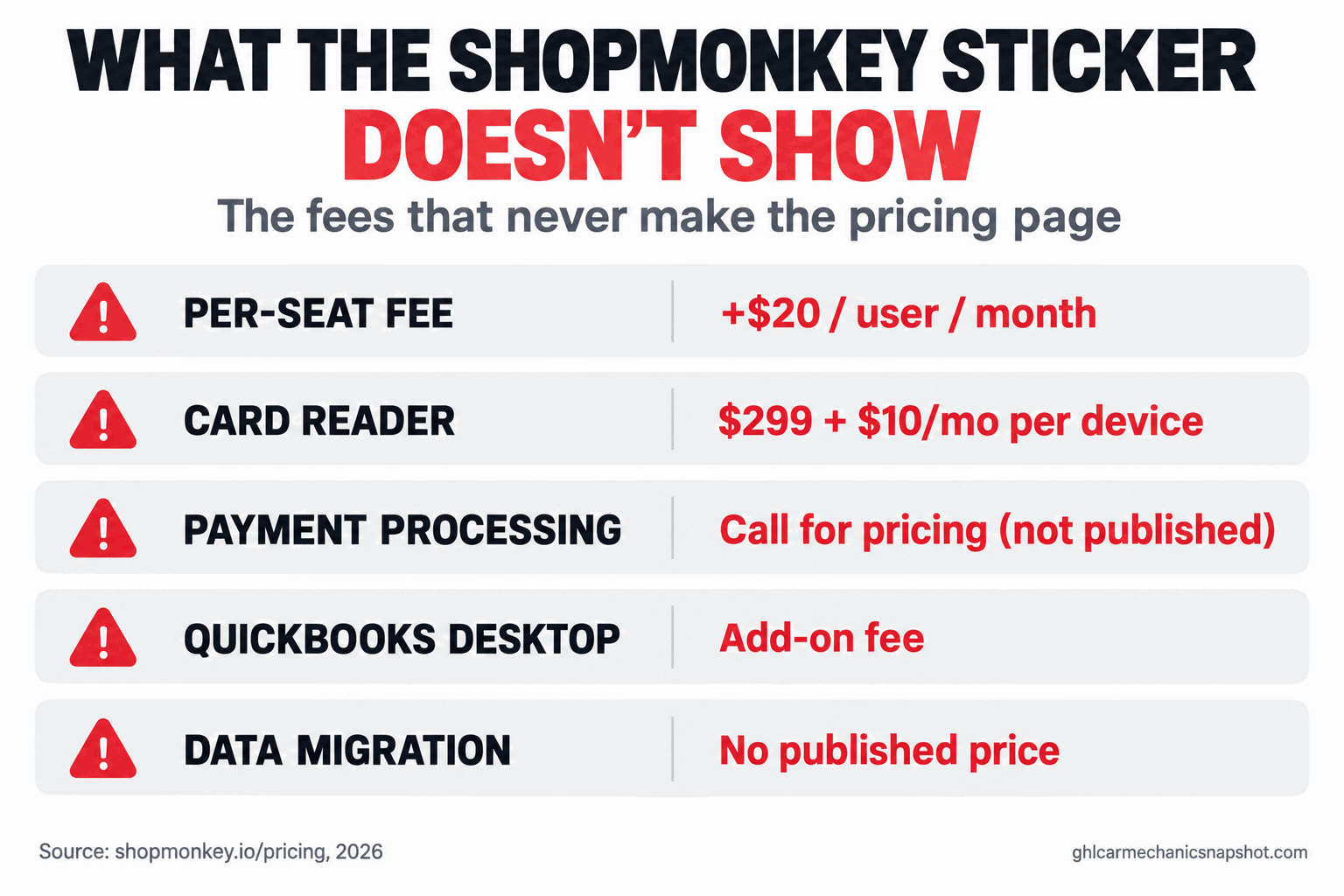
- Per-seat fees. The big one, covered above: $20 a month per user beyond your included seats, on every tier, forever.
- Payment processing. If you run cards through Shopmonkey Payments, the rate is not published. The payments page advertises “interchange plus” pricing with “fully customized competitive rates,” which is sales-speak for “call us.” On real card volume that line can dwarf the gap between tiers, so pin it down in writing first.
- Card readers. A physical reader is $299 per device plus $10 a month, with another $10 a month per device for cellular, per the pricing page. Two readers, money on top.
- Data migration. Moving your customer list and repair history off your old system is a real project, and Shopmonkey publishes no migration price. Get the number before you sign.
- No self-serve free trial. The published path is a demo request, not a trial you can drive yourself. You commit on a guided walkthrough, which is exactly when the add-ons are easiest to gloss over.
What a shop your size actually pays
The right answer depends on your headcount and card volume, not the plan name. Here is honest first-year math, assumptions stated so you can check it against your quote.
| Shop profile | Plan you realistically land on | Monthly plan | Likely extras | First-year all-in estimate |
|---|---|---|---|---|
| Solo / 1-2 bays, 3 logins | Basic (fits inside 3 seats) | ~$239 (or ~$215 annual) | A reader or two, light card volume | ~$3,200-$4,500 |
| Mid-size / 4 bays, 6 logins | Clever + 2 extra seats | ~$399 + ~$40 seats | Readers, QuickBooks add-on, processing | ~$6,000-$9,000 |
| Growing / 4-5 bays, 8 logins, wants reviews + diagrams | Genius + 3 extra seats | ~$499 + ~$60 seats | Readers, processing, maybe marketing | ~$8,500-$12,000 |
Two things jump out. The solo shop is the one profile that can live inside the advertised price, because three logins fits Basic. And the mid-size and growing shops are where sticker and bill diverge most, because the per-seat fees, readers and the jump to Genius add up to a very different number from “$399 a month.”
Where it breaks for each size. Basic is a fair deal for one or two people. The mid-size shop’s regret is budgeting $399 and getting a statement 30 to 50 percent higher once extra seats, readers and processing are on. The growing shop’s regret is climbing to Genius purely for the review tool, then still texting from a personal cell phone because the in-platform automation does not go as far as a real CRM. None of this makes Shopmonkey a bad product. It makes the sticker a starting point, not a bill.
How Shopmonkey stacks up against the alternatives
Shopmonkey is a polished, modern system. The honest question is not “is it good,” it is “is it the right fit at this price.” Here is how the top standard tier compares to the other mainstream names, all from published pricing.
Top standard monthly plan, US dollars, excluding custom multi-shop and enterprise tiers. Sources: Tekmetric, AutoLeap, Shopmonkey, Shop-Ware via Software Finder.
| What matters | Shopmonkey | Tekmetric | AutoLeap | Shop-Ware |
|---|---|---|---|---|
| Entry plan | ~$239 | ~$199 | ~$199 | ~$249 |
| Top standard plan | ~$499 | ~$439 | ~$449 | ~$799 |
| Per-user fee | $20 per extra seat / month | No per-user fee advertised | Not advertised | Possible over your seat count |
| Reviews / follow-ups | Genius tier ($499) | Varies by tier | Elite + add-on | Varies by tier |
| Free trial | No, demo request | None | None | None |
| Contract | Monthly or annual | No long-term contract | Annual, 60-day notice | Varies |
One contrast is worth your attention. Tekmetric advertises no per-user fee, so a shop that plans to add techs does not watch its bill climb with every hire, a real structural difference from Shopmonkey’s per-seat model. At the other end, Shop-Ware sits highest, aimed at larger operations. For the full picture, see our four-way breakdown, the AutoLeap teardown, the complete 2026 shop software pricing teardown, and the Shop-Ware versus Tekmetric cost after add-ons.
The communication layer you might be renting twice
Here is the pattern worth naming before you climb to Genius. Owners buy a management system, move to the top tier mainly to unlock reviews and estimate follow-ups, pay a per-seat fee for every login, and still run half their customer contact from a personal cell phone. A management system exists to run repair orders, estimates, parts and invoicing, and Shopmonkey does that job well. The texting, reminders, review requests, missed-call follow-up and reactivation are a second job, gated into the upper tier and billed on top of a bill that already grows with your headcount. You can rent that there, or run it on a platform you own.
GoHighLevel is the common choice for small local businesses, at $97 a month for Starter and $297 for Unlimited, with messaging and AI usage billed on top. It is a CRM, texting, booking and automation platform, not a repair-order system, so it does not replace Shopmonkey’s estimating and parts workflow. What it replaces is the patchwork of a personal phone and a sticky note, at a flat price that does not care how many techs you hire. That is the model we build. The Car Mechanic Snapshot system is a set of done-for-you GoHighLevel workflows, installed once for a one-time fee instead of rented back at a higher tier with a per-seat line on top. See how two-way texting and automated Google reviews work when you own the layer.
The compliance cost nobody budgets for
One line item never shows up in the spreadsheet until it bites, and it is yours the moment you text a customer. Under the federal Telephone Consumer Protection Act, statutory damages run $500 per text, and up to $1,500 for willful violations, with no cap and no need for the customer to prove harm, under 47 U.S.C. 227.
Here is the trap that catches good shops. A plain service text (“Your Civic is ready for pickup”) is transactional and generally fine. Add one promotional line (“and refer a friend for $20 off”) and the whole message is reclassified as marketing, which needs prior express written consent and instant STOP handling. One cheerful extra line turns a compliant reminder into a violation, multiplied by every number on your list. Carriers also require A2P 10DLC registration for business texting, or your messages get filtered and quietly stop arriving. Whatever you text from, confirm it handles consent, STOP and 10DLC. We cover the rules and steal-these consent scripts in the texting compliance guide for auto shops.
Straight answers to the objections
“Is Shopmonkey worth $399 a month?” If it runs your repair orders well and your techs use it, the management side is money well spent, in line with Tekmetric and AutoLeap. The question is not the plan, it is the seats and the processing. Price the per-seat fees for your real headcount and get the card rate in writing, because “$399” and the real statement are often 30 to 50 percent apart for a shop with more than four logins.
“I already signed with Shopmonkey. Did I make a mistake?” Probably not, if it runs your shop. Find out how many seats you are paying for and whether any are logins you do not use, because that is $20 a month each you can trim. Then pin down your processing rate. If reviews and follow-ups are why you climbed to Genius, that part is worth pricing against a platform you own.
“The per-seat fee is only $20. Why does it matter?” Because it never stops and it points the wrong way. Twenty dollars times three extra seats is $720 a year, every year, and it climbs the day you hire your next tech. A tool whose cost rises every time you grow quietly penalizes the thing you are working toward. Not a dealbreaker, but it belongs in the math, not hidden under a round plan number.
“Do I need a free trial? Shopmonkey doesn’t offer a self-serve one.” A trial is how you learn whether your team will actually use the thing before you commit. Shopmonkey’s path is a guided demo instead, which is fine, but it means you decide during a sales conversation rather than after a week of real use. If driving it yourself first matters, ask for a short pilot in writing.
Frequently asked questions
Shopmonkey pricing questions
How much does Shopmonkey cost per month in 2026?
Shopmonkey's published plans run roughly $239 for Basic, $399 for Clever and $499 for Genius per month, dropping to about $215, $359 and $449 on annual billing. Multi-Shop groups get a custom quote. Every user beyond your plan's included seats is an extra $20 a month, and card readers and processing are billed on top.
Does Shopmonkey charge per user?
Yes. Each plan includes a fixed number of user licenses, 3 on Basic, 4 on Clever and 5 on Genius, and every additional seat is $20 a month on every tier. A shop with more logins than its plan includes pays that fee monthly, and it climbs each time you add a tech.
Does Shopmonkey offer a free trial?
No self-serve free trial is advertised on Shopmonkey's pricing page. The published path is a demo request with a sales rep, so you evaluate it through a guided walkthrough rather than by driving a trial account yourself. If hands-on evaluation matters, ask for a pilot in writing.
What is Shopmonkey's payment processing rate?
Shopmonkey does not publish its card processing rate. Its payments page advertises interchange-plus pricing with custom rates, which means you get a number only by asking sales. Get the rate in writing before you sign, because on real card volume it can cost more than the plan itself.
Which Shopmonkey plan has Google reviews and estimate follow-ups?
The Google Reviews Manager and automated estimate follow-ups are listed under the Genius plan at about $499 a month, along with in-system diagrams. A shop that wants those marketing features from Shopmonkey is looking at the top standard tier, not the entry Basic plan.
Is Shopmonkey or Tekmetric cheaper for a small shop?
Their plans are in the same range, but the structure differs. Tekmetric advertises no per-user fee, so its price does not climb as you add techs, while Shopmonkey charges $20 per extra seat. For a growing shop that plans to hire, the per-seat difference can matter more than the few dollars between tiers.
Back to that demo
Pull your Shopmonkey quote back up, or your last statement if you already signed. The $399 is not the problem by itself. The problem is not knowing how many seats you are really paying for, what the processing rate is, and which features you had to climb a tier to unlock. A tool you only half use, at a price that grows every time you hire, is the most expensive line in the building.
So do the two-minute version for your own shop. Count your logins, add the per-seat fees, pin down the card rate, and write your real all-in monthly number. Then decide which job you are buying: the management system, the communication layer, or both. Make the software earn its line, or cut it. If you want a hand pricing that communication layer as a fixed cost you own instead of a per-seat one that climbs with every hire, book a walkthrough and we will map it against your Shopmonkey numbers.