

It is 10:15 on a Wednesday. A Camry is up on the lift, your one open tech is halfway into a brake job, and the phone rings. It is the lady who dropped off the Camry. “Just checking, is it ready yet?” You say no, another hour, and hang up. Twenty minutes later it rings again, a different customer, same question. By noon you have answered that call six times, and every one pulled you off the counter.
Here is the short version, because your bay is full. The “is it ready?” call is not a customer problem. It is a silence problem. People call because you went quiet and have no idea what is happening to the most expensive thing they own after their house. Close that silence with a short text at four or five fixed points, drop-off to pickup, and most of those calls stop before they start. More than half of service customers now prefer text, and shops that do it score higher and sell more of the work they recommend. Below is the whole system, stage by stage, with the messages you can steal and where it falls apart.
What’s on this page
- What customers actually want while they wait
- The six stages: drop-off, check-in, approval, progress, ready, after pickup
- Steal this: the exact messages
- Run it at your size
- The compliance line that rides along
- Objections
- FAQ
The real cost of that call is not the ninety seconds on the phone. It is the customer at the counter who waits while you talk, the tech whose rhythm just broke, and the next caller who gets voicemail. Stack it across ten or twelve cars a day and the phone is running your front desk. The customer is not being difficult, just anxious: they handed over the thing that gets them to work and got no window into what happens next, so they fill the silence with a call.
What customers actually want while they wait
They do not want a phone call, which surprises owners who grew up calling them. In J.D. Power’s 2024 Customer Service Index study, customers were four times as likely to want updates by text (68%) than by phone (16%), per CarPro’s write-up. In the 2025 U.S. Aftermarket Service Index study, 56% of oil-change and tire customers named text as their preferred way to get a work update, and plenty said they got a call instead, per Ratchet+Wrench.
A text respects the one thing your customer is short on, attention. A call makes them stop, so it becomes voicemail and phone tag while the job stalls on an approval that needed a thumb-tap.
How customers want to be updated during service, percent. Source: J.D. Power 2024 U.S. Customer Service Index, via CarPro.
Matching the channel is not just a courtesy. The same research found customers contacted by their preferred method scored 854 satisfaction, 34 points above the study average, per the 2025 U.S. Aftermarket Service Index. That score becomes a five-star review and a car that comes back, even when the repair was identical.
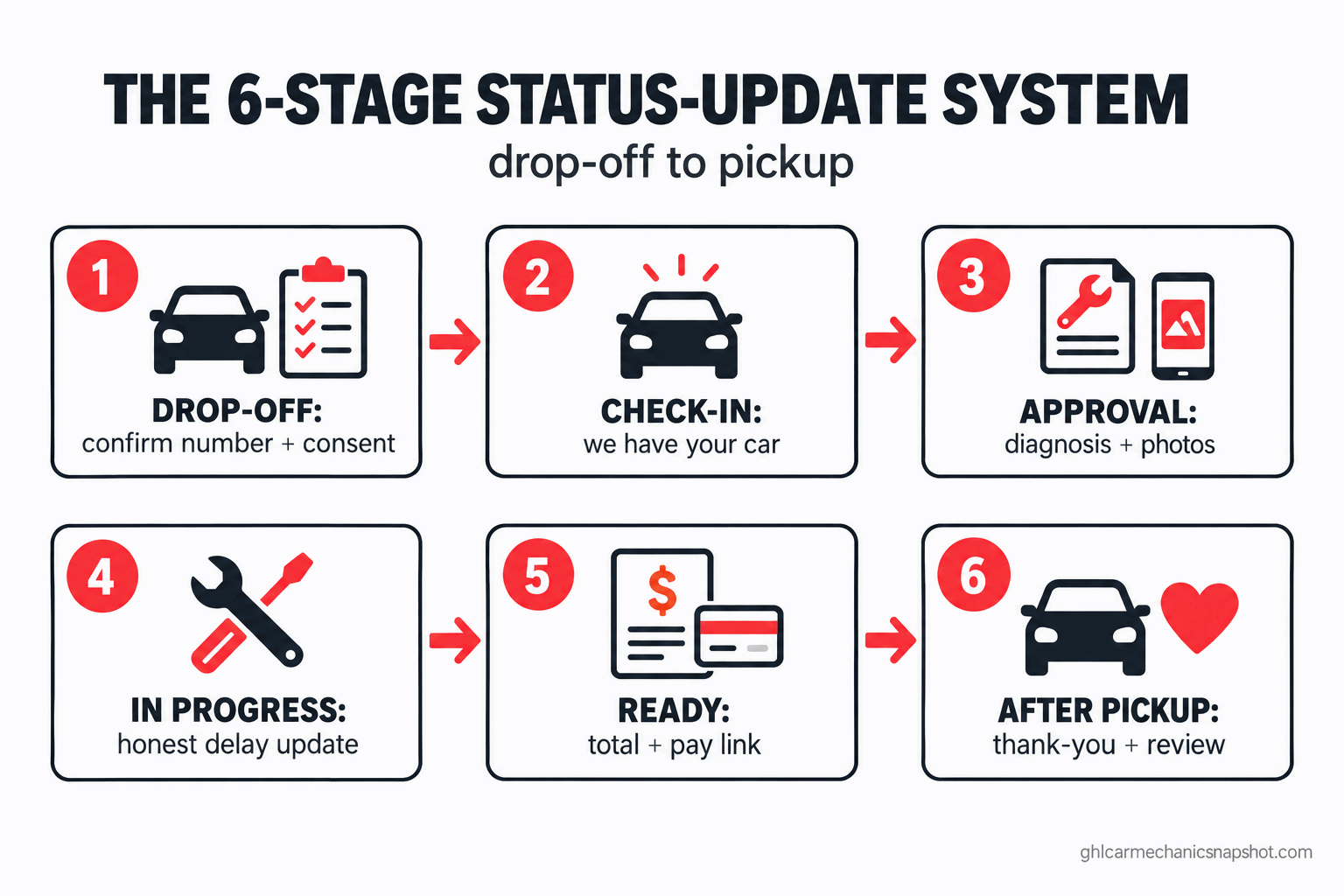
The six stages of a status-update system
A status system is not one text. It is a short series pinned to the stages a job moves through, so the customer always knows where their car is. Six stages cover almost every repair order:
- Drop-off: confirm how you will reach them, get consent, set the clock.
- Check-in: a quick “we have it” the moment the car is logged.
- Approval: the diagnosis-done message with photos and a clear yes/no.
- Work in progress: an honest update when the job runs long.
- Ready: the pickup text that empties your lot.
- After pickup: the thank-you that asks for the review and plants the next visit.
You do not need every stage on every job. A ten-minute oil change is drop-off, ready, and after-pickup; a three-day engine job uses all six. Build the full set once, then let the job type decide which fire.
Stage 1: set expectations at drop-off
Everything downstream depends on this one. At drop-off you do three things: get the right mobile number, get permission to text it, and say when the next word is coming. Most shops get the number and skip the other two, which is where both problems start. The script is short: “Best cell to text you updates at? We’ll text when we’ve diagnosed it and when it’s ready. That okay?” A yes, logged, is your consent. Then: “You’ll hear by early afternoon.” Now the customer is not wondering at 10:15, because you told them 2:00.
How it breaks. The number is a landline, so every text bounces and you never know. Send the check-in text while they stand there and watch it land. Or nobody logged consent, so weeks later your texts look like unsolicited marketing. Capture the yes on the intake form, every time. It is the same groundwork that makes your appointment reminders land instead of bounce.
Stage 2: the “we’ve got it” check-in
The second the car is logged, a one-line text goes out: we have your car, here is who is on it, here is when you will hear next. It costs nothing and shuts down the “did my car make it in okay?” calls from the night drop box. It is also your trust anchor: a friendly text at 7:50am tells the customer you run a tight shop, before a single wrench turns.
How it breaks. The text fires on a status change, but the writer logs cars in a batch at 9am, so it lands two hours after a customer already called. Log the car at the counter, not later. Or the message reads like a robot: keep it human, with a name and a time. People answer a person.
Stage 3: the approval request that sells the work
This is the money stage: you have diagnosed the car and need a human to say yes before the tech can keep working. By phone, this is where jobs die: no answer, voicemail, a callback two hours later, the bay idle. By text, with photos, it is the strongest sales tool in the shop.
A customer cannot see their own brakes. “Your rear pads are at 2 millimeters” is a number they have to trust; a photo of the worn pad next to a new one is proof they can forward to their spouse and approve from their desk. The J.D. Power study found shops that sent photo or video documentation got 41% of recommended repairs approved, against 17% for shops that sent none, per Ratchet+Wrench. More than double, from one habit.
Share of recommended repairs approved, with vs without photo or video documentation. Source: J.D. Power 2025 U.S. Aftermarket Service Index, via Ratchet+Wrench.
The approval text is a small decision, not an essay: vehicle, what it needs, the total, a plain way to say yes, photos attached. A one-tap approve link beats “call us back” every time. This is the backbone of a good two-way texting setup, and the deeper case for photos is in photo-backed estimates that close more jobs.
How it breaks. Send the price with no photo and the customer sees a scary number with no proof and stalls, so always attach the evidence. Bury three recommendations in one wall of text and they freeze and approve nothing, so send the safety-critical item first. And test the approve link and reply thread on your own phone first.
Stage 4: the honest work-in-progress update
This is the stage shops skip, and skipping it breeds the worst reviews. Sometimes a job runs long. The instinct is to go quiet until you have good news, and that is wrong. Send the update anyway, especially when it is bad. “Quick update: the part comes in tomorrow morning, so your car will be ready by noon. Sorry for the wait, we’ll have it right.” A customer who hears that stays calm. One who hears nothing, then calls at 4:45 to find the car not ready, writes the one-star. Same delay, opposite outcome, one text.
How it breaks. You only send updates when things go well, so the one time a customer needed a heads-up, there was silence. Make the delay text a habit, not a mood, and keep it concrete: “still working on it” is a brush-off, so always give a new time.
Stage 5: ready for pickup
The car is done. The ready text pays your invoice and clears your lot, so make it work: the car is ready, the total due, when they can pick up, and a pay link. A customer who pays from their phone at 3pm skips the counter line at 5:30. And a car left overnight because nobody told them is your liability and your parking space.
How it breaks. The text says “ready” but not the total, so they balk at the counter: put the price in it. Or it goes out at 5:25 when you close at 5:30, so the car sits. Fire it the moment the car is done and road-tested.
Stage 6: after pickup, the part most shops skip
The job is not over when the car leaves. The hour after pickup is the best moment you will get to earn a review, and most shops waste it in silence. The customer is driving a car that feels fixed, relieved, thinking well of you. That feeling has a short shelf life. Catch it.
A few hours after pickup, send a short thank-you that asks for the review while the goodwill is fresh and plants whatever you flagged but they deferred. “Thanks for trusting us with the Camry, Maria. If we did right by you, a quick Google review really helps a small shop: [link].” That is how a repair becomes a relationship. We broke down how to get more Google reviews without buying fakes, and the deferred-work line starts a declined-work follow-up system.
How it breaks. You lump the review ask and a sales pitch into one pushy message right when the customer felt good. Lead with the thank-you and keep the ask light. And never drop a promo into it, which reclassifies the whole message as marketing. More on that below.
Steal this: the exact messages
Here is the full set, ready to adapt. Keep names and vehicles in them, keep them short, clean of any offer.
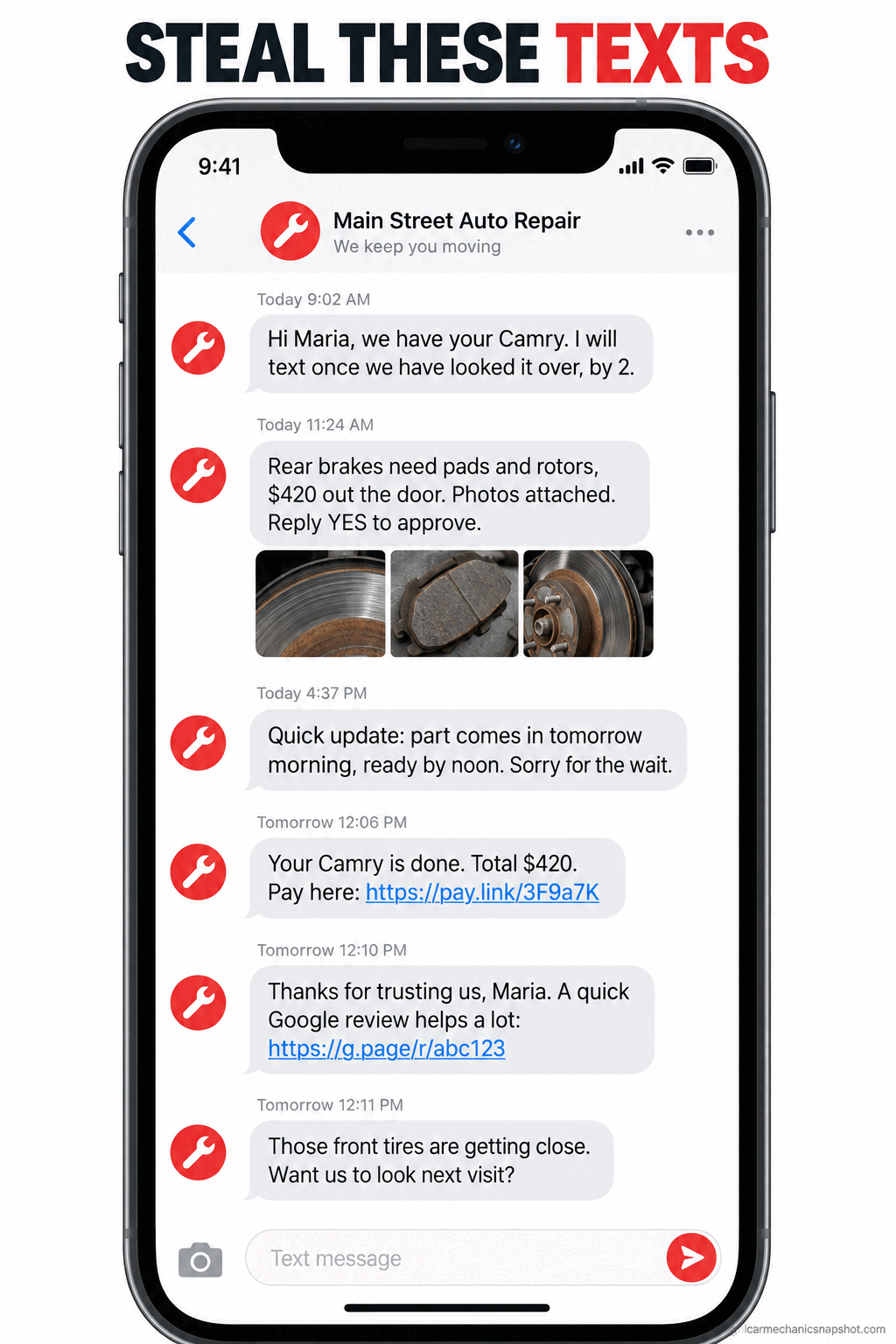
Notice what is not in any status text: no coupon, no “refer a friend,” no “book now.” Those go in a separate, consented message. That is the law, not style.
Run it at your size
One framework, three very different shops. The stages are the same; who sends them is not.
| Solo / 2-bay | Mid-size 3-4 bay | Large 6+ bay | |
|---|---|---|---|
| Who sends | Owner, between jobs | One service advisor | Advisor per tech group |
| How | Phone, a few canned texts | Templates, some automation | Automated on status changes |
| Biggest risk | Updates stop when slammed | Advisor forgets stage 4 | Texts feel robotic |
| The fix | Automate stages 1, 5, 6 | Make the delay text required | A human line in every template |
If you run the counter alone, automate the texts that need no judgment (check-in, ready, thank-you) and keep the approval personal, because that one earns the sale. With an advisor, the bottleneck is consistency: build two-tap templates and make the delay update non-negotiable. At six bays and up, full automation is the only way to keep up, and the risk flips to robotic texts, so put a name and a human sentence in every template.
The compliance line that rides along
The rule that protects your shop is simple. A status update is a transactional message: the customer gave you their car, so telling them about it is a service they asked for, and you are on safe ground.
Mix one promotional line into that text and the whole message is reclassified as marketing. “Your car is ready, total $420. And refer a friend for $20 off!” is no longer a status update. It is an ad, and ads carry a higher bar: prior express written consent and an honored opt-out. Get it wrong and the Telephone Consumer Protection Act allows $500 in damages per text, trebled to $1,500 for a willful violation, per 47 U.S.C. §227(b)(3) on Cornell’s Legal Information Institute. Multiply that by a customer list and the math gets ugly fast.
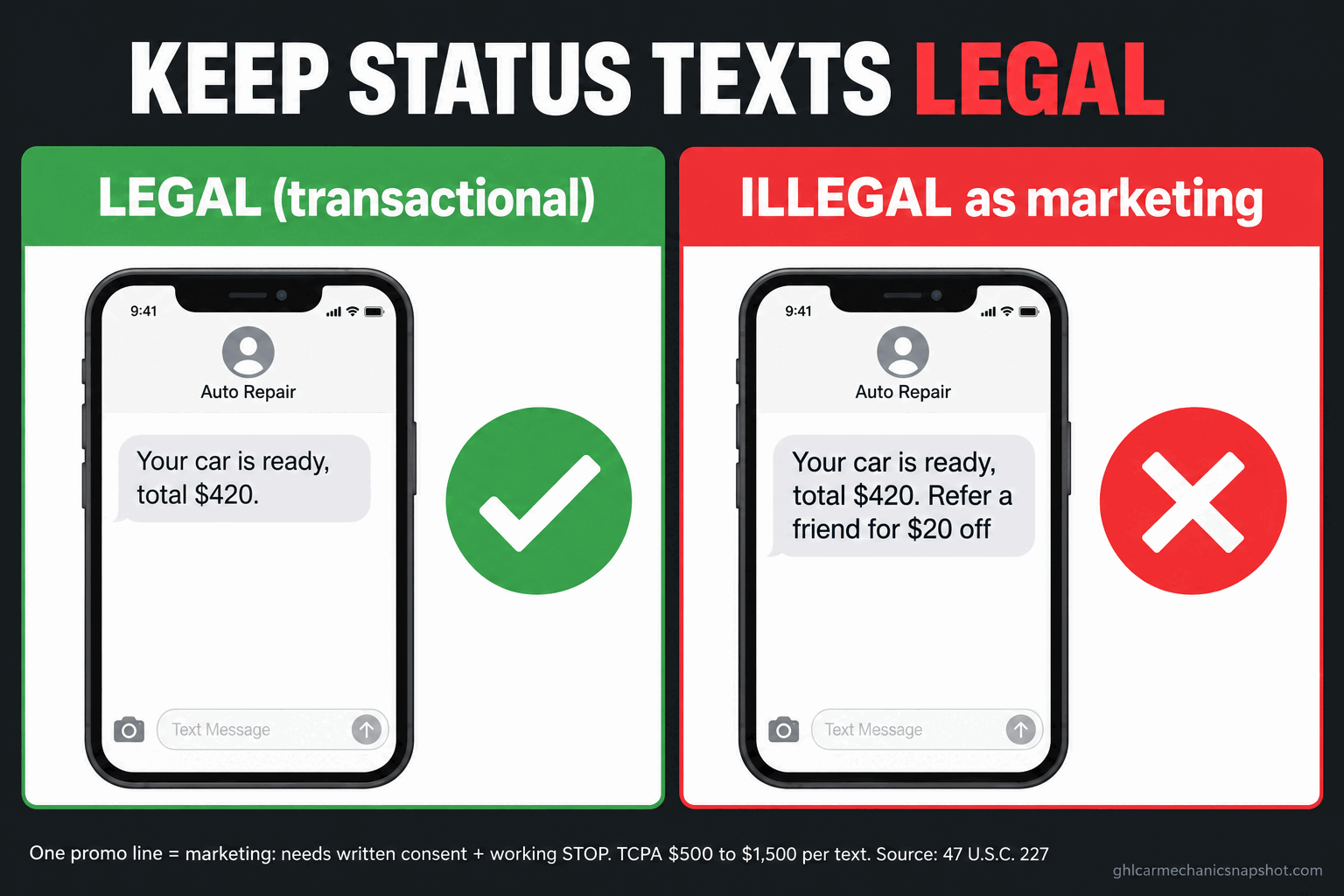
None of this stops you from marketing. Just do it in its own lane, to people who opted in, with a STOP that works. The full breakdown is in “Your service reminder text is legal. Your ‘refer a friend’ line makes it illegal.”.
Straight answers to the objections
“Won’t customers find the texts annoying?” Not if they are about their car and nothing else. People do not find the hospital texting about their own surgery annoying; they find silence annoying. The annoying version has a coupon bolted on.
“My shop software already does this.” Maybe partly. Most systems can send a text, but sending one is not running a system. The gaps are usually stage 4 (the delay nobody remembers) and stage 6 (the review ask), plus the photos on the approval. Audit your last ten jobs: did every car get a check-in, an approval with a photo, a ready text, and a thank-you? If not, the tool exists but the habit does not, and the habit is what makes money.
“Do I need to be technical to set this up?” No, but you do need it built right once. The judgment is in the words and timing, which you already know. The wiring, which text fires on which status change and how consent is logged, is a one-time build. The Car Mechanic Snapshot ships it pre-built.
“My customers are older and don’t text.” Some do not, and that is fine. The system is a default, not a cage. Flag the few who want a call and call them. For everyone else, text is faster for you and preferred by them.
Frequently asked questions
How many status texts should I send per repair?
Match the texts to the job. A quick oil change needs three: a check-in, a ready text, and an after-pickup thank-you. A multi-day repair uses all six stages. One text at each real change of state, never a stream of filler.
Isn't a phone call more personal than a text?
It feels that way to owners, but customers disagree. J.D. Power found customers four times as likely to want updates by text than by phone. A call also forces the customer to stop, so it often becomes voicemail and phone tag.
Can I put a discount or referral offer in my status texts?
No. A status update about the customer's car is transactional and on safe legal ground. Add a promotional line and the whole message counts as marketing, which needs prior express written consent and a working opt-out under the TCPA, with damages of $500 to $1,500 per text.
What do I need before I can text customers legally?
A documented opt-in (captured at drop-off is ideal), your business number registered for A2P 10DLC, and a working STOP for any marketing. Status updates are transactional, but you still want the registration and logged consent so nothing gets filtered.
Do photos in the approval text really change anything?
A lot. In the J.D. Power 2025 aftermarket study, shops that sent photo or video documentation got 41% of recommended repairs approved, versus 17% for shops that sent none. A number feels like a sales pitch; a photo feels like proof.
Back to the Camry. Same Wednesday, but the lady who dropped it off got a text at 7:50 that you had it, one at 11:30 with a photo of her worn pads and a price she approved from her desk, and one at 3:00 that it was done and paid for. She did not call once, and you were never pulled off the counter. She left a five-star review that night because it felt easy. Not a bigger staff, not a longer day, just the same six texts, on time, every car. Build it once and let it run.