
It is 7:40am and the phone rings while you are under a car with your arms covered in old coolant. You cannot get to it, and the caller leaves no voicemail. By the time you dial back at 9:15, it goes to their voicemail, and they never call back. That was a timing belt job, and it went to the shop three blocks over that answered on the second ring.
Now the version that hurts more. A customer is at your counter, you hand them a $1,900 estimate for struts and brakes, and they say the four words that cost shops the most money in America: “let me call you back.” They walk out. You meant to follow up, then Thursday got busy. That job is gone too, diagnosed by a tech you paid, for free.
Both leaks have the same fix, and it is not a bigger phone. It is a two-way texting system that catches the contact you missed, puts the estimate on a screen the customer actually looks at, and keeps an automatic conversation going until you get a yes or a real no.
What’s on this page
- Why estimates die on the phone
- What the callback pile is costing you
- The six stages of a two-way texting system
- Stage 1: catch the call you just missed
- Stage 2: one number, a real conversation
- Stage 3: send the estimate as a text
- Stage 4: the follow-up that saves the callback
- Stage 5: book it in the same thread
- Stage 6: keep the thread alive
- Run it at your size
- The texting rule you cannot skip
- Objections
- FAQ
Why estimates die on the phone
Estimates die because your only two closing tools are a phone customers ignore and a memory that gets busy. Two-way texting replaces both: a channel people actually read, and a follow-up that runs itself.
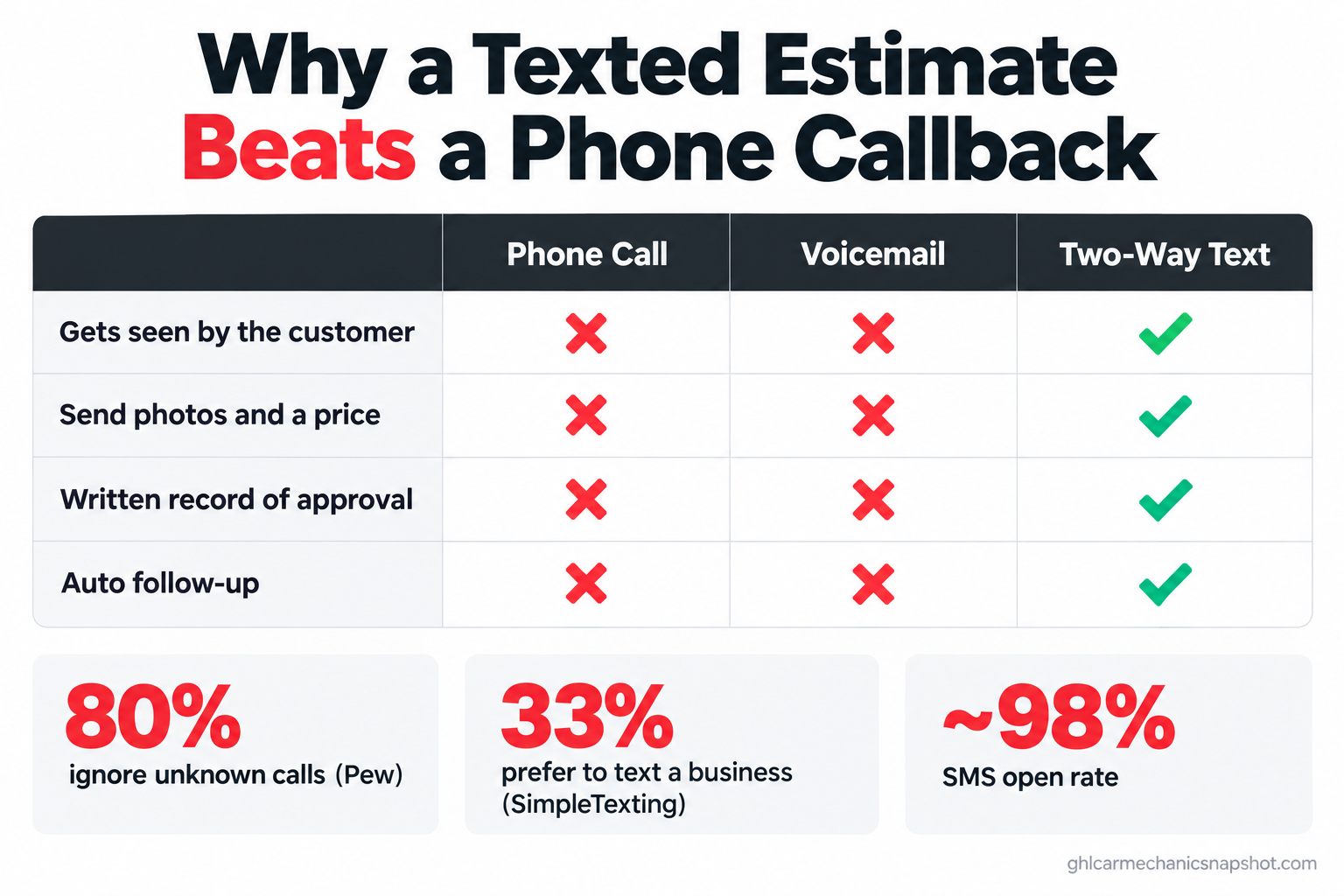
Start with the phone. About 80% of Americans say they do not generally answer their cellphone when an unknown number calls, according to the Pew Research Center. Your customer has not saved your shop’s number, so when you call them back with their estimate, you are the exact call they were trained to send to voicemail. You did the diagnostic work, then delivered it on the one channel built to fail.
Texting is the opposite. It gets read fast, with SMS open rates reported around 98% and most messages opened within minutes, per SimpleTexting’s business texting research. Customers prefer it now too: in the same research, 33% said they would rather text a business with a question than use any other channel, ahead of phone at 18%. The customer already wants to handle this by text; the shop is the one still forcing a call.
What the callback pile is costing you
It is the pattern, every week. The national average auto repair labor rate hit $132 an hour in 2026, ranging from about $85 to $197 by state across more than 10,000 shops, per the Tekmetric labor rate report. A brakes-and-struts job you diagnosed and lost to a voicemail is several billable hours plus parts margin, gone, and you already paid your tech to find it. Lose two a week and you hand a competitor a five-figure month out of work you had already won once.
Speed is the part shops underrate most. In a study of 1.25 million sales leads across 42 companies, the Harvard Business Review found that firms contacting a new lead within an hour were nearly seven times more likely to have a real conversation than those who waited one more hour, and more than 60 times more likely than those who waited a day. Your “I’ll get to the callbacks after lunch” habit is the gap between a booked bay and a cold lead. A texting system answers in seconds, hands busy or not.
Here is how the channels stack up when you are closing an estimate.
| What you need it to do | Phone call | Voicemail | Two-way text |
|---|---|---|---|
| Gets seen by the customer | Rarely, from an unknown number | Often skipped | Almost always, fast |
| Lets you send photos and a price | No | No | Yes, with a link |
| Leaves a written record of the approval | No | No | Yes, timestamped |
| Follows up without a person remembering | No | No | Yes, automatically |
| Customer can reply on their own time | No | One way only | Yes |
The six stages of a two-way texting system
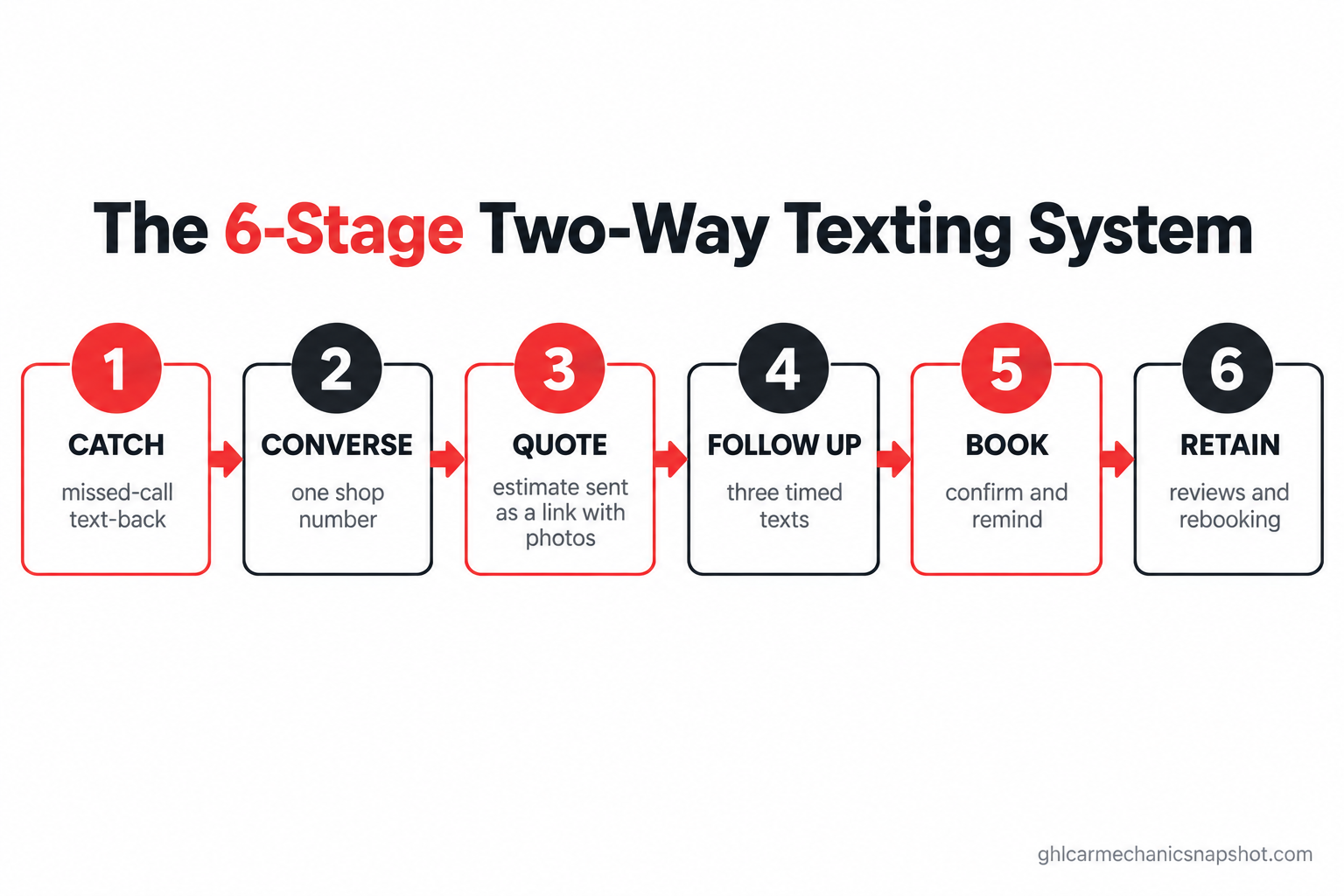
Buying a texting app is not the same as running a texting system. Sending texts is one link in a six-stage chain: catch, converse, quote, follow up, book, retain. The chain breaks at whichever link you never built, and for most shops that is the follow-up.
How consumers say they would rather reach a business with a question, per SimpleTexting. Text is the most preferred channel; the phone is last.
Stage 1: catch the call you just missed
The first thing to automate is the call you cannot answer. When a call rings out, the system texts that number within seconds, turning a dead missed call into a live conversation on the channel the customer prefers. Keep it human: the text names the shop and asks a simple question so they reply. This is the same leak from how auto repair shops lose jobs to missed calls, closed at the front door.
Stage 2: one number, a real conversation
Two-way means the customer can text back and a human at your shop sees it and replies, all on one number. The customer texts “check engine light is on and it’s shaking,” your advisor replies and books a diagnostic, no phone call needed. Every reply lands in one shared inbox, so if the advisor goes to lunch, whoever is at the desk picks it up with the full history.
Stage 3: send the estimate as a text, not a voicemail
This is the stage that stops estimates from dying. When the estimate is ready, it goes out as a text with a link, not a callback or a voicemail. The customer taps it, sees the ranked, priced work with photos of the worn parts, and replies right there.
Texting the estimate does three things a phone call cannot. It gets opened, because it is a text and not an unknown call. It lets the customer study the photos and show their spouse instead of being put on the spot. And it leaves a written record of what you quoted and what they approved. Pair it with clear pictures and the close rate climbs, the whole idea behind photo-backed estimates that close more repair jobs.
Everything above is the front-office system we wire up for shops on GoHighLevel, connected so nobody has to remember it. If you would rather see it running, book a free walkthrough.
Stage 4: the follow-up that saves the callback
Most shops send one estimate, hear nothing, and give up. But “I’ll call you back” almost never means no. It usually means “I’m at work” or “I need to check with my wife.” Three spaced texts catch that without anyone having to remember: a gentle nudge a few hours later, a reason to act the next morning, and a soft close two or three days out that asks for a decision either way so you can stop holding the part. Each is specific to their car and their quote, and each runs on a timer whether the shop is slammed or empty.
An easy way to say “not now” gets you a real answer, worth more than a maybe you keep chasing. The busy ones book; the rest tell you, and you free up the part.
Stage 5: book it and confirm it in the same thread
When the customer says yes, the booking happens in the same conversation. You send a link or two time options, they pick, the system confirms. Reminders are the no-show insurance: a confirmation right after booking and a reminder the day before cut the empty bay a forgotten appointment creates, and because it is one thread, a reschedule lands as a text, not a no-show.
Stage 6: after the job, keep the thread alive
The conversation that closed one estimate is now a channel you own. A review request texted an hour after pickup is the easiest way to grow your Google rating, and it runs off this thread automatically, the core of getting more Google reviews on autopilot. Weeks later it reminds them about the struts they passed on. One conversation, started by a missed call, now feeds reviews and rebooked work for years.
Run it at your size
The six stages are the same everywhere. What changes is who does each job and where your weak link sits.
Solo operator or two-person shop. You are the tech and the front desk, so the missed-call text-back is your highest-value piece: it works the phone while your hands are full. Keep the rest lean, one number you both can see and the follow-up on a timer. You have no staff to chase callbacks, so let the sequence chase for you.
Mid-size shop, three to eight techs. Your weak link is the handoff. Estimates get sent and then sit because the advisor got pulled onto a diagnostic. Fix it with one shared inbox any advisor can pick up, and let the follow-up run on its own so a busy afternoon never kills an estimate. This is also the size where the texting tool inside the shop system you already pay for is often underused, so check what your auto shop software already costs before buying anything new.
Multi-bay or multi-location group. Your risk is inconsistency: one location texts back in seconds, another lets the inbox pile up unread. Standardize the templates, the timing, and the one-number rule across locations, and watch response time per store. The slowest store is where your leads leak.
The texting rule you cannot skip
The moment you text customers, federal law applies. The good news: most of what you send is the safe kind. A missed-call reply, an estimate, a confirmation, and a reminder are all transactional messages about a car the customer brought you, which sit on the lowest consent standard.
The trap is bolting a promotion onto a transactional text. “Here’s your estimate” is transactional. “Here’s your estimate, and refer a friend for $20 off” is marketing, and one promotional line can reclassify the whole message as marketing, which needs stricter written consent. Get it wrong and the damages are real: $500 per text, up to $1,500 if a court finds it willful, under 47 U.S.C. 227. There is also delivery: a business texting from a regular number has to be registered under A2P 10DLC, or carriers quietly filter your messages.
So keep the follow-up about the vehicle, register your number, and honor STOP, and you can text every stage above safely. The full breakdown is in our guide on why your service reminder text is legal but the refer-a-friend line makes it illegal.
Straight answers to the objections
“Won’t customers find the automated texts annoying?” They find bad texts annoying, not helpful ones. A reminder about their own car and an estimate they asked for are useful. The rule is volume and relevance: cap the follow-up at three, give an easy out, and stop the second they reply.
“I already pay for Tekmetric or Shopmonkey. Do I need something else?” Maybe not, and do not buy anything before you use what you have. Most shop systems include some texting, and the gap is usually the system around it, not the app, so build the six stages on your current tool first. If you are still comparing platforms, our head-to-head on Tekmetric, Shopmonkey, AutoLeap and Shop-Ware covers where each one’s texting fits.
“Do I need to be technical to run this?” No. You make a few decisions: text back every missed call, send estimates as a link, follow up three times, keep it about the car. The tooling runs the timers and inbox; steal the templates above.
“My customers are older, they don’t text.” Some do not, and you still call those customers. But many older customers would rather get an estimate they can read twice than a rushed call they half remember. Texting does not replace the phone; it catches the two out of three who were never going to answer it.
Frequently asked questions
Two-way texting for auto shops questions
What is two-way texting for an auto repair shop?
It is a system where customers text your shop's number and a person at the shop texts back, all on one business line in a shared inbox. It covers the whole job: an automatic text back when you miss a call, a real conversation, the estimate sent as a link with photos, a follow-up sequence, booking and reminders, and review requests after the visit. It is a real conversation, not a mass blast.
Why do estimates get lost on the phone?
Because about 80% of people do not answer calls from unknown numbers, per Pew Research, and your customer has not saved your shop's number. When you call back to go over a $1,900 estimate, you are the exact call they send to voicemail. A texted estimate, by contrast, gets opened and approved with a tap.
How many follow-up texts should I send on an estimate?
Three, spaced out, is the sweet spot: a nudge a few hours after the estimate, a reason to act the next morning, and a soft close two or three days later that asks for a yes or no either way. Always give an easy out, and stop the moment they reply or book. More than that feels like nagging and can trigger a STOP.
Is it legal to text customers their estimates and reminders?
Generally yes. An estimate, confirmation, or reminder about a car the customer brought you is a transactional message on the lowest consent standard. The risk is adding a promotional line, which can reclassify the whole text as marketing, with damages of $500 to $1,500 per text under the TCPA. Keep messages about the vehicle, register your number under A2P 10DLC, and honor STOP.
Do I need new software, or can I use what I already have?
Start with what you have. Most shop systems and CRMs include some texting, and the gap is usually the workflow around it, not the app. Build the six stages on your current tool first, and only look at something new if it genuinely cannot do them.
Back to that 7:40am call
Run the opening again with the system in place. The phone rings while you are under the car, and this time the caller gets a text back within seconds naming your shop. They reply, your advisor picks it up, and the diagnostic is booked before you have washed your hands. Later the estimate goes to the customer’s phone with photos, not to a voicemail, and when they go quiet the follow-up brings them back with a soft close. The job that used to walk three blocks over stays in your bay, and it started with a call you never even answered. For the automations that ride on top of this, see the five automations every auto repair shop should run.