

It is the third Tuesday of the month and your two techs are leaning on the bench. The schedule has one oil change and a brake inspection on it. Payroll is Friday, the parts bill is due, and the bays that were slammed two weeks ago are dead quiet now. Nothing is wrong with your shop. The work just comes in waves.
That gap, between money that arrives in lumps and bills that arrive like clockwork, is what keeps shop owners up at night. A maintenance plan is the simplest honest fix. You sell a customer a year of the routine work their car already needs, they pay a flat amount up front or monthly, and now you have a reason to text them back into the bay on a schedule you control instead of waiting for something to break. Here is the whole system, stage by stage, with the copy you can steal and the places it falls apart.
What’s on this page
- Why lumpy cash flow is the real problem
- What a repeat customer is worth
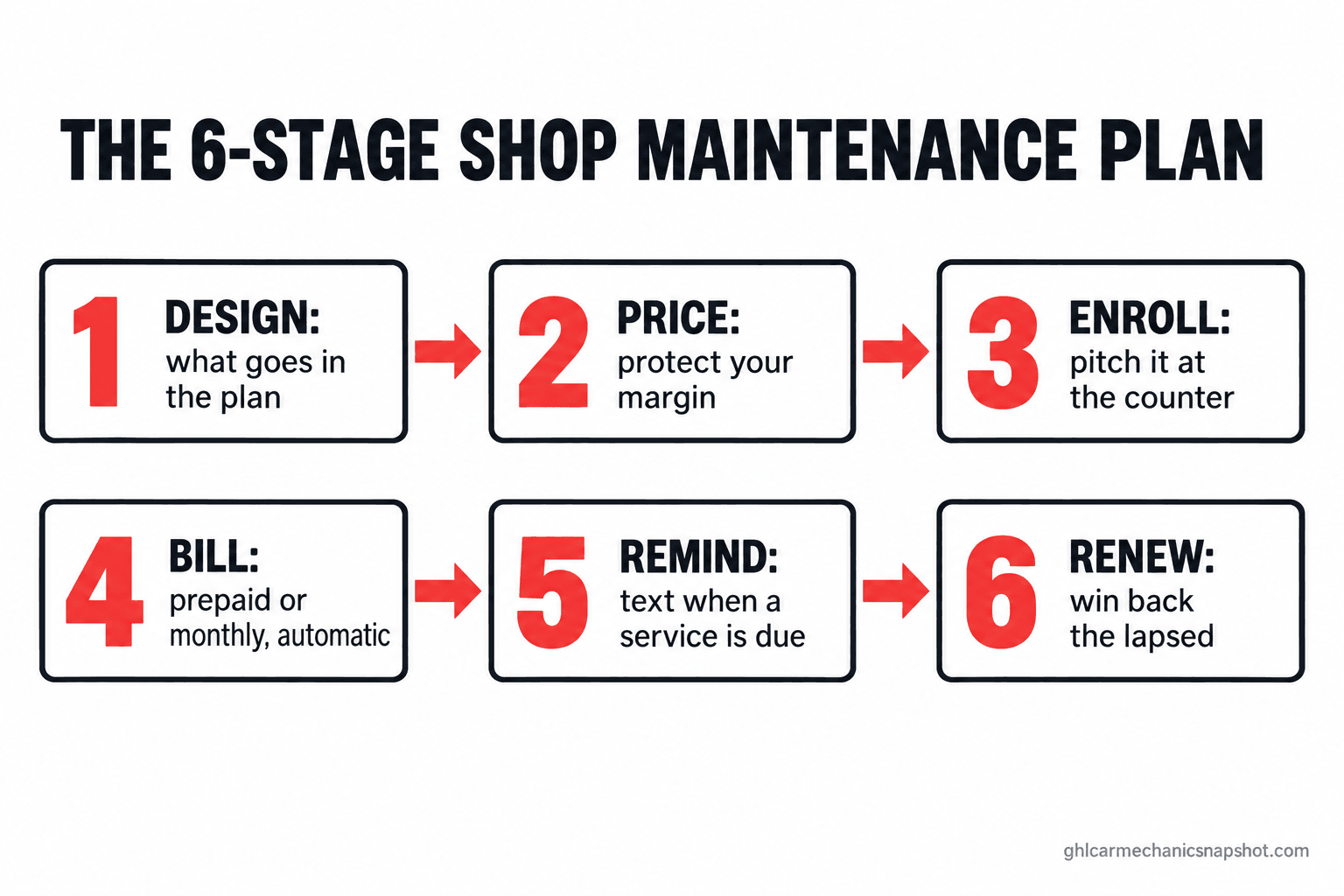
- The six stages of a shop maintenance plan
- Stage 1: what goes in the plan
- Stage 2: price it to keep your margin
- Stage 3: pitch it and enroll
- Stage 4: bill it on autopilot
- Stage 5: the reminders that make members show up
- Stage 6: renew and win back
- Steal this: the exact messages
- Run it at your size
- The compliance line that rides along
- Objections
- FAQ
Why lumpy cash flow is the real problem
Most owners think their problem is car count. It usually is not. The problem is that car count is uneven and your costs are not. Rent, payroll and the parts account come due on a fixed calendar. The work comes in bursts: a cold snap fills the bays, then two slow weeks, then a payday rush, and you float the gaps on a credit card.
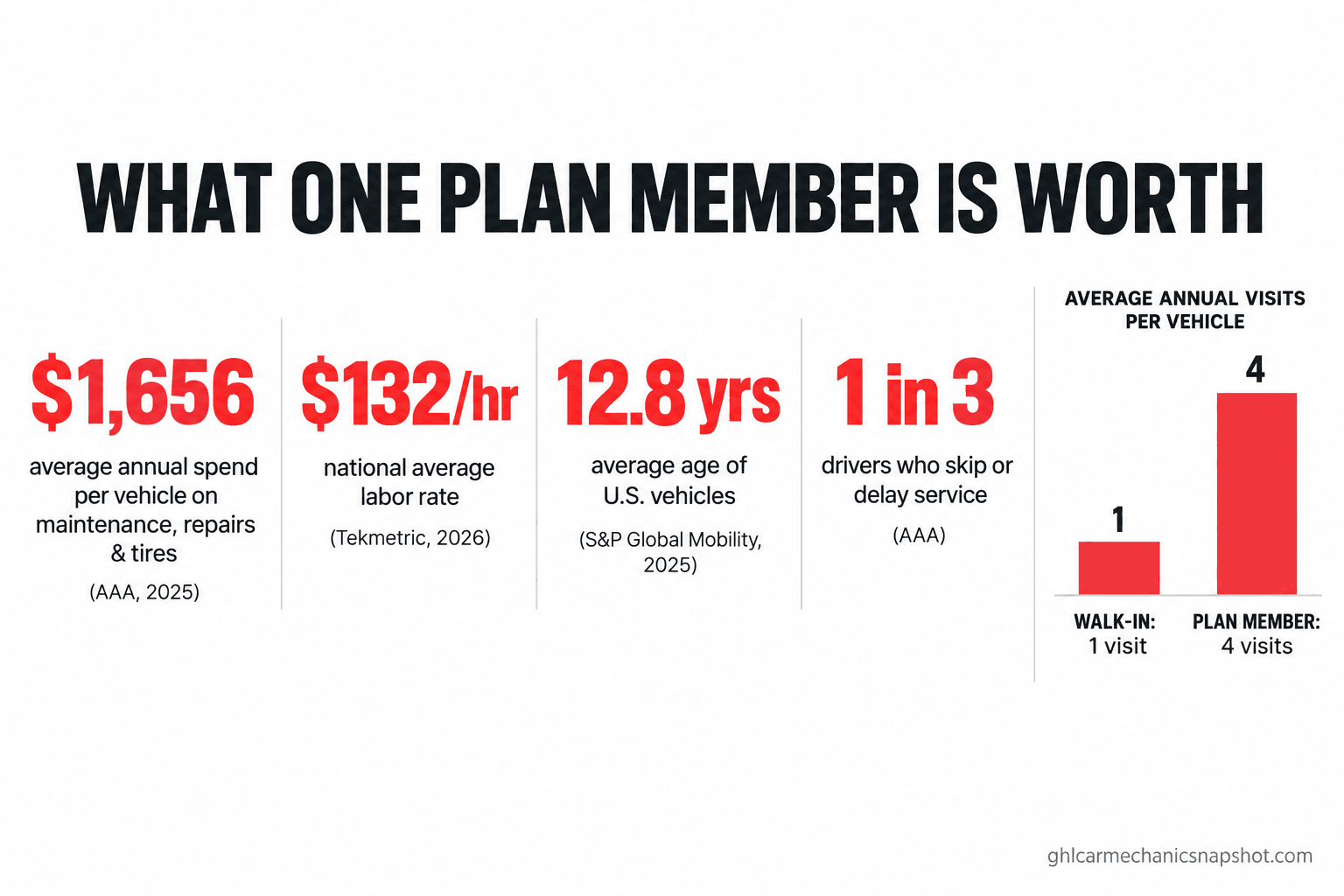
The squeeze on your customers makes it worse. AAA has reported that roughly one in three U.S. drivers could not cover an unexpected repair bill without debt, and that about a third skip or delay recommended service because of cost, per AAA’s reporting on repair affordability. A driver who skips your recommendation does not come back until something fails. A plan turns “I will get to it” into a small amount already paid for, so the visit happens on your schedule. And there is more routine work on the road than ever: the average U.S. vehicle is now 12.8 years old, a record, with passenger cars averaging 14.5 years, per S&P Global Mobility.
Average age of U.S. vehicles, in years, up about two months a year to a record 12.8 in 2025, per S&P Global Mobility. Older cars mean more routine maintenance.
What a repeat customer is worth
Run the math on one member. The average driver spends about $1,656 a year on maintenance, repairs and tires, up from roughly $1,341 in 2019, per AAA’s Your Driving Costs study. You will not capture all of it, but the routine slice (oil, rotations, inspections, filters) is yours to lock in if you give them a reason to choose you over the quick-lube chain.
Put a labor number on it too. The national average auto repair labor rate reached about $132 an hour in 2026, from roughly $85 to $197 by state across more than 10,000 shops, per the Tekmetric labor rate report. A member who comes in four times a year is four cars on your lift, each a chance to spot the brake job, the leaking strut or the tires that will not pass next winter. The plan is the hook; the upsell on a lifted car is the money.
Average annual spend per vehicle on maintenance, repairs and tires, 2019 versus 2025, per AAA’s Your Driving Costs study. A plan decides whether that money lands in your bays or someone else’s.
The six stages of a shop maintenance plan
Selling a membership is not the same as running one. A plan that smooths your cash and fills your bays runs through six links: design, price, enroll, bill, remind, renew. Skip the remind step and you have sold a refund. For most shops the weak link is the reminder or the billing.
Stage 1: what goes in the plan
The fastest way to lose money is to stuff the plan with your highest-cost work. Build it from services that are cheap to deliver and valuable to receive, which means routine maintenance, not repairs. A solid starter plan for a daily driver is three or four oil-and-filter changes a year, a rotation and a multi-point inspection at each, and top-offs on fluids. Your hard cost is mostly oil, a filter and twenty minutes of a tech’s time.
Two tiers is plenty: a basic plan for commuters, and a higher tier that adds a seasonal AC check, a winter battery test and a bigger repair discount. Resist five tiers; nobody parses five options at a service counter.
Stage 2: price it to keep your margin
Price on two things owners forget: discount and breakage. Discount is what you give away versus your menu price. Breakage is the service a member pays for and never uses, which is pure margin. Gyms run on breakage, and so do maintenance plans. Start from your real menu price for everything in the plan, add it up, then set the plan at a discount that still clears your costs with room on top. A bundle that retails at $360 might sell for $279 a year or $25 a month. The member saves, you get the cash and the visits, and what they skip is margin you keep.
Decide up front how unused services roll. The cleanest rule is “use it in the plan year or lose it,” stated plainly at signup. If services bank forever, you will be doing year-three oil changes someone paid for in year one.
Stage 3: pitch it and enroll
The best time to sell is never cold. It is at pickup, when you have just done right by the customer and the car is running well. The advisor hands back the keys: “Most folks with a car your age are back here three or four times this year anyway. We have a plan that covers all of that for about the price of two oil changes. Want me to set it up before you go?” No brochure, no pressure. It works because it is true and they are already in a good mood. Train every advisor to say it on every qualifying pickup, and track who actually says it, because this step quietly stops happening the week you get busy.
Make enrolling take under a minute: pull up a form on the counter tablet, take the card, and the plan is active before they leave. For the “let me think about it” crowd, a same-day text with a link to enroll online catches the ones who meant yes.
Stage 4: bill it on autopilot
You have two honest ways to take the money. Prepaid annual means the customer pays the full year up front. This is the best thing you can do for a lumpy bank account, because the cash lands the day they join, before you deliver a single service. The trade-off is a higher number at the counter. Monthly subscription means a smaller recurring charge every month. It is easier to say yes to and builds a base of money that shows up on the same day each month.
Whichever you pick, the billing has to be automatic. A plan you invoice by hand dies the first time you forget. Set up recurring card billing, automatic receipts, and a sequence that texts a member when a card fails, so a declined Visa does not silently cancel a good member. In the Car Mechanic Snapshot the renewal and failed-payment messages fire from the same system that sends the reminders, so nothing depends on your front desk.
Stage 5: the reminders that make members show up
This stage decides whether the plan makes money, and most shops get it wrong. A member who pays and never comes in feels, for a while, like free money. Then renewal arrives, they see what they actually used, and they cancel and tell their friends your plan is a ripoff. The reminder is not marketing. It is the product.
The member bought a year of visits, so spend them on your schedule, spaced so the bay is busy in your slow stretches. That means a text when each service comes due, by time or estimated mileage, with a one-tap way to book. The same two-way texting that keeps a regular estimate alive is what gets a member onto your calendar; if you have not set that up, start with two-way texting for your shop and service reminders that do not annoy your regulars. Space them to fill your valleys: if November is dead, pull members’ winter-prep visit forward with a text. You are not inventing work, you are moving work they already paid for into the week you need it.
Stage 6: renew and win back
A plan is an annual relationship, so the renewal is the second sale. Start it before the plan lapses. Thirty days out, a text that sums up the year (“you came in 4 times and we caught that nail in your tire”) plus a one-tap renew link does most of the work. A member who used the plan renews without thinking; one who did not is telling you the reminders failed, so fix those, not the price. For members who lapse anyway, a win-back a few weeks later (“your plan expired, here’s 10% to come back”) recovers a real slice. The same approach works for lapsed regulars who were never on a plan, covered in winning back customers who went to the dealer and following up on declined work.
Steal this: the exact messages
Change the bracketed bits to your shop and keep the tone plain. These run the plan once a member is enrolled.
Run it at your size
Solo or two-person shop. You are the advisor, the tech and the bookkeeper, so a plan that depends on you remembering anything will fail. Start with one tier, prepaid annual only, so there is no monthly billing to manage. Sell it at the counter and let the automated service-due reminder do the only ongoing work; your biggest win is the prepaid cash.
Mid-size shop, three to six bays. Now the monthly subscription earns its keep, because predictable monthly money across a few hundred members smooths payroll week. Run two tiers, track your advisors’ enrollment rate, and make the reminder and failed-payment automations bulletproof, because at this volume a 5% silent-cancellation leak is real money.
Large or multi-location shop. The plan is now a retention engine and a valuation asset, because recurring revenue is worth more than one-time work when you go to sell. Standardize it across locations, report enrollment and usage per store, and feed members into a CRM. The danger is inconsistency between stores, so run one system and one source of truth.
The compliance line that rides along
A plan involves two things regulators care about, so handle both plainly.
Recurring billing. If you charge a card every month, get clear consent at signup for the recurring charge, the amount, and how to cancel. Say it plainly on the enrollment form and keep a record, which also heads off chargebacks.
Texting the plan. Service-due reminders are transactional, about a service the member bought, which is the safe side of the line. The moment you mix a promotion into that thread (“and refer a friend for $20 off”) you can reclassify the whole message as marketing, which needs prior express written consent and instant STOP handling under the TCPA. The statute allows damages of $500 per text, and a court may award up to $1,500 per text for willful or knowing violations, per 47 U.S.C. 227. Keep plan reminders clean and get separate consent for promos. Full breakdown in text message compliance for auto shops.
Straight answers to the objections
“I’ll just be discounting work I’d get anyway.” Only if your reminders are weak. The point is the scheduled visit, not the discount. A member you text in four times is four cars on your lift, each a shot at the brake job or the tires you would otherwise lose to the quick-lube chain.
“My customers won’t prepay.” Some won’t, which is why the monthly option exists. A $25 charge clears almost everyone’s bar, and the ones who prepay the year hand you cash up front. Offer both; many pick annual once an advisor says “two oil changes gets you the whole year.”
“It’s too complicated to track who’s used what.” By hand, yes, which is why you do not. The billing, usage and reminders live in one system that knows who is due and texts them. If you are tracking members on a clipboard, the plan will fail.
“I tried a punch card and it didn’t work.” A punch card is a discount with no reminder, so it pays off only when the customer remembers you. A plan is the opposite: the shop drives the visit, the money is collected automatically, and the renewal is built in.
Frequently asked questions
How much should an auto shop maintenance plan cost?
Price it off your own menu. Add up what the included services retail for, then discount to a price that still clears your delivered cost (parts plus the tech's time) with margin. A common shape is three or four oil changes, rotations and inspections sold at roughly the price of two oil changes, often $20 to $30 a month.
Should the plan be prepaid annual or monthly?
Both, if you can. Prepaid annual is best for cash flow because the money lands the day they join. Monthly subscription is easier to say yes to and builds a predictable base. Offer both; solo shops often start annual-only to avoid managing monthly billing.
What services should go in a maintenance plan?
Routine maintenance that is cheap to deliver and valuable to the customer: oil and filter changes, tire rotations, multi-point inspections, fluid top-offs, seasonal checks. Keep actual repairs out of the flat price and give members a percentage discount instead. A plan that promises free repairs loses money the first time a member needs an expensive job.
Won't a maintenance plan cannibalize revenue I'd earn anyway?
Not if the reminders work. The plan's value is the scheduled visit, not the discount. Each visit puts the car on your lift, where your tech can quote the brake job, the struts or the tires. A plan with no reminder system does cannibalize, which is why the automation matters more than the pricing.
Is texting plan members about due services legal under the TCPA?
Service-due reminders are transactional, about a service the member bought, which is the safe side of the line. Mixing a promotion into that thread can reclassify the whole message as marketing and require prior express written consent and STOP handling. The TCPA allows $500 per text, up to $1,500 for willful violations. Keep reminders clean and get separate consent for promos.
A maintenance plan is not a magic growth hack. It is a boring, durable fix for the two things that actually hurt a shop: cars that come in waves, and regulars who drift away. You sell the work the car already needs, collect the money on a schedule you control, and give yourself a built-in reason to text every member back into the bay during your slow weeks. Build the six stages, automate the billing and reminders so nothing depends on a busy front desk, and the quiet third Tuesday stops being the week you sweat payroll.