

It is Monday morning. You open your phone, and there it is: one star. “Charged me $900 for a water pump and the check engine light came back on two days later. Total ripoff. Avoid this place.” You know the car, and you know the new code was unrelated. Your stomach drops anyway, because that review is now sitting on the same map every “auto repair near me” search pulls up, right under your four-point-eight.
Here is the short version, because you have cars to move. A bad review is not the emergency. The emergency is leaving it there with no reply, because the next customer reads your response more than the complaint. Reply fast, reply calm, take the details offline, fix what is fixable, and flag the ones that actually break Google’s rules. Do that on every review, and one angry Monday stops being a threat to your rating. Below is the whole system, stage by stage, with the replies you can copy, plus the one common move that gets your shop penalized instead of the reviewer.
What’s on this page
- Why the bad review matters less than your silence
- The six stages of a review-response system
- Steal this: the exact replies
- Run it at your size
- The line that gets your shop penalized
- Straight answers to the objections
- FAQ
Why the bad review matters less than your silence
Every owner reads a one-star as a verdict on the shop. The customer reading it a week later does not. They are scanning for a pattern and for how you handle it. A single angry review next to forty happy ones, with a calm owner reply underneath, reads as “this shop is normal and stands behind its work.” The same review with no reply reads as “they did not care enough to answer.”
The numbers back this up. In BrightLocal’s 2026 Local Consumer Review Survey, 97% of people said they read reviews for local businesses, and 41% do it every single time. For a shop, the review page is your storefront. It is the first thing a driver with a dead alternator sees, before your bays, your ASE badges, or the twenty years you have been on that corner.
It gets sharper. BrightLocal found 68% of consumers will only use a business with a rating of four stars or higher. So your star average is a gate, not a vanity score. A drift from 4.6 to 4.2 is not cosmetic; it drops you under the bar a chunk of searchers set before they read a word. The point of answering a bad review well is not to win an argument with one customer. It is to keep the next hundred from bouncing.
The six stages of a review-response system
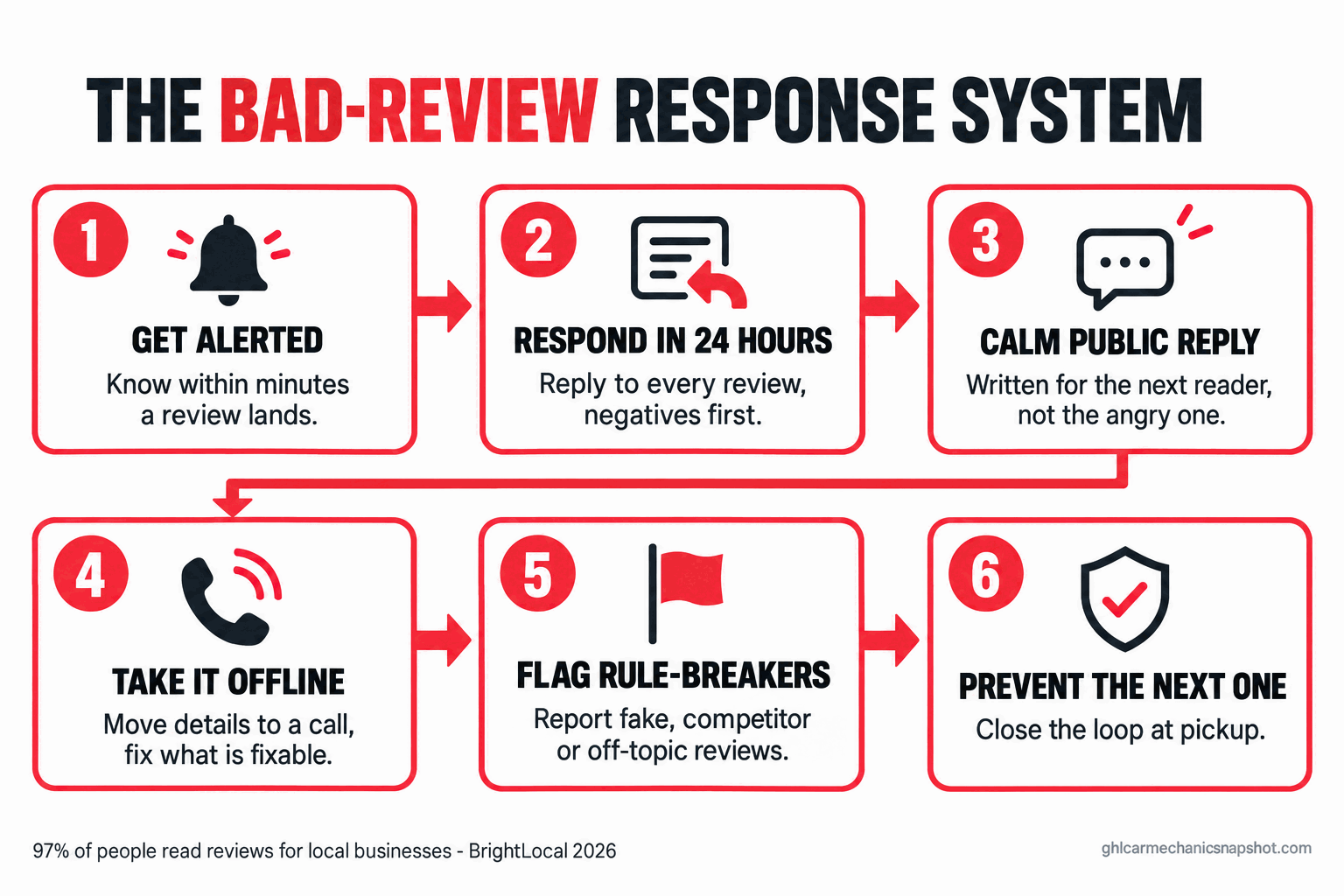
A response system is not one reply typed in anger. It is a short, repeatable loop that runs every time a review lands, so nothing sits ignored and nothing gets answered hot. Six stages cover it, and you build the templates and the alert once, then work the loop.
- Alert: know within minutes that a review landed, good or bad.
- Triage: respond to every review inside 24 hours, with the negatives first.
- The public reply: calm, specific, and written for the stranger reading it.
- Take it offline: move the details to a phone call or private message and try to make it right.
- Flag the bad actors: report the reviews that break Google’s rules, not the ones that just sting.
- Prevent the next one: close the loop at pickup so the unhappy customer talks to you first.
Let’s take them one at a time.
Stage 1: get alerted the moment a review lands
You cannot respond fast to something you find out about on Thursday. Most shops discover a bad review days later, by accident, after it has already cost them calls. The fix is an alert the second a review posts, straight to your phone, so a one-star never sits for a weekend.
How it breaks. You rely on “checking Google now and then,” so a bad review on Friday night festers until Monday, when the damage is done. Or the alert goes to an email nobody opens. Send it somewhere you actually look, the same place your texts land, and make answering reviews a daily two-minute habit.
Stage 2: respond to every review inside 24 hours
Here is the habit that separates shops that own their rating from shops that fear it: they answer everything, fast. Not just the angry ones. The five-star gets a thank-you too, because every reply you post is a small sign to the next reader that a real person runs this place.
BrightLocal’s data is blunt about the cost of staying quiet: 80% of consumers are more likely to use a business that responds to all of its reviews, while 42% say they are unlikely to use a business that never replies. Silence is not neutral. It reads as not caring.
Share of consumers more likely to use a business, by how it responds to reviews. Source: BrightLocal 2026 Local Consumer Review Survey.
How it breaks. You answer the angry ones and ignore the happy ones, so your profile looks defensive, all apologies and no gratitude. Answer both. Or you let a review age two weeks, by which point it has already turned away the readers who saw it fresh. Twenty-four hours is the target.
Stage 3: the public reply that is written for the stranger
This is the stage everyone gets wrong, because they write the reply to the reviewer. Write it to the next person reading it instead. That one shift changes the tone from defensive to professional and keeps you out of a fight you cannot win.
A good reply to a negative review does four things in about four sentences: it thanks them for the feedback, it stays calm and never calls them a liar, it states the facts briefly without re-litigating, and it moves the conversation offline. What it never does is argue, overshare private details, or blame the customer. “You approved the $900 estimate in writing and the code is unrelated” might be true, but airing it publicly makes you look combative and can expose customer information. Say less in public, say more on the phone. The angry reviewer may never soften, and that is fine. You are not writing for them.
How it breaks. You match their energy and write a paragraph proving them wrong, and now the stranger sees two angry people instead of one angry customer and one calm shop. Delete the sarcasm before you post. Or you copy-paste the identical “We’re sorry, please call us” under every negative, and BrightLocal found half of consumers are put off by generic template replies. Vary it. Name the car, the service, the person.
Stage 4: take it offline and actually fix it
The public reply shows you are reasonable. The private conversation is where you recover the customer and, often, the review. Give a real way to reach a human: a direct line, a name. Then listen first and fix what is fixable. A comeback on a job that was not right is cheaper than the review it prevents, and a customer who feels heard will often update the star rating on their own. You do not ask them to. You earn it.
Sometimes the complaint is not about the work at all. It is a $90 diagnostic fee they did not expect, or a two-hour wait nobody warned them about. Those are front-desk problems wearing a one-star costume, and the fix is upstream: a clearer estimate, a status text while the car is in the bay, a heads-up on the wait.
How it breaks. You take it offline and never follow through, so the customer is angrier than before and posts an update saying so. If you promise a callback, make the callback. Or you refund to make it disappear and never fix the actual problem, so the same thing hits the next customer next week.
Stage 5: flag the reviews that break the rules
Not every bad review is a legitimate unhappy customer. Some are fake, some are from people who were never in your shop, some are a competitor, some are a rant about a tow company you are not part of. Those you can report, and Google does remove reviews that violate its content policy.
Google’s review content policy prohibits several things worth knowing by name, because these are your grounds to flag:
- Fake engagement: a review not based on a real experience at your shop.
- Conflict of interest: reviews from a current or former employee, a competitor posting to tank your listing, or a family member.
- Off-topic: a rant about politics, the weather, or a business that is not yours.
- Harassment or extortion: a threat to post or keep a one-star unless you give a refund.
To flag one, open your reviews in the Google Business Profile, choose “Report review,” and pick the reason. Removals can take days and Google does not catch everything. What you should not do is flag a review just because it is harsh and true. That is not a violation, and burying honest criticism is exactly what regulators are now watching, which is the next section.
How it breaks. You report every negative as “fake,” Google ignores you, and you have wasted the one tool that works on the reviews that actually are fake. Save flagging for genuine policy violations and document them: a name you do not have in your system, a date you were closed, a service you do not offer.
Steal this: the exact replies
Here is a starter set. Adapt the details, keep them short, keep them human, and never paste the same one twice in a row.
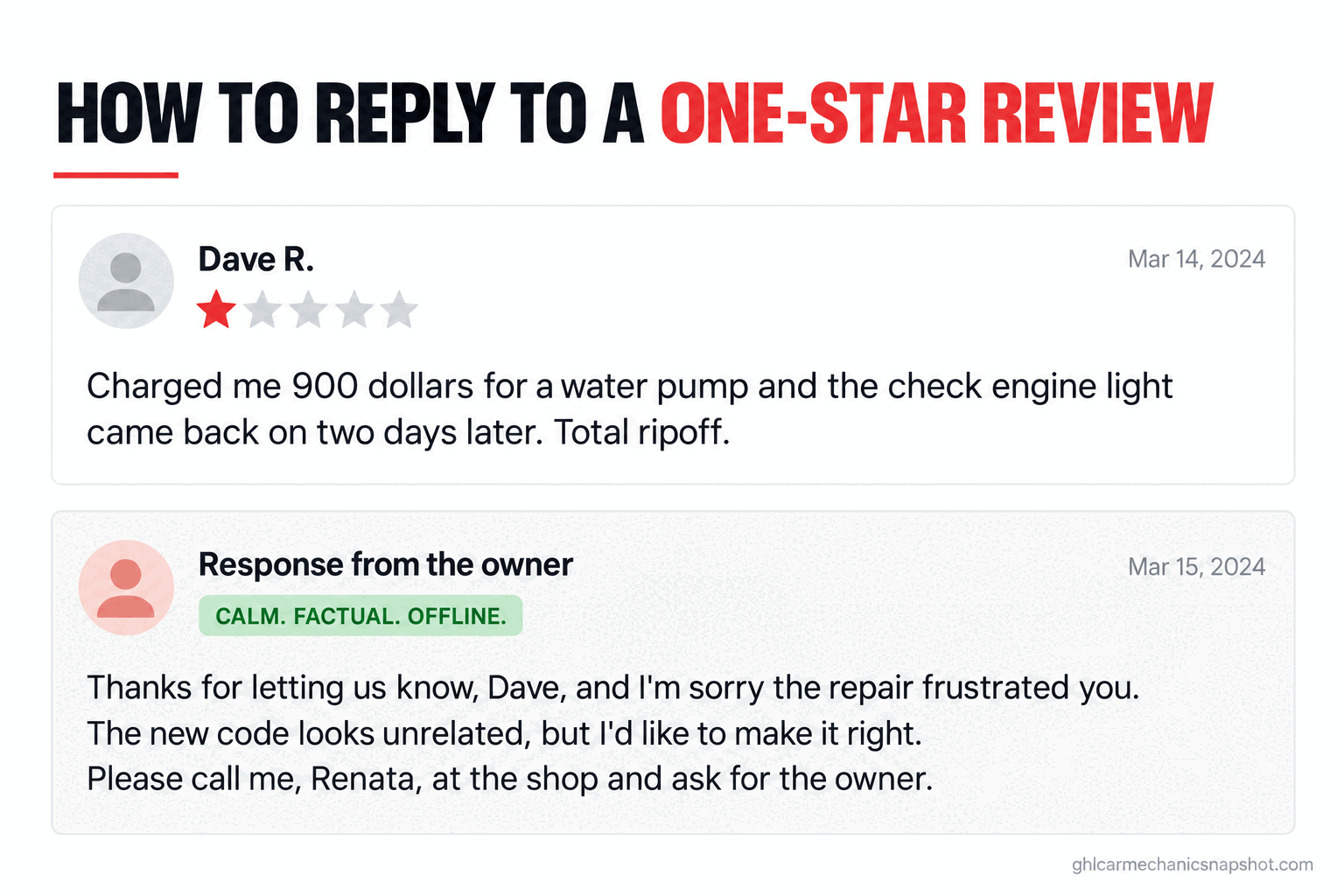
Notice what none of them do. None argue. None dump private details. Every one moves the matter to a call. That is the pattern, whatever the complaint.
Run it at your size
Same six stages, very different shop. Who works the loop changes.
| Solo / 2-bay | Mid-size 3-4 bay | Large 6+ bay / multi-location | |
|---|---|---|---|
| Who responds | Owner, daily | Service advisor or manager | One person owns reputation |
| How | Phone alert, replies by hand | Templates, owner handles the hot ones | Alerts routed, replies on a schedule |
| Biggest risk | You reply angry, same day | Generic template on every review | A location goes a month unanswered |
| The fix | Draft, wait an hour, then post | Vary replies, flag the hard ones up | Assign each location an owner + weekly check |
If you run the counter alone, your danger is replying hot. Write the reply, save it, walk the floor for an hour, then read it again before it posts. With an advisor, the danger is lazy copy-paste; give them templates and a rule to personalize each one. Across locations, the danger is a review rotting unanswered where nobody is watching, so one person owns the whole map with a weekly sweep.
The line that gets your shop penalized
This is the part that trips up well-meaning owners, because the obvious “fix” for bad reviews is illegal.
The tempting move is to filter: ask only the happy customers, and quietly steer the unhappy ones somewhere private so they never post. That is called review gating, and Google explicitly prohibits it. The policy says a business may not selectively solicit positive reviews or discourage negative ones, and it bans offering any payment, discount, or free service in exchange for a review. Get caught and Google can remove reviews or restrict your profile.
It is not just Google’s rule anymore. In 2024 the Federal Trade Commission finalized a rule banning fake reviews and testimonials, effective October 2024. It bars buying positive or negative reviews, posting fake or AI-written ones, insider reviews that hide the reviewer’s connection to the business, and suppressing honest negatives through threats. The teeth are real: civil penalties up to $53,088 per violation as of 2025, per Wilson Sonsini’s analysis, and the agency can treat each fake review as its own violation.
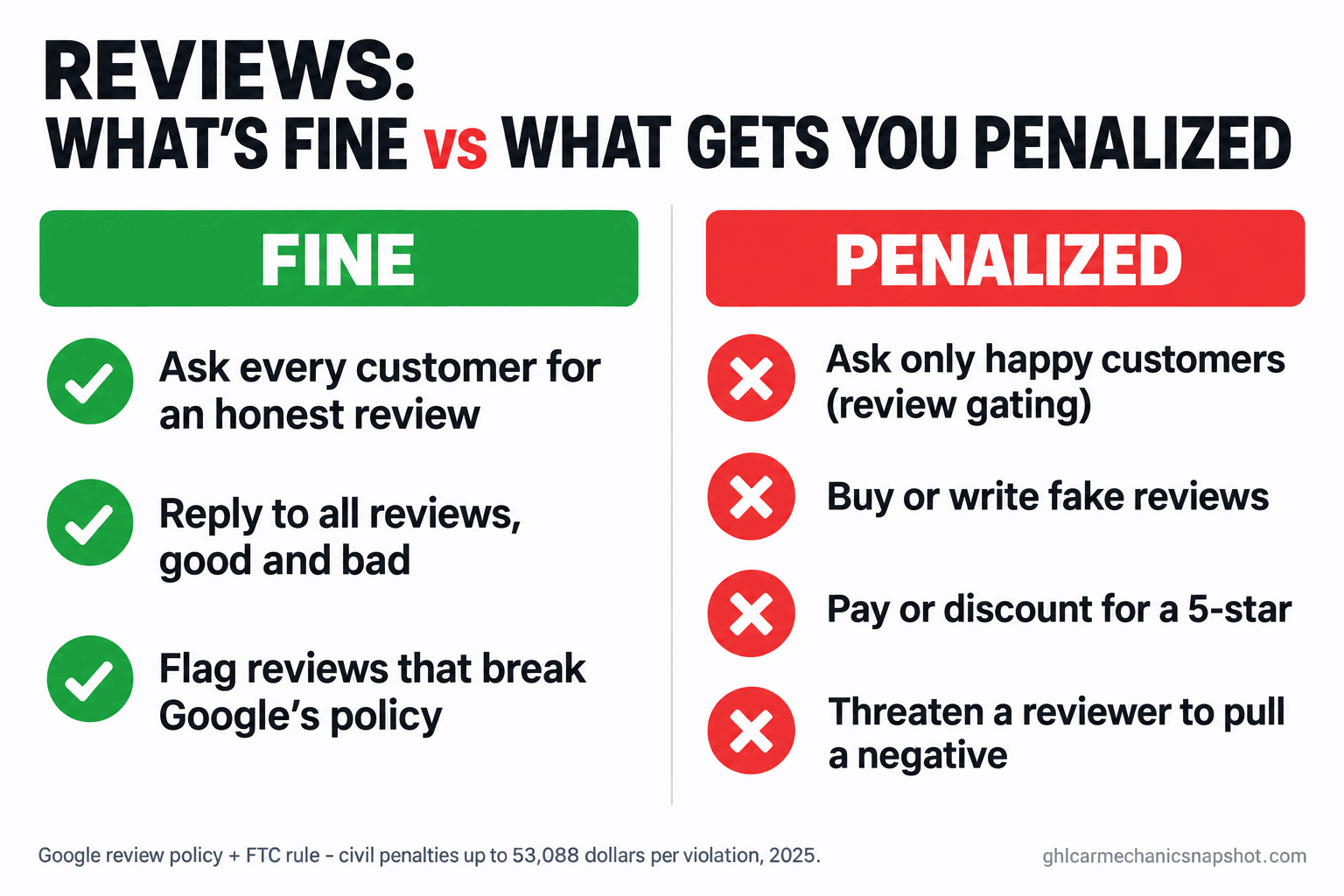
So you do not win on reviews by hiding the bad ones. You win by burying them under real recent five-stars and answering every one like a professional. The clean, compliant way to get more Google reviews on autopilot is a separate playbook, and the texting-consent rules that overlap with review requests are in our TCPA guide for auto shops.
Straight answers to the objections
“Should I just ignore it and let it get buried?” No. A buried review still shows, and the reader who sorts by “lowest” or “most recent” lands right on it. More to the point, an unanswered negative is the one that looks worst, because it signals you did not care. The reply is cheap insurance.
“What if the customer is flat-out lying?” Reply calmly in public, correct the record in one line without the private details, and invite them to call. If it truly violates Google’s policy, such as a review from someone who was never your customer, flag it. What you cannot do is threaten them to take it down, which is exactly the suppression the FTC rule targets.
“Can’t I just pay a service to remove bad reviews or post good ones?” Steer clear. Buying reviews or paying to post fakes is precisely what the FTC rule bans, and Google removes bought reviews and can restrict your profile. The only durable fix is real reviews plus good responses.
“I don’t have time to watch Google all day.” You do not need to. An instant alert plus a two-minute daily check covers it, and auto-replies can handle the simple thank-yous so you only touch the ones that need a human. The review and Google reply automations in our system are built for exactly this.
Frequently asked questions
How fast should I respond to a bad Google review?
Within 24 hours, same business day if you can. A review is most visible when it is new, and a fast, calm reply signals that a real owner is paying attention. Letting a negative sit for a week is when it does the most quiet damage to your call volume.
Can I get a bad review removed from Google?
Only if it breaks Google's content policy: a fake review, one from a competitor or former employee, an off-topic rant, or an extortion threat. Open the review in your Google Business Profile, choose Report review, and pick the reason. Google does not remove reviews just for being negative or harsh.
Is it against the rules to ask only happy customers for a review?
Yes. That is review gating, and Google prohibits selectively soliciting positive reviews or discouraging negative ones. Ask every customer for an honest review. The legitimate version of catching problems early is to ask how the job went at pickup and fix any issue before the customer leaves.
Can my shop really be fined over reviews?
The FTC's 2024 rule on fake reviews carries civil penalties up to $53,088 per violation as of 2025. It targets buying reviews, posting fake or AI-written ones, undisclosed insider reviews, and suppressing honest negatives through threats. Asking real customers for real reviews is completely safe.
Should I respond to positive reviews too?
Yes. Replying only to negatives makes your profile look defensive, and 80% of consumers are more likely to use a business that responds to all of its reviews. A quick, specific thank-you on a five-star takes ten seconds and tells the next reader a real person runs the shop.
Back to that Monday review. You saw the alert at 7:50, not Thursday by accident. By 8:15 you had posted four calm sentences and a direct line. Dave called at lunch, you rescanned the car for free, the code was a loose gas cap, and he updated the review to four stars that afternoon with “owner called me back same day.” The next customer who reads your profile does not see a ripoff. They see a shop that answers. That is the whole game, and it is a two-minute habit, not a crisis. Build the loop once and work it every day.