
It is 4:50pm and a car in for an oil change is up on the lift. Your tech spots a serpentine belt with a crack running most of the way across it. Thinking about the three cars still ahead of him, he does what techs have done for forty years: scribbles “belt cracked, recommend replace” on the bottom of the paper ticket and moves on. That note lands on the counter during the 5pm rush and maybe gets mentioned. The customer pays and drives off. Two weeks later the belt snaps on the highway and the tow truck takes the car to whichever shop is closest. Not yours.
You did the hard part. You found the work. Then you lost it on the way to the customer’s phone. That is the leak a digital vehicle inspection is built to plug, and it is why the workflow, not the software, is what matters.
What’s on this page
- What the paper inspection is costing you
- The six stages of a DVI that actually runs
- Stage 1: every car gets inspected
- Stage 2: the tech’s ten minutes
- Stage 3: the advisor builds the estimate
- Stage 4: the send
- Stage 5: the approval
- Stage 6: the follow-up on declined work
- Run it at your size
- The texting rule you cannot skip
- Objections
- FAQ
What the paper inspection is costing you
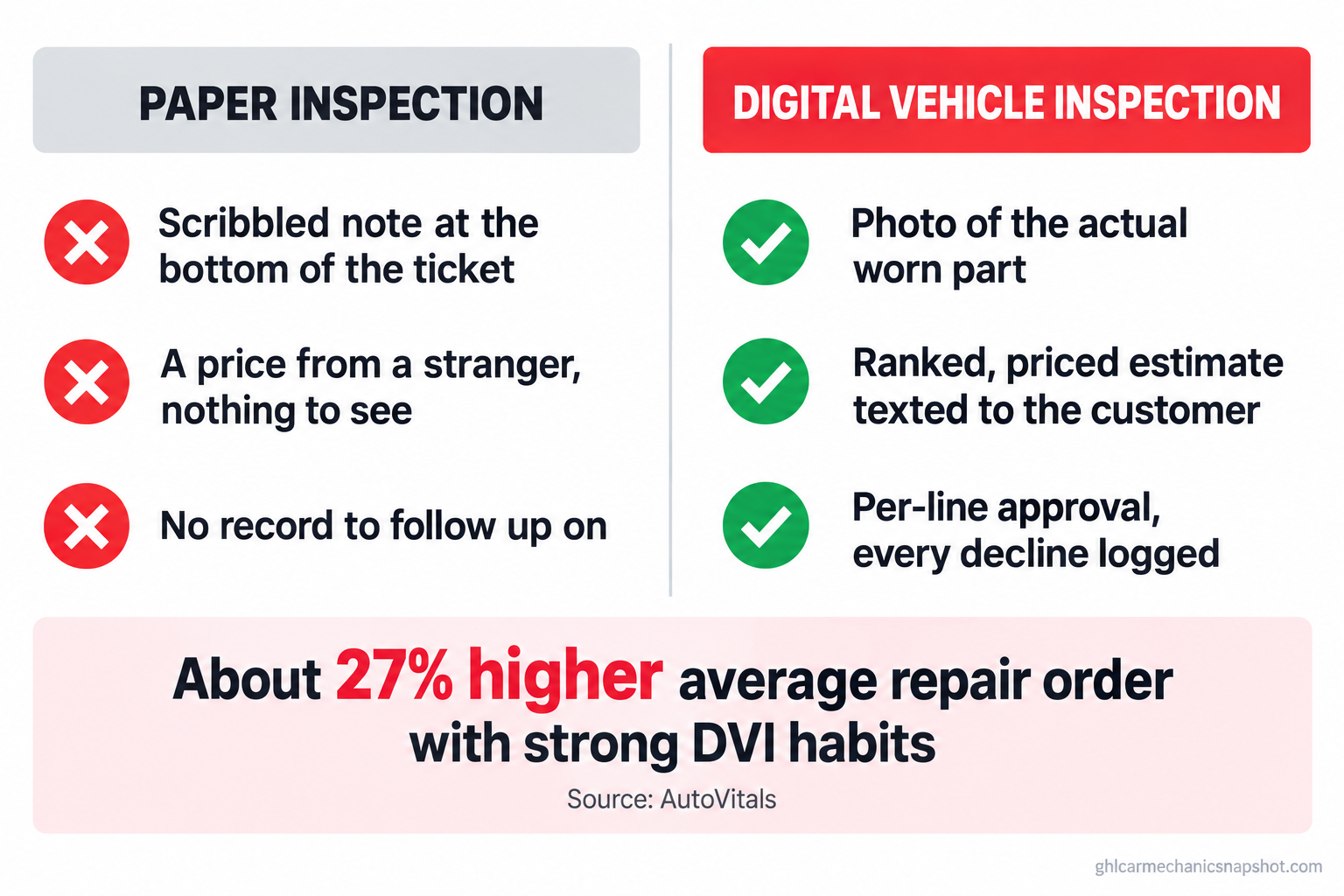
Start with the trust problem: it is why a photo beats a sentence. Two out of three US drivers say they do not trust auto repair shops, citing recommendations for unnecessary services (76%) and overcharging (73%) as their top two reasons, per the AAA auto repair trust survey. The biggest reason customers decline your recommendations is that they quietly assume you are making them up.
Now picture how a paper finding reaches that skeptical customer. Your advisor, who they met ten minutes ago, says “you also need a serpentine belt, that is another $180.” No belt to look at, no photo, just a number from a stranger, so a chunk of people say “not today,” filling the gap with the worst assumption. A digital inspection changes what they are deciding on. Instead of trusting your word, they are looking at a photo of their own cracked belt, next to a clear price, and the decision stops being “do I trust this guy” and becomes “do I want to fix that.” That shift is why shops with strong DVI habits report about a 27% higher average repair order, according to AutoVitals.
Put a dollar figure on the leak. The national average labor rate hit $132 an hour in 2026, ranging from about $85 to $197 by state across more than 10,000 shops, per the Tekmetric labor rate report. A belt-and-tensioner job you find but fail to sell is real labor hours plus parts margin, gone. Do that a couple of times a day and you are leaving five figures a month in already-found work on the table.
There is a staffing angle too, and it is why the workflow has to be fast. The technician pipeline cannot keep pace with demand, with the industry needing far more new techs each year than schools produce, per the TechForce Foundation supply and demand report. Your best techs are already slammed, so any inspection that adds fifteen fiddly minutes to every car will quietly die. Speed is the difference between a system that runs and a login nobody opens.
The six stages of a DVI that actually runs
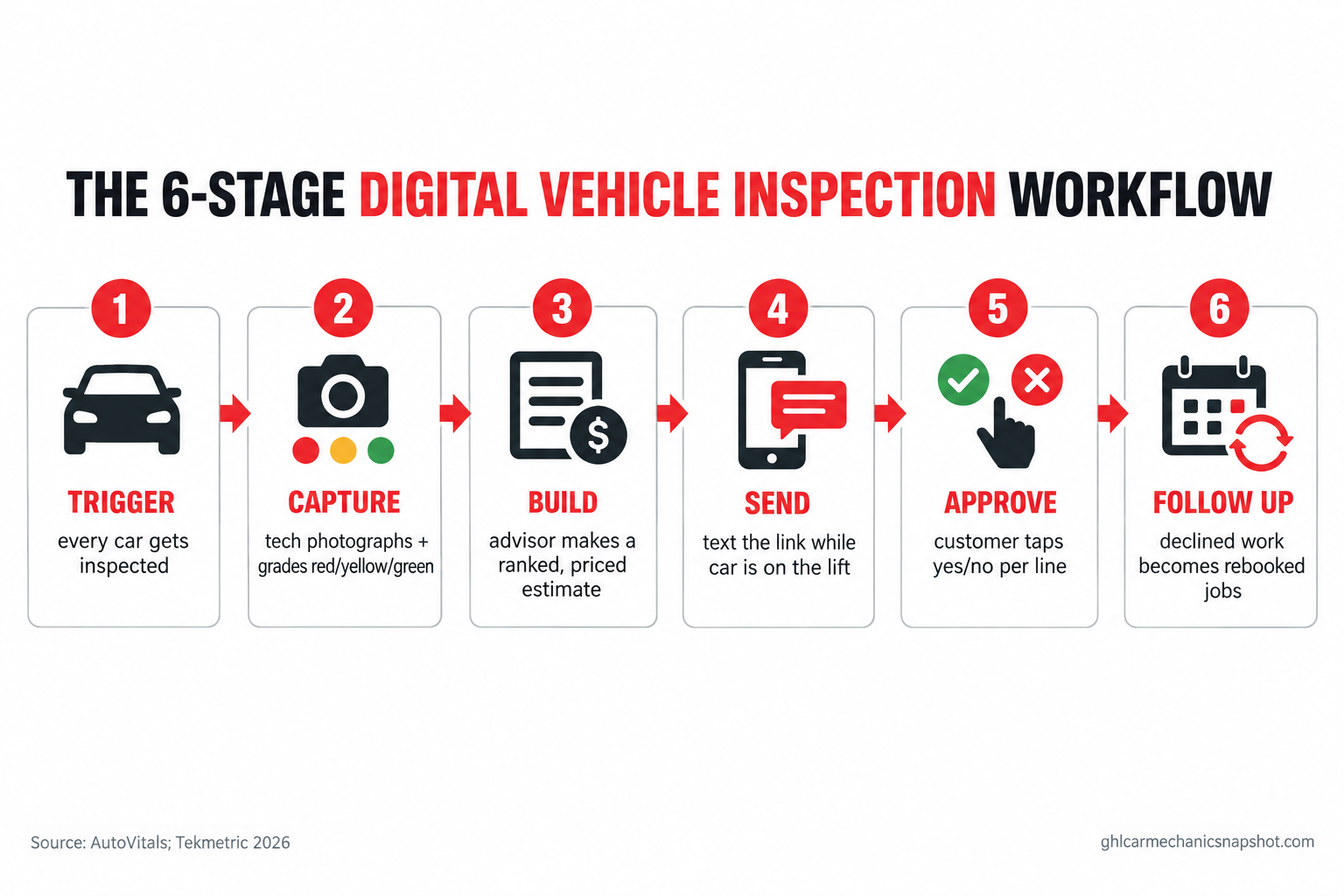
Buying inspection software is not the same as running inspections. The platform is one link in a six-stage chain: trigger, capture, build, send, approval, follow-up. The chain breaks at whichever link you never built. Here is each stage, what good looks like, and how it breaks.
Stage 1: every car gets inspected, no exceptions
The first decision is a rule, not a setting: every car that comes in gets a courtesy digital inspection, whether it is here for a check-engine light or a $39 oil change. Not the cars your tech remembers. Every car. The whole return on a DVI comes from volume, and the oil-change customer with no idea their brakes are at 3 millimeters is the entire point.
Make it automatic. When a repair order is created, the workflow assigns an inspection as a required step, so the car cannot be marked ready for pickup until the inspection exists. That one gate turns “we do digital inspections” from a thing you say into a thing that happens on every ticket.
Stage 2: the tech’s ten minutes
Now the tech walks the car with a phone or tablet. For each item on a preset checklist he assigns a status and, for anything not green, takes a photo. Keep it to the traffic-light system every platform uses: green for good, yellow for attention soon, red for now or a safety issue. A tech grades color far faster than he writes, and the customer reads it instantly.
The photos are where it lives or dies. A dark, zoomed-out shot of the engine bay sells nothing. A close, well-lit photo of the specific worn part, damage centered, does the selling on its own, and platforms that publish their data show heavily-photographed inspections pulling much higher repair orders. A short voice-to-text note (“outer pad at 3mm, rotor still in spec”) turns the photo into a finding.
Stage 3: the advisor turns findings into an estimate
The tech’s raw inspection is not customer-ready. Stage three is the advisor turning red and yellow findings into a clear, priced, ranked estimate. Skip it and you send a wall of confusing line items and watch it get declined.
Ranking matters more than owners think. Group the work by urgency: safety and do-it-now items first (the red brakes, the cracked belt), then soon items (the yellow shocks), then eventually. One flat list at one scary total makes people freeze and approve nothing; ranked, they approve the reds, often add a yellow, and talk through the rest. Price every line honestly, parts and labor, at your real rate; the photo already built the trust that lets you charge fairly.
Stage 4: the send, while the car is still on the lift
Timing quietly makes or breaks the whole workflow. Send the inspection while the car is still in your bay and the customer is still thinking about it. The advisor texts a link: “Hi Maria, we finished the inspection on your Civic. Here is what we found, with photos. Reply or call with any questions.” The customer opens it and approves from anywhere.
The failure here is waiting. If the estimate does not go out until the customer is home and mentally done with the car, your close rate falls off a cliff. A text link two hours later is a decision the customer will “get back to you on,” which usually means never. It is the same disease that kills quotes at the counter, the one behind how shops lose jobs to missed calls. A text with photos also beats a call: it lets the customer look, show their spouse, and approve on their own time, with a written trail.
Everything above is the front-office workflow we wire up for shops on GoHighLevel, connected so nobody has to remember any of it. If you would rather see it running than build it yourself, book a free walkthrough.
Stage 5: the approval, line by line
The customer opens the link and sees the ranked, photographed estimate. The key feature is per-line approval: they approve the brakes, decline the shocks, and each choice is captured with a timestamp, no phone call needed.
Per-line approval beats an all-or-nothing yes: the customer says yes to the part they are ready for, almost always more than they would approve under pressure on the phone. The one who would have frozen at a $2,400 total happily approves the $600 of red work today, and the door is open for the rest. Capture the declines as cleanly as the approvals: a declined line is a scheduled future sale, so log every yellow the customer passed on, with the vehicle, mileage, and the price you quoted.
Stage 6: the follow-up on declined work
This is the stage that pays for everything else, and almost nobody runs it. Every yellow a customer declined is a warm lead with a known vehicle, a known problem, and a price you already quoted. The one who passed on shocks in March is a more ready buyer in June.
The follow-up is a simple timed message. Six to eight weeks after a declined yellow, the system sends a specific reminder: “Hi Maria, back in March we flagged your rear shocks as getting worn. With summer road trips coming, want us to take another look? We quoted $340 and can still honor that.” You are not blasting a coupon, you are reminding one person about one real thing on their own car. Done consistently, this turns your declined pile into a predictable stream of rebooked work, because the selling was already done. It runs off the same record as your maintenance reminders and review requests.
Run it at your size
The six stages are the same everywhere. What changes is who does each job and where your weak link sits.
Solo operator or two-person shop. You are the tech and the advisor, and the risk is the inspection gets skipped when you are slammed. Keep it lean: a short checklist, three or four photos on anything not green, a one-tap text. A fast ten-point inspection you complete beats a 200-point one you skip. Your highest-value move is the follow-up, because no one else is chasing declined work for you.
Mid-size shop, three to eight techs. Your weak link is the handoff between capture and build: techs finish inspections and they sit because the advisor is buried. Fix that seam by having the completed inspection alert the advisor to review and send now. This is also the size where the platform you already pay for probably includes a DVI you are underusing, so check what your auto shop software already costs before buying anything new.
Multi-bay or multi-location group. Your risk is inconsistency: one location shoots great photos and follows up religiously, another grades everything red and never sends. Standardize the checklist, photo standard, and follow-up timing across locations, and watch the inspection-to-car-count ratio per store. The store with a low ratio is skipping stage one, and that is your biggest single opportunity, not a new tool.
Illustrative daily inspection volume by shop size, showing why an automatic, blocking inspection step matters more as car count grows. Figures are directional examples, not survey data.
The texting rule you cannot skip
The moment your DVI link goes out by text, you are texting customers, governed by federal law. The good news: an inspection result for a car the customer brought you is a transactional message, the low-consent kind, and generally fine to send. The trap is bolting a promotional line onto it. “Here is your inspection, reply with questions” is transactional. “Here is your inspection, and refer a friend for $20 off” is marketing, and marketing texts need stricter written consent, with statutory damages of $500 per text and up to $1,500 if a court finds it willful under 47 U.S.C. 227. There is also delivery: any business texting from a regular number has to be registered under A2P 10DLC or carriers filter the messages. Keep it about the vehicle, register the number, honor STOP automatically, and you can text every inspection safely. The full breakdown is in our guide on service reminder texts and the refer-a-friend line that makes them illegal.
Straight answers to the objections
“My techs will never use it. They hate new software.” They hate slow software that adds work. The fix is a fast workflow, not a lecture. A ten-point inspection with a three-photo minimum takes under ten minutes, and when a flat-rate tech sees thorough inspections turn into approved hours on his own paycheck, adoption stops being a fight.
“Won’t customers think I’m just upselling them?” That is exactly the fear the photo removes. An upsell is a stranger asking for money; a photo of the customer’s own cracked belt, next to a fair price, is evidence. Distrust of recommendations is the number one reason customers decline, per the AAA data above, and the DVI attacks it head-on.
“I already pay for Tekmetric or Shopmonkey. Do I need something else?” Probably not, and not before you use the one you have. Every major shop management system now ships a digital inspection feature, and the gap in most shops is the workflow, not the software. Build the six stages around the DVI you already pay for first. If you are still comparing, our head-to-head on Tekmetric, Shopmonkey, AutoLeap and Shop-Ware covers where each one’s inspection tool fits. And you do not have to be technical: you make three decisions (inspect every car, keep photos clear, follow up on declines) and the tooling runs itself.
Frequently asked questions
Digital vehicle inspection workflow questions
What is a digital vehicle inspection?
A digital vehicle inspection, or DVI, is when a technician records a car's condition on a phone or tablet, grading each item green, yellow or red and attaching photos of anything that needs attention. The advisor turns those findings into a priced, ranked estimate and texts it to the customer, who approves or declines each line from their phone. It replaces the scribbled note on a paper ticket with photo evidence and a record of what was authorized.
Does a digital vehicle inspection actually sell more work?
Yes, when the workflow is run properly. Shops with strong DVI habits report roughly a 27% higher average repair order according to AutoVitals, because customers approve more of the work they can see in a photo than the work they only hear described. The gain comes from clear photos, ranked estimates and following up on declined items, not from owning the software.
Why do so many shops buy DVI software and stop using it?
Because they bought a tool but never built the workflow around it. A DVI depends on six stages: inspect every car, capture clear photos and grades, build a ranked estimate, send it while the car is on the lift, approve line by line, and follow up on declined work. If any stage is missing, usually the every-car rule or the follow-up, the software becomes a login nobody opens.
Is it legal to text a customer their inspection results?
Generally yes. An inspection result for a car the customer brought you is a transactional message on a low consent standard. The risk is adding a promotional line, which can reclassify the whole text as marketing and trigger stricter consent rules, with damages of $500 to $1,500 per text under the TCPA. Keep inspection texts strictly about the customer's vehicle, and make sure your number is A2P 10DLC registered so the messages get delivered.
What should I do with the work a customer declines?
Log it and follow up. Every declined yellow item is a warm lead with a known vehicle, a known problem, and a price you already quoted. A timed reminder six to eight weeks later, naming the specific item and honoring the original price, converts a share of that pile into rebooked work. This is often the most profitable part of the whole DVI system, because the selling was already done.
Back to that cracked belt
Run the opening scene again with the workflow in place. The tech finds the same crack, but this time he cannot mark the car ready until he photographs it and grades it red. The advisor drops the photo into a two-line estimate and texts it while the car is still on the lift. Maria opens it at her desk, sees the crack in her own belt, taps approve, and the belt gets done before pickup. The job never walks down the street. That is six stages that connect, run on every car, and remember the work your customers were not ready for yet. For the automations that ride on top of it, see the five automations every auto repair shop should run.