
You saw the truck at the dealership. A regular of yours, six years running, the guy whose F-150 you have had on the lift a dozen times. You did his brakes, his water pump, his last set of tires, always a fair price. Then you drove past the dealer’s service lane and there it was, getting an oil change you would have done for half the money. He never called. He never had a complaint. He just quietly went somewhere else.
Here is the part that stings and the part that helps: he did not leave because the dealer does better work. He left because the dealer never stopped talking to him, and you went silent the second his truck cleared your lot.
What’s on this page
- Why your customer really went back
- What losing a repeat customer costs
- The six parts of a retention system
- Part 1: capture the next visit
- Part 2: the reminder that lands
- Part 3: own the relationship first
- Part 4: win back the drifters
- Part 5: give them a record
- Part 6: measure it
- Run it at your size
- The texting rule you can’t skip
- Objections
- FAQ
Why your customer really went back
Start with the thing nobody tells you: the dealers are losing this fight, and your customer defecting to one is not proof the dealer is winning. It is proof that whoever reminds the customer, gets the customer.
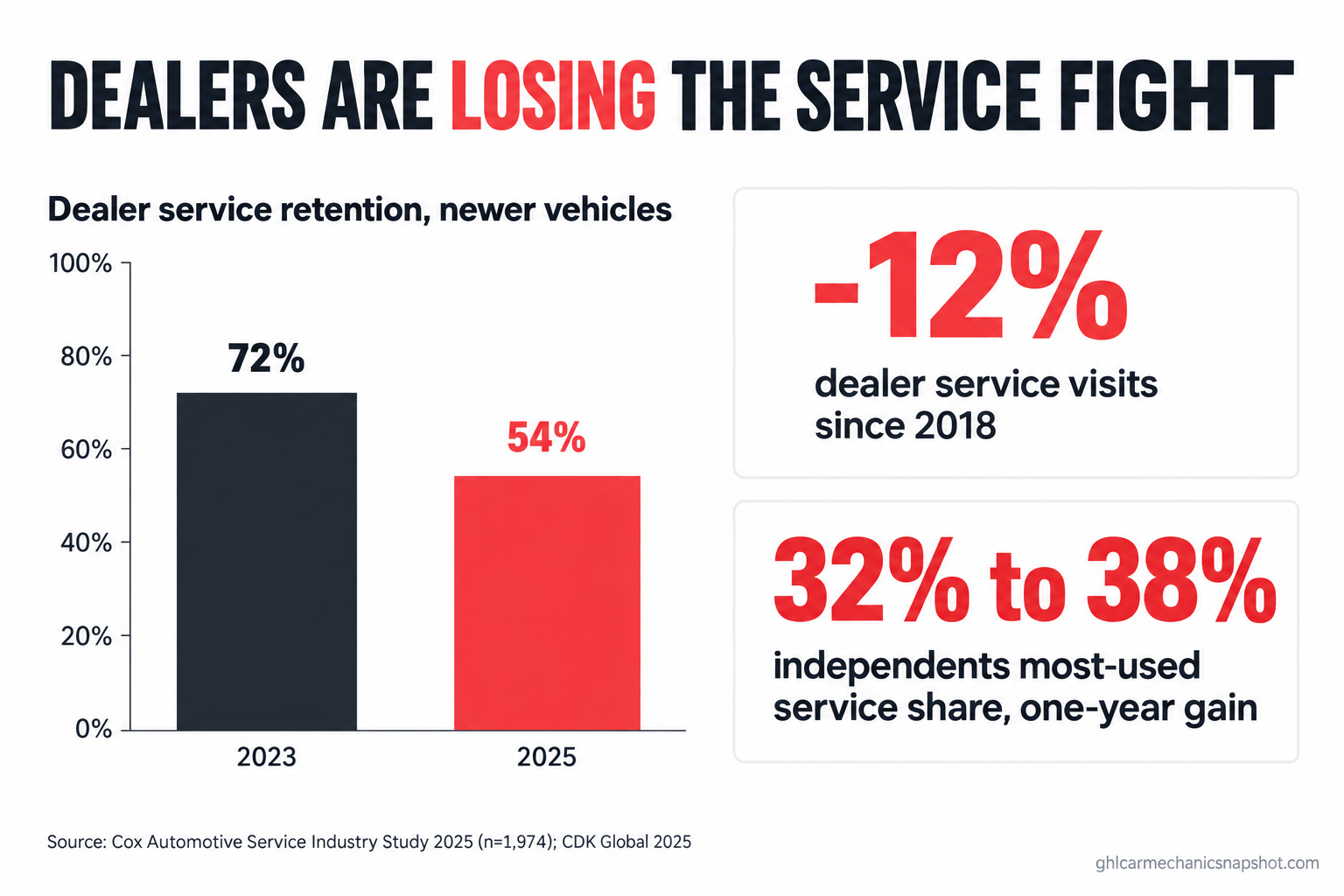
The numbers are stark. Dealer service retention on newer vehicles fell from 72% in 2023 to 54% in 2025, and dealerships now handle about 12% fewer service visits than in 2018, with that work moving to independents, quick lubes, and mobile mechanics, according to the Cox Automotive Service Industry Study of 1,974 owners. Nearly half, 45%, said they were dissatisfied with dealer service, citing unexpected costs and poor communication. A separate CDK Global study found the share naming an independent as their most-used provider climbed from 32% to 38% in one year, while dealers slipped from 47% to 42%.
So why did your guy still drift back? The dealer kept a record of his truck, knew his oil change was due, and sent a text that said so. You earn loyalty in the bay, then lose it in the ninety days of silence that follow, when the only business still talking to that customer is the one with the automated reminder. It is a handful of texts on a schedule, and you can run the same play.
What losing a repeat customer costs
Put a number on it. Keeping a customer you already have costs 5 to 25 times less than landing a new one, and cutting your defection rate by just 5% can raise profit 25% to 95%, per research summarized by Harvard Business Review (that work measured a 30% gain in an auto-service chain). A repeat customer needs no ad click and books higher-value work, because they already believe your diagnosis.
Now layer on the market. The average US vehicle is a record 12.8 years old, with about 289 million in operation, per S&P Global Mobility. Those older, out-of-warranty cars are yours. At a $132-an-hour national average labor rate ($85 to $197 by state, per the Tekmetric report), a customer who visits three times a year for a decade is tens of thousands of dollars in lifetime repair orders, lost to a text you could have sent.
The six parts of a retention system
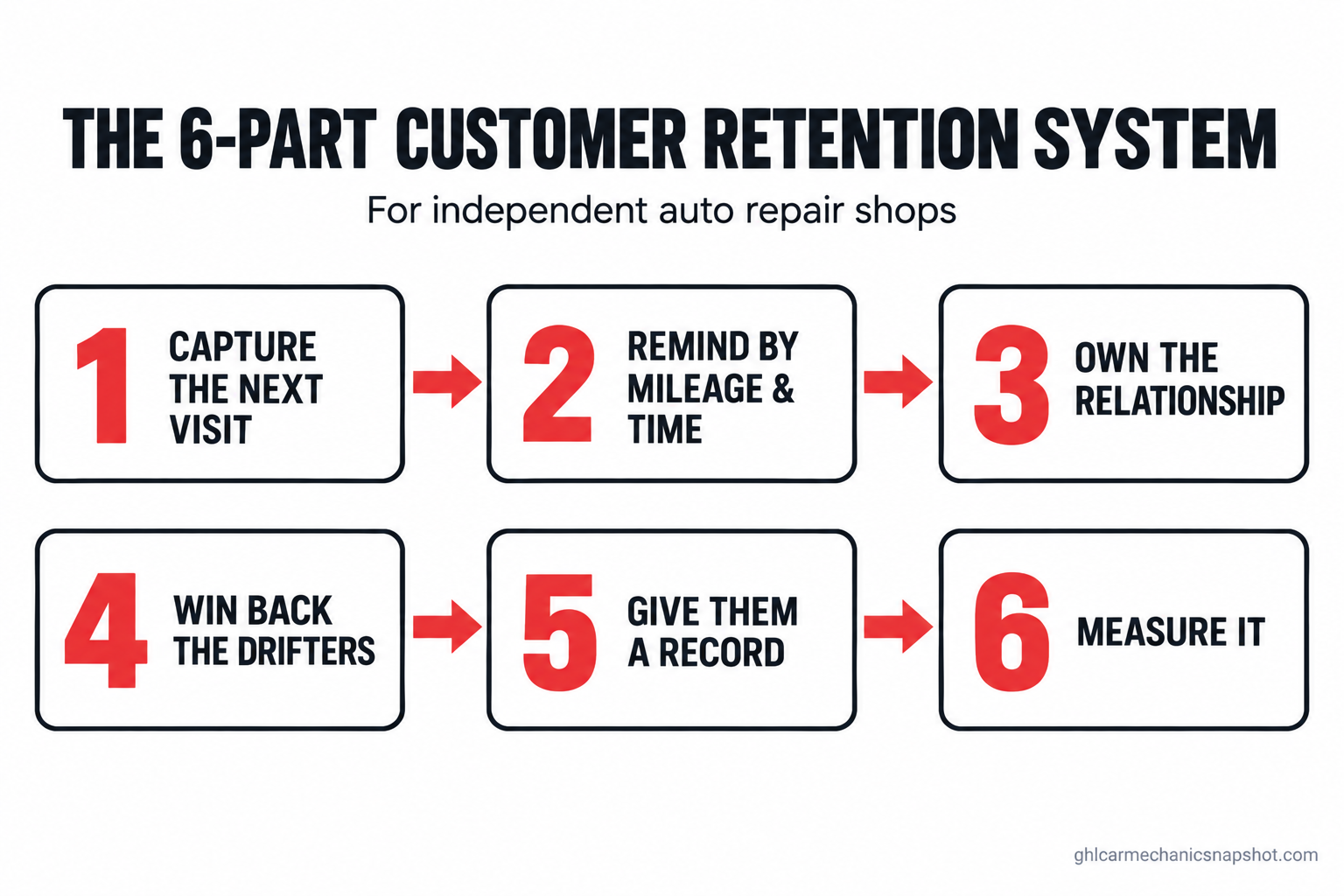
A retention system is not a loyalty punch card or a newsletter nobody opens. It is six connected parts, and it breaks at whichever one you never built: capture the next visit, remind by mileage and time, own the relationship, win back the drifters, give them a record, and measure it. Miss the capture and you have nothing to remind against; miss the win-back and you write off customers who were one text from home.
Part 1: capture the next visit
Retention starts at the counter on the day of service. Before the customer drives off, log two things against his name and vehicle: the work he declined today, and the date or mileage his next service is due. Miss this and every later part has nothing to run on.
The declined work is gold you already mined. Your tech flagged rear shocks at 62,000 miles and the customer passed. That is a scheduled follow-up with a known vehicle, a known problem, and a price you already quoted, so log the item, the mileage, the price, the date. Do the same for the next-due service, by mileage or date, while the car is still on the lift.
Part 2: the reminder that lands
When the next-due date arrives, the system sends one plain text about that specific car, not a coupon blast.
Steal this copy. The maintenance reminder: “Hi Dave, it’s Maria at Prospect Auto. Your F-150 is coming due for an oil change and tire rotation, probably in the next few weeks based on your mileage. Want me to grab you a slot?” The declined-work follow-up, six to eight weeks after he passed on something: “Hi Dave, back in March we flagged your rear shocks getting worn and quoted $340. With winter coming, want us to take another look? We can still honor that price.” Both are about his truck, not your sales target. Send the maintenance reminder a week or two before service is due, early enough to land before the dealer’s.
Part 3: own the relationship first
Here is where you take the customer back. The dealer’s advantage is not their tools, it is that they got their reminder in first. So get yours in first. A customer who hears from you two weeks before service is due has no reason to think about the dealer.
This is a cadence, not a single text. A new customer gets a thank-you the day after their first visit. A regular gets the maintenance reminder ahead of each due date, plus a seasonal nudge that is useful, not a discount: a pre-winter battery check, a pre-road-trip once-over. After a big transmission or engine job, a check-in a month later keeps you in the picture instead of handing the relationship to the dealer’s next notice. Three or four touches a year and you become the shop they think of first.
Building this by hand, remembering every due date and typing every message, is impossible past a few dozen cars. It is exactly the kind of thing we wire up to run on its own inside GoHighLevel.
Part 4: win back the drifters
You are not starting from zero. Pull your customer list and find everyone who has not been in for eight to twelve months but used to come regularly. That is a pile of people who liked your work and fell out of the habit while nobody reminded them. They are not loyal to the dealer, they are loyal to whoever texts them next.
The win-back message is honest and low-pressure. Steal this: “Hi Dave, it’s Maria at Prospect Auto. It’s been about a year since we saw your F-150 and I wanted to check in. If it’s due for anything, we’d love to get you back in. No pressure, just wanted you to know we’re still here.” No coupon, no guilt, just a door held open, and a portion of that list comes back because you were the one who reached out.
Part 5: give them a record
The dealer uses their service history to pull you back: “our records show you’re due.” You can do that better, because you actually know the car. Keep a clean digital record of every visit, every service, every photo of a worn part you replaced, tied to the customer and reachable in a text.
This turns reminders from generic to undeniable. “Your F-150 is due for an oil change, and we’ve got you down for the rear shocks we photographed last visit” is a shop that knows the truck better than any dealer service lane. Two out of three US drivers say they do not fully trust repair shops, per an AAA survey; showing your work is the fix, the same reason a photo-backed estimate closes more jobs.
Part 6: measure it
The last part keeps the other five honest. Three numbers, checked monthly, tell you everything.
Track your repeat rate, the share of this month’s customers who have been in before. Track visit frequency, how often your average customer returns in a year. And track win-back conversions, how many lapsed customers came back after a reminder. A low repeat rate means your reminders are not landing; low win-backs mean the lapsed list is going untouched.
Dealer service retention on newer vehicles fell from 72% to 54% between 2023 and 2025 as owners moved to independent shops, per the Cox Automotive Service Industry Study (2025, n=1,974).
The dealer versus your shop, honestly
Lay the two side by side and the picture is not what most shop owners fear. You are not losing on quality or price. You are losing on one column, the one you can fix this month.
| What matters to the customer | The dealer | Your independent shop |
|---|---|---|
| Quality of the work | Fine, often flat-rate churn | Usually better, you know the car |
| Price on out-of-warranty work | Higher on many jobs | Lower, and honest |
| Knowing the customer by name | Rarely, high staff turnover | Yes, that’s your whole edge |
| Systematic service reminders | Yes, automated and relentless | Usually none, this is the leak |
| Follow-up on declined work | Sometimes | Almost never, missed money |
| A record the customer can see | A database they can’t access | Photos and history you can text |
Five of six columns already lean your way. The one you are giving away, systematic reminders, is not a matter of budget. It is a decision to stop going silent.
Run it at your size
The six parts are the same everywhere. What changes is where your weak link sits.
Solo operator or two-person shop. You are the tech, the advisor, and the front desk, so the capture step is where you lose: too slammed to log the next-due date, so the reminder never fires. Fix capture first, then automate the reminders so you are not the bottleneck. Your highest-return move is the win-back list, because nobody else is chasing it.
Mid-size shop, three to eight techs. Your weak link is the handoff. Techs capture the next visit, but reminders sit because texting customers is nobody’s actual job. Make it a job, or make it automatic. You already pay for software that stores customer history, so check what your shop software already costs before buying another tool. The gap is almost never the software, it is that no one turned the reminders on.
Multi-bay or multi-location group. Your risk is inconsistency: one location runs win-backs religiously, another never does. Standardize the capture, cadence, and win-back timing, and watch the repeat rate by store. The low number is skipping part one, and that is your biggest opportunity.
Everything here is a scheduled message tied to a customer and a vehicle, which is what our CRM and workflow automations and appointment automation handle, so the reminders actually run without anyone at the counter remembering to.
The texting rule you can’t skip
The moment your reminders go out by text, you are under federal texting law. The good news: a reminder about a car the customer brought you, or a service they are due for, is a transactional message on a low consent standard, generally fine to send once you have their number and permission to use it.
The trap is bolting a promotion onto it. “Your F-150 is due for service, want a slot?” is transactional. Add “refer a friend for $20 off” and one promotional line reclassifies the whole message as marketing, which then needs stricter written consent and instant STOP handling. Get it wrong and the damages are $500 per text, up to $1,500 if a court finds it willful, under 47 U.S.C. 227. Delivery matters too: any business texting from a regular number must be registered under A2P 10DLC or carriers quietly filter the messages. Keep it about the vehicle, register the number, honor STOP, and the system runs safely. The full breakdown is in our guide on the service reminder text that stays legal.
Straight answers to the objections
“My customers know where I am. If they need me, they’ll call.” Some will. The rest drift to whoever reminds them first, and right now that is the dealer. Your best customer is not disloyal, he is busy, and the oil change he keeps meaning to book gets booked the day a text makes it easy.
“Won’t customers find the texts annoying?” Only if the texts are annoying. A monthly coupon blast is annoying. A message that says his specific truck needs the specific service it is due for is a favor, and people book off it.
“I already pay for Tekmetric or Shopmonkey. Do I need something else?” Maybe not, and not before you use what you have. Most shop management systems store customer history and can send reminders, and the gap is usually that nobody turned the feature on. If you are still comparing, our head-to-head on Tekmetric, Shopmonkey, AutoLeap and Shop-Ware covers where each one’s follow-up lives.
“The dealer has way more resources than me. How do I compete?” You already are, and winning. The dealer’s size is also their weakness: high turnover, nobody who knows the customer. The only thing they do better is the reminder, and that is solved the day you turn it on.
Frequently asked questions
Auto repair customer retention questions
Why do repair customers go back to the dealer?
Usually not because the dealer does better work or charges less, but because the dealer keeps a record of the vehicle and sends automated reminders when service is due. The independent does the job, the customer leaves, and the shop goes silent while the dealer keeps texting. Whoever reminds the customer first tends to get the visit, so build your own reminder system.
How much does it cost to lose a repeat auto repair customer?
Far more than one oil change. Keeping an existing customer costs 5 to 25 times less than acquiring a new one, and a 5% improvement in retention can lift profit 25% to 95%, per research summarized by Harvard Business Review. A regular who visits a few times a year for a decade is tens of thousands of dollars in lifetime repair orders.
Are dealerships really losing service customers to independent shops?
Yes. Dealer service retention on newer vehicles fell from 72% in 2023 to 54% in 2025, and dealers handle about 12% fewer service visits than in 2018, with that work moving to independents and quick lubes, per the Cox Automotive Service Industry Study of 1,974 owners. Independents win on price and trust, and lose only on systematic follow-up.
How do I win back a customer who hasn't been in for a year?
Pull your list, find regulars who have not visited in eight to twelve months, and send a low-pressure check-in that references their actual vehicle. No coupon, no guilt, just a note that it has been a while and you are still here. Most lapsed customers fell out of the habit, and a portion come back because you reached out first.
Is it legal to text customers service reminders?
Generally yes, when the reminder is about a vehicle the customer brought you or a service they are due for and you have their number with permission to use it. That is a transactional message on a low consent standard. Adding a promotional line can make the whole text marketing and trigger damages of $500 to $1,500 per message under the TCPA, so register your number under A2P 10DLC and keep reminders about the vehicle.
Back to that truck in the dealer bay
Run the opening scene again with the system in place. When Dave’s F-150 left in March, your advisor logged the next oil change for July and the rear shocks he passed on. In late June a text went out: his truck is due, want a slot, and we still have you down for those shocks at the price we quoted. He tapped yes from the driver’s seat. The truck came to you, not the dealer, because you were the one who remembered.
That is the whole system. The dealers are losing this fight, and the only thing they still do better than you is refuse to go quiet. Match that, and the truck stays in your bay. For the automations that ride on top of this, see the five automations every auto repair shop should run and how shops stop losing jobs to missed calls.