

It is the third week of January. The holiday rush is over and next week’s schedule has four jobs on it. Two bays sit cold. You already know every customer who should be in here: the Tahoe whose battery you flagged as weak in November, the regular who never came back for the alignment after that pothole. None of them are thinking about their car right now. You are. And nothing is reaching out to close that gap.
That quiet stretch is not bad luck. It is a calendar problem. Every shop has a rhythm: the dead weeks after the holidays, the lull before summer travel, the slow patch in early fall. Most owners ride it out hoping the phone wakes up. The shops that stay busy send the right message to the right customer at the right point in the year, every year.
This is that playbook, the actual texts. Season by season you get the work that is due, the message to send, when, and how it breaks. Steal the scripts word for word. They sound like you, not like a coupon, and they stay on the right side of the rules that can turn a friendly reminder into a $500 problem.
What’s on this page
- Why the slow season is a calendar problem
- What an empty bay costs you
- How the playbook works
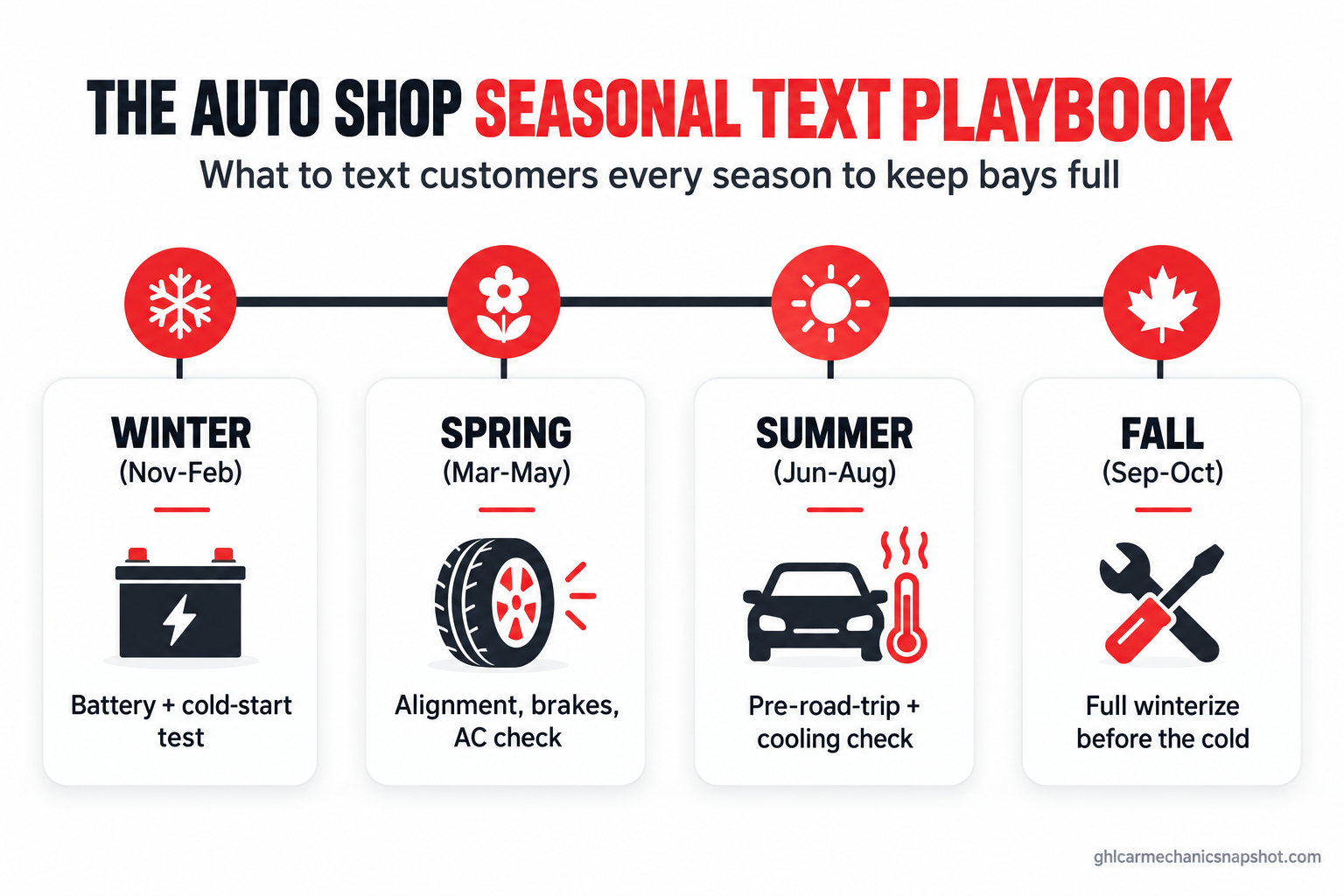
- Winter: cold-start and battery
- Spring: the post-winter reset
- Summer: road-trip and heat
- Fall: winterize before it hits
- Run it at your shop’s size
- The rule that keeps texts legal
- Objections
- FAQ
Why the slow season is really a calendar problem
Your customers do not forget you because they are disloyal. They forget because nobody keeps a car’s maintenance schedule in their head except the person who fixes cars for a living. The driver does not know the coolant should be flushed before the first hard freeze, or that a three-year-old battery is on borrowed time once it drops below freezing. The car gets ignored until it strands them, and by then they go wherever can see them today.
Weather does the selling if you let it. Cold kills weak batteries. Heat cooks cooling systems. Spring potholes wreck alignment. Long summer drives expose every soft spot. Your customers do not know this until something reminds them. And the demand is not shrinking: the average vehicle on U.S. roads is now 12.8 years old, per S&P Global Mobility, and older cars need steadier maintenance, not less. The only question in the slow weeks is whether the car comes to you or to the shop that texted first, the same drift that sends your best customers back to the dealer.
What an empty bay in the slow weeks costs you
Put a number on the cold bay. The national average auto repair labor rate hit $132 an hour in 2026, ranging from about $85 to $197 by state, per the Tekmetric labor rate report. A single open day is two or three billable jobs you did not do, and a slow stretch of three or four weeks is a five-figure hole that never shows up as a lost sale, because the job was never booked. Recover one or two of those jobs a day and you have covered payroll during the stretch that usually scares you.
The shape of a slow week, with and without a seasonal touch:
Illustrative slow-week capacity for a 3-bay shop; a seasonal message pulls forward work customers already need. Labor benchmark: Tekmetric 2026 state labor rate report.
How the seasonal playbook works
Three rules make the scripts work.
Layer the season on top of the car. A seasonal message is a filter, not a blast. Start with the customers whose own history says the service is due, then add the seasonal reason on top. “Your Civic is coming up on its interval and the first freeze is almost here” beats a blanket “WINTER SPECIAL.” The season is the hook. The car is the reason.
Send from a real person. Sign every message with a name and the shop name. “It’s Renata at Eastside Auto” gets a reply. An unsigned promo from a short code gets deleted.
Make saying yes one step. End every text with a simple ask and a one-tap way to book. If they have to call during business hours, half of them never will. That is why two-way texting beats a missed call.
Winter: the cold-start and battery season
Cold is the hardest season on a car and the easiest sell you have, because the failures are dramatic. A battery that was fine in October dies on the first morning below freezing, so you only have to reach the customer before it happens.
The numbers match the drama. A battery loses about 35% of its capacity once the temperature hits 32 degrees, and a cold engine needs up to 50% more power to crank over, per AAA. The one that was marginal in October is the one that strands somebody in January, and the customer who would have paid $30 for a test instead pays for a tow.
Send it a week or two before the first hard freeze, to anyone with a battery older than about three years or declined cold-weather work from last year.
How it breaks. The number one mistake is sending the text after the cold already hit. Once the car will not start, your customer is calling a tow truck, not reading a text, so send it while the weather is still mild and the message is a favor. The other miss is forgetting the people who declined work in the fall. That “I’ll wait on the battery” from October is your warmest winter lead.
Spring: the post-winter reset
Spring is quieter, so you have to be smarter, because the damage is less obvious. Potholes knock the alignment out and tear up suspension and tires, road salt eats at brake components, and the AC has sat unused for months until the first hot day, when every shop in town is suddenly backed up. The spring play is to get ahead of the rush on both fronts, and because spring stress is subtle, lean on each car’s own history. A proper service-reminder system that tracks mileage and declined work does most of the targeting for you.
Send it early to mid spring, before the first hot days, to anyone due for rotation or alignment, with declined suspension or brake work, or who has not had the AC looked at in over a year.
How it breaks. Spring texts fall flat when they are vague. “Spring maintenance special” means nothing to a driver whose car seems fine. Name the real winter damage, the potholes, the salt, the idle AC, so the customer connects it to something they felt. And send the AC text before the heat, or you are fighting every shop for the same backordered compressor while your customer sweats.
Summer: the road-trip and heat season
Summer gives you two angles, and most shops use only one. The obvious one is the road trip, the family who wants peace of mind before a long drive. The one shops miss is heat damage, because summer is prime season for cooking batteries and cooling-system failures. The summer play pairs the pre-trip inspection with a cooling-and-battery check.
Breaking down on a long drive is not rare. AAA responded to more than 30 million roadside service calls in 2025, with battery failures, flat tires, and jump-starts among the most common, per AAA. And heat is quietly brutal: summer temperatures can cut a battery’s typical three-to-five-year life to as little as two years, which is why the car that started fine all winter will not turn over in August.
Send it ahead of the big summer travel weekends and through the first heat waves, to anyone with an older battery or a coolant service overdue.
How it breaks. The road-trip text works only if it goes out before people leave, so lead the big travel weekends by a week or two. The second failure is leaning only on the trip angle, which leaves the non-traveler whose battery is cooking with no reason to come in. Run both angles.
Fall: the winterize-before-it-hits season
Fall is the most valuable season here and the one most shops sleep through. It is the setup for winter, so every emergency you prevent in October is a planned job now instead of a frantic tow in January. The fall play is the full once-over, battery, fluids, heater, and tires, framed as getting ready for the holidays and the cold.
The travel volume makes the case. AAA projected a record 81.8 million Americans traveling for Thanksgiving 2025, at least 73 million by car, per the AAA Thanksgiving travel forecast. That is a wave of long, cold-weather drives on cars nobody has looked at since summer, and those drivers would rather find the problem in your bay than on the shoulder.
Send it early to mid fall, well ahead of the first freeze and the holiday rush, filtered to cars due for service, aging batteries, and anyone who declined work over the summer.
How it breaks. Shops that skip fall do winter work as emergencies instead of appointments, losing both margin and goodwill. The other mistake is sending it too late. Fall outreach has to go out while it is still mild, in September and early October, not the week of the first freeze.
Run it at your shop’s size
The same four scripts work at any size. What changes is how much the system does for you.
Solo or one or two bays. Keep it dead simple. Pick the single biggest seasonal play for your climate, battery before winter up north, cooling and AC before summer down south, and send one focused text to a filtered list of 40 to 80 customers each season. Even from your phone on a slow afternoon, that beats sending nothing. The goal here is consistency, four sends a year.
Mid-size, three to five bays with a service writer. Now you can run the full calendar and layer it on each car’s history, with your service writer owning the sends off a saved list per season. This is where a real reminder system earns its keep, because doing it by hand four times a year across a few hundred customers is a part-time job nobody at the counter has. Tie it to the data that drives your everyday service reminders and no-show follow-ups.
Larger or multi-location. At this size the playbook has to be automated or it does not happen. Triggers fire off each customer’s vehicle data and the season, the filter pulls the right list, and booking is one tap. A human spot-checks and handles the real conversations.
Whatever your size, this sits on top of your everyday capture. It does no good to text a hundred customers if your phone keeps going to voicemail when they call back, so fix the catch first.
The one rule that keeps seasonal texts legal
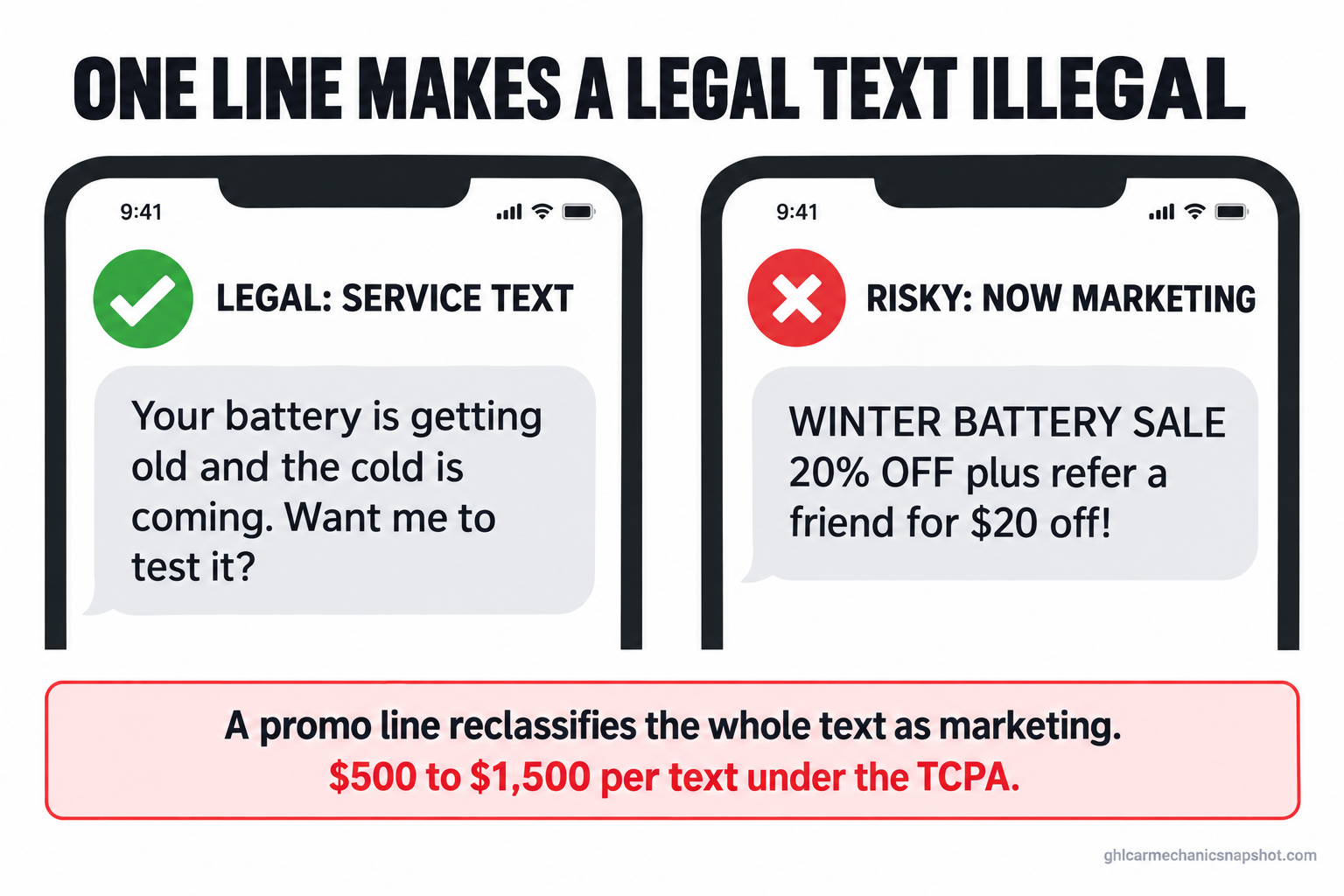
A genuine service message, a reminder about a car the customer brought you, sits on safer footing under texting law. The moment you add a promotional line, a discount, a “refer a friend for $20 off,” the whole message can reclassify as marketing, which needs stricter prior express written consent and instant opt-out handling. If you did not have that consent, every text is a violation.
The damages are not theoretical. Under the federal Telephone Consumer Protection Act, a non-compliant text runs $500 per message, and a court may award up to $1,500 if it finds the violation willful. Blast a seasonal “coupon” to a thousand customers without the right consent and the number ends shops. The full trap is covered in why your service reminder text is legal but your promo line is not.
The playbook above is built to stay clean. None of the scripts contain a discount or a referral ask, which keeps them transactional. You also need to be registered for A2P 10DLC to text from a business number, and every message must honor STOP immediately.
Straight answers to the objections
“Won’t customers find a seasonal text annoying?” Not if it is about their car. Four well-timed messages a year, each pointing at real work the car needs, is a service, not spam. What annoys people is a coupon blast with no connection to them, and the ones who do not want it reply STOP.
“I already pay for Tekmetric or Shopmonkey. Don’t they do this?” Use whatever reminder feature you have. The gap is almost never the sending tool, it is the seasonal strategy and the copy. Your software sends a blank reminder on a schedule; it will not tell you to hit batteries before the freeze or filter the fall send by who declined work in summer. That part is this playbook.
“I’m not a computer person. This sounds like a lot.” At the solo level it is four texts a year, which you can do from your phone. Above that, a built system sets up the triggers and lists once and the sends happen on their own. You approve a list and answer the replies.
“My slow season is just how it is.” An empty bay is not the same as no work existing. The work is sitting in your customers’ driveways as a weak battery, a thin brake pad, an alignment knocked out by a pothole. The slow season is just the stretch where nobody reminds them it is due. Remind them at the right time, and the bay fills with jobs that were there the whole time.
Frequently asked questions
Auto shop seasonal texting questions
What should an auto repair shop text customers each season?
Tie it to the work the season stresses. Winter: battery test, coolant, heater, before the first hard freeze. Spring: alignment and suspension after pothole season, brakes, and an AC check before the heat. Summer: a pre-road-trip inspection with a cooling and battery check. Fall: a full winterize once-over ahead of the cold and holiday travel. Always filter to customers whose history says the work is due.
When should I send seasonal service texts?
Ahead of the weather, never during it. Winter battery text before the first hard freeze, AC text before the first hot week, road-trip text before major summer travel weekends, and fall winterize text in September or early October. A text is a favor before the problem and useless once the customer is stranded.
Is it legal to text customers seasonal reminders?
A genuine reminder about a car the customer brought you is generally treated as a transactional service message. Adding a promotional line, a discount or refer-a-friend offer, can reclassify the whole text as marketing that needs stricter written consent and STOP handling. Damages run $500 to $1,500 per text under the federal TCPA. Keep it about the car, register for A2P 10DLC, and honor STOP. This is general information, not legal advice.
How many times a year should I text my customers?
About four seasonal sends a year, each filtered to customers for whom the work is due, on top of everyday reminders tied to mileage. What annoys people is not four relevant messages, it is a steady drip of generic blasts.
How is a seasonal text different from a regular service reminder?
A regular reminder fires off one car's own timeline: mileage, last service, declined work. A seasonal text adds the weather as a second layer, the first freeze, the summer heat, holiday travel, as the reason to reach out now. The best sends combine both: the car is due AND the season makes it urgent.