

It is 7:50 on a Tuesday and a regular calls before the coffee is even going. “My registration’s coming up. Is my inspection due this year?” If you run a shop in Texas, the honest answer changed on January 1, 2025, and a lot of owners are still answering it wrong. In New York or Virginia, that call is a guaranteed visit you can bank on. In Florida, that call never comes, because there is nothing to inspect.
Same question, three completely different businesses. The inspection and emissions rules in your state quietly decide how much guaranteed traffic walks through your door, what you can legally put in an ad, and whether the hook that works two states over is a waste of your money. Most owners never map it, so they copy a competitor’s “we handle your state inspection” headline or keep running it a year after the law killed the requirement. This is the 2026 map.
What’s on this page
- Why the rules in your state are a marketing decision
- The three regimes every shop falls into
- Safety inspection, state by state in 2026
- Emissions testing, and where the retest hook works
- What Texas shops lost, and what to run instead
- California: the strictest emissions state
- The five ways shops get this wrong
- Steal these reminder scripts
- Run it at your size
- Straight answers to the objections
- FAQ
Why the rules in your state are a marketing decision
A state inspection or emissions requirement is a calendar the government forces onto every car owner in your area. When a car must pass a test every year to stay registered, that driver has to visit somebody, and if you are the shop that reminds them, books them online, and has the bay ready, you capture the visit. When the state requires nothing, that calendar disappears and you have to manufacture the reason to come in yourself.
Money rides on this. The national average auto repair labor rate hit $132 an hour in 2026, running from about $100 in West Virginia to $161 in Alaska, per Tekmetric’s 2026 state labor rate report. An inspection or emissions visit is rarely just the test fee. It is the door opener for the tire, the wiper, and the brake job the tech spots while the car is up.
The three regimes every shop falls into
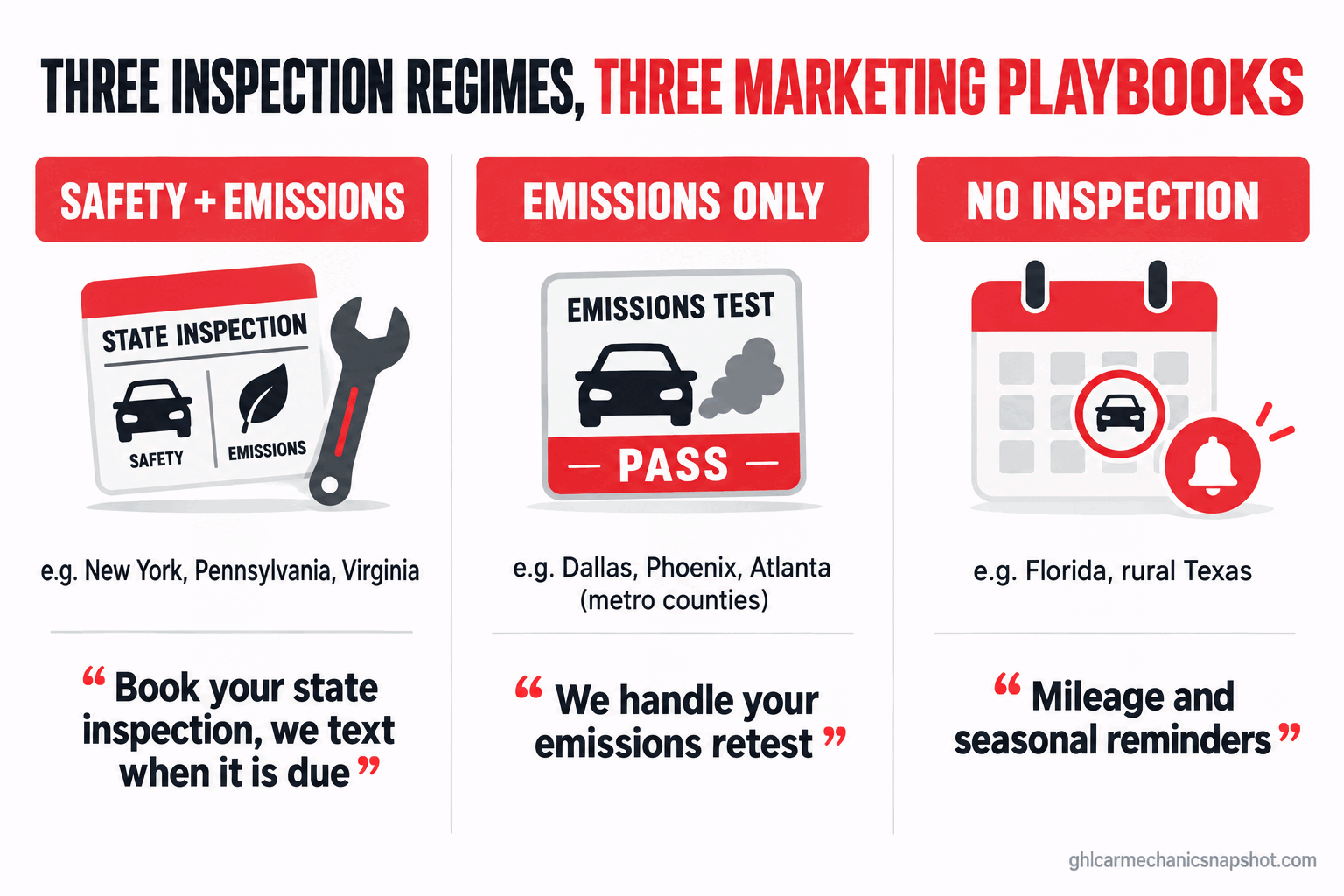
Every shop sits in one of three buckets, and the bucket decides which hook you are allowed to use.
Regime one: safety plus emissions. States like New York, Pennsylvania, and Virginia require a periodic safety inspection, most with emissions on top in the metro areas. Your customers are legally required to come in on a clock, so the hook writes itself: “We handle your state inspection, book online, we text you when yours is due.”
Regime two: emissions only. Big chunks of Texas, Arizona, and Georgia dropped or never had a safety inspection but still run emissions testing, almost always limited to metro counties. The “we handle your emissions retest” line is gold, but only for customers in a covered county. Run it to a rural customer 40 miles out and you advertise a test they do not need.
Regime three: no inspection at all. Florida, most of Texas now, and the rural counties of nearly every state require nothing for a normal private car. With no government calendar to ride, a shop that builds its whole lead flow on inspection traffic is building on sand. The play is maintenance reminders on mileage and time, seasonal campaigns, and follow-up on declined work.
Safety inspection, state by state in 2026
The list is shorter than most people think.
| Requirement | States (private passenger vehicles) |
|---|---|
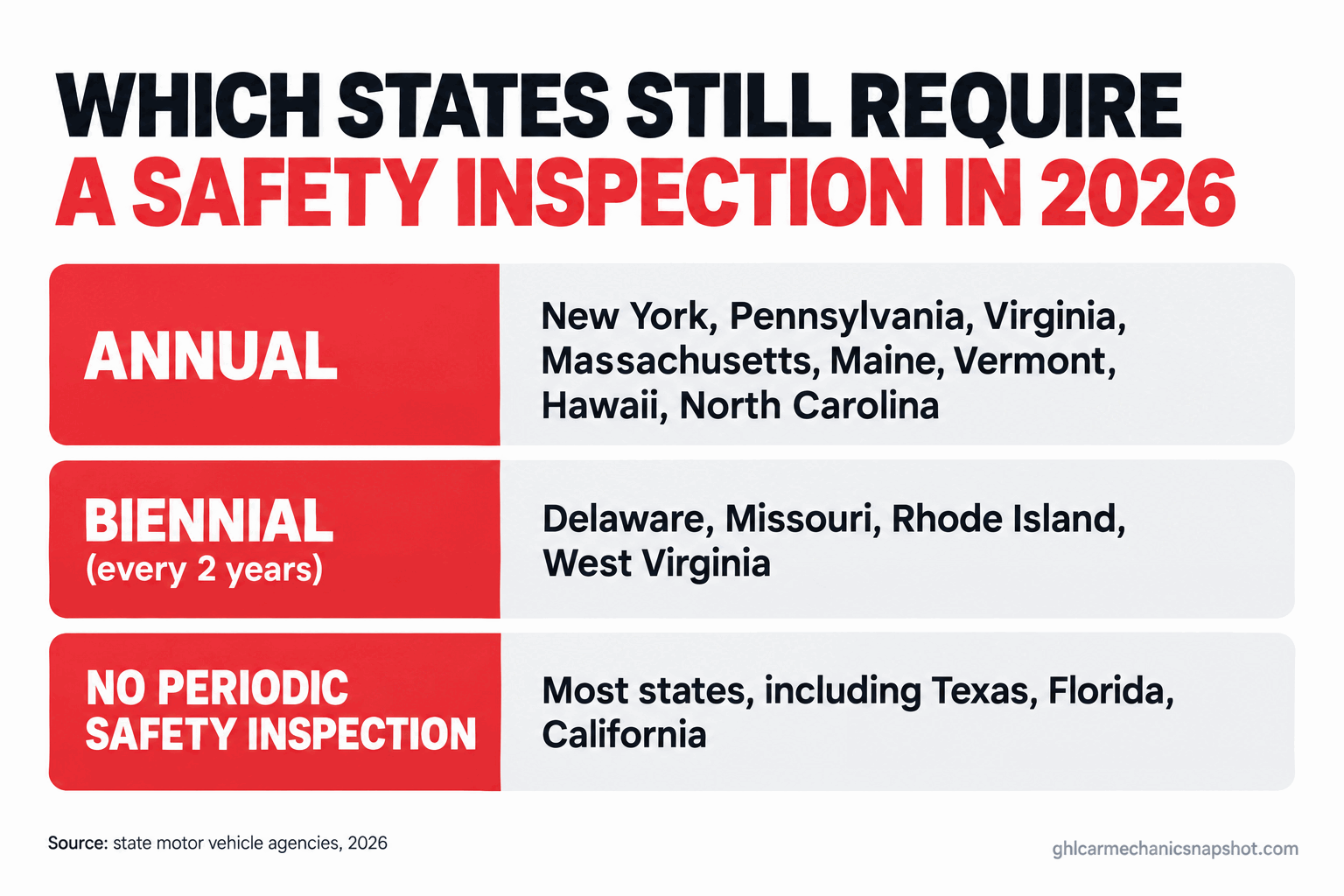
| Annual safety inspection | Hawaii, Maine, Massachusetts, New York, North Carolina, Pennsylvania, Vermont, Virginia |
| Biennial (every two years) | Delaware, Missouri, Rhode Island, West Virginia |
| No periodic safety inspection for most private cars | Everywhere else, including Texas, Florida, California, and D.C. |
That is eight annual states and four biennial ones, with the other 39 jurisdictions requiring no periodic safety check, per the rundown at Wikipedia’s vehicle inspection in the United States and each state’s own agency. West Virginia moved from annual to biennial on January 1, 2024, so a shop there sending yearly reminders is now nudging half its customers a year too early.
U.S. jurisdictions (50 states plus D.C.) by periodic safety inspection requirement for private passenger vehicles in 2026: 8 require an annual inspection, 4 require one every two years, and 39 require none, counted from the state lists at the source above.
The practical read: safety inspection traffic is bankable in about a dozen states and nonexistent in the rest. Anywhere else, do not build your plan around a requirement your customers do not have.
Emissions testing, and where the retest hook works
Emissions, or smog, testing is the larger program and the one with the sharper angle, because a car that fails has to get fixed and retested to stay on the road. Around 30 states run a program somewhere, but almost all limit it to the metro counties that fall under the federal Clean Air Act, as the EPA’s inspection and maintenance program guidance lays out. That county line is the whole game. In a covered county, “failed your emissions test? we will fix it and get you retested” is one of the highest-intent messages you can send. Outside those counties, the same message is noise.
Coverage is usually narrow: Arizona tests only in the Phoenix and Tucson metros, Georgia in the 13 counties around Atlanta, Pennsylvania in 25 of its 67 counties on top of its statewide safety inspection. A shop that knows which customers live in a testing county, and texts only them, runs a tight campaign. Your state agency publishes the covered-county list, and it is worth an hour to pin down before you spend on a retest offer.
What Texas shops lost, and what to run instead
Texas is the clearest case of a rule change rewriting the playbook overnight. On January 1, 2025, House Bill 3297 ended the mandatory annual safety inspection for most non-commercial vehicles. Drivers now pay a $7.50 inspection program replacement fee at registration instead, per the Texas DPS vehicle inspection updates. Commercial vehicles still need one, but the private car that used to be a guaranteed yearly visit is gone.
Emissions testing did not go away. It still runs in 17 counties: Brazoria, Collin, Dallas, Denton, Ellis, El Paso, Fort Bend, Galveston, Harris, Johnson, Kaufman, Montgomery, Parker, Rockwall, Tarrant, Travis, and Williamson, per Fox 7 Austin’s rundown of the counties that still test. Bexar County (San Antonio) joined on November 1, 2026 at $18.50, bringing the list to 18.
So a Texas shop’s play depends on where it sits. In Dallas, Fort Worth, Houston, Austin, El Paso, or now San Antonio, the emissions retest hook still works. In a rural county with no emissions program, the inspection hook is dead, and a shop still running “get your Texas inspection here” ads in 2026 is promoting a service the state abolished.
If you are in that second group, the shift is from a government calendar to one you build yourself: mileage reminders, seasonal campaigns before the summer heat and the first cold snap, and follow-up on declined work. Our seasonal text playbook and declined-work follow-up system are built for exactly this.
California: the strictest emissions state
California does not require a periodic safety inspection, but its Smog Check program is the most demanding emissions regime in the country, running in parts of 41 of the state’s 58 counties, per the California Smog Check Program overview and the state’s Bureau of Automotive Repair. Smog is the recurring-visit anchor, and three rules shape the marketing:
- Biennial testing. Most gasoline and hybrid vehicles get checked every two years, so your cadence is a two-year clock.
- The 8-year rule. Gasoline and hybrid vehicles eight model years old or newer are exempt and pay an annual smog abatement fee instead, so a chunk of newer cars are not due.
- EVs are exempt from Smog Check entirely, so an electric customer is never a smog lead.
Your smog reminder list is not your whole customer list. It is gasoline and hybrid vehicles older than eight model years, in a covered county, due this cycle. Get the targeting right and the biennial visit becomes a predictable anchor. Get it wrong and you are texting EV owners about a test they will never take.
The five ways shops get this wrong
Almost nobody gets in trouble for the test itself. They lose money on the marketing around it, usually one of these five ways.
1. Advertising a requirement your state killed. The Texas shops still running “state inspection here” headlines in 2026 are the clearest case. Audit your ads against the current rule, not the rule you grew up with.
2. Running the retest hook outside the covered counties. Emissions is almost always county-limited. Blast a retest reminder to your whole list and most of it lands on people with no test, who learn your texts are not worth reading.
3. Reminding on the wrong clock. Annual and biennial states are a year apart, so a biennial-state shop sending yearly reminders nudges people a full year early and reads as a shop that does not know its own rules.
4. Building the whole lead flow on inspection traffic. In a no-inspection area there is no government calendar. A shop with no mileage reminders, no seasonal campaigns, and no declined-work follow-up, just waiting for inspection season, has no plan at all.
5. Letting the mandatory visit end at the test. The biggest waste is treating the visit as a $20 transaction instead of the best upsell moment all year. The car is up and the customer trusts you to look, so flag the next service, book the follow-up, and ask for the review.
Steal these reminder scripts
Here is the copy, by regime. Keep every one about the vehicle, because a promotional line reclassifies the whole message as marketing under federal text rules. More in our auto shop text compliance guide.
Inspection-due reminder (annual safety-inspection state):
Hi [Name], [Shop] here. Your [Year Make] state inspection is due by [Month], and we can knock it out in about 30 minutes. Book here: [link]. Reply STOP to opt out.
Emissions retest offer (covered county, after a fail):
Hi [Name], [Shop] here. Your [Vehicle] did not pass emissions. We can diagnose the fault and get you retested so you renew on time. Book here: [link]. Reply STOP to opt out.
Biennial smog reminder (California, targeted to due vehicles only):
Hi [Name], [Shop] here. Your [Vehicle] is due for its California Smog Check this cycle. We are a licensed station and can test and renew in one visit. Grab a slot: [link]. Reply STOP to opt out.
No-inspection-area maintenance reminder (Florida, rural Texas):
Hi [Name], [Shop] here. Your [Vehicle] is about due for its [mileage]-mile service. Want us to check it before the [season] driving starts? Book here: [link]. Reply STOP to opt out.
Every message carries the vehicle, the requirement, a booking link, and a way to opt out. No coupon, no promo. Run real promotions as their own consented marketing messages. For the cadence and retention side, see our guides on service reminders that do not annoy regulars and more Google reviews on autopilot.
Run it at your size
Solo operator or two bays. You have no service writer with time to track due dates by hand, so this is the piece to automate first. Pick the one anchor your state gives you (annual inspection, biennial smog, or a mileage reminder if neither) and set a single sequence against it. Tag each customer with their county so you never text a retest offer outside the covered area.
Four to six bays with a front desk. Now you can segment. Split your list by regime and county, run the inspection or emissions anchor as its own sequence, and layer maintenance and seasonal reminders on top for the customers the government does not schedule for you. The front desk stops chasing due dates and starts selling the work the tech flagged.
Seven-plus bays or multi-location. If you run shops in more than one county or state, you straddle regimes, and a one-size flow is wrong for part of your base. A Dallas location can run the emissions retest hook; a shop in a rural county 90 minutes away cannot. Build the automation per location, keyed to that site’s rule and county, and set your door rate using our state labor rate guide.
Straight answers to the objections
“My state still requires inspection, so I get that traffic no matter what. Why automate the reminder?” Because the customer chooses which shop does it, and the one that reminds them first usually wins the visit and the upsell. A required inspection guarantees they go somewhere, not that they come to you. The reminder, the booking link, and the open bay turn a legal requirement into your repair order.
“Texas killed inspection, so I just lost that revenue. Is it over?” The guaranteed visit is gone, but the cars did not stop needing maintenance. The shops that are fine after HB 3297 replaced the government’s calendar with their own: mileage reminders, seasonal work, and declined-work follow-up. If you are in an emissions county you still have that hook too.
“I am in Florida with no inspection at all. Does any of this apply to me?” Most of it, flipped. You never had the government calendar, so the no-inspection playbook is your core strategy, not a backup. Mileage reminders, seasonal campaigns, and follow-up on deferred work are how a Florida shop fills bays, and they work just as well in the parts of Texas that lost theirs.
“Won’t customers find an automated reminder text annoying?” Not when it is about their car and their deadline and easy to opt out of. People do not resent a text that saves them from a missed inspection or a failed registration. They resent promos they did not ask for, which is the exact line the law draws. A service reminder is transactional, but mix in a discount and the whole message becomes marketing under the Telephone Consumer Protection Act, which needs prior express written consent. Statutory damages run $500 per text, up to $1,500 if willful, under the federal TCPA statute at 47 U.S.C. 227.
State inspection and emissions marketing questions
Does Texas still require a vehicle inspection in 2026?
Not a safety inspection for most private cars. House Bill 3297 ended the mandatory annual safety inspection for non-commercial vehicles on January 1, 2025, and drivers pay a $7.50 inspection program replacement fee at registration instead. Emissions testing still applies in 17 counties, with Bexar County (San Antonio) added November 1, 2026 for 18 total. Commercial vehicles still need a passing safety inspection.
Which states still require a periodic safety inspection?
About a dozen as of 2026. Annual states include New York, Pennsylvania, Virginia, Massachusetts, Maine, Vermont, Hawaii, and North Carolina. Delaware, Missouri, Rhode Island, and West Virginia run a two-year cycle, with West Virginia having moved from annual to biennial in 2024. Most other states, including Texas, Florida, and California, require none for a normal private car.
Can my shop advertise 'we handle your emissions retest' anywhere in my state?
Only where emissions testing actually applies, usually a set of metro and suburban counties, not the whole state. Run it to customers outside a covered county and you are promoting a test they do not need and training them to ignore your texts. Pull your state's covered-county list, tag customers by county, and send the offer only to those legally required to test.
How often should I send inspection or emissions reminders?
Match the cadence to your state's cycle. Annual states get a yearly reminder timed to the registration or sticker month. Biennial states, including California Smog Check and West Virginia safety inspection, get one every two years. No-inspection areas have no government cycle, so you remind on mileage and time. A yearly reminder in a biennial state nudges half your customers a year too early.
Is it legal to text customers these inspection reminders?
Yes, when the message stays transactional: the vehicle, the requirement or service, a booking link, and an opt-out. Trouble starts when you add a promotional line like a discount, which reclassifies the whole text as marketing under the TCPA and requires prior express written consent. Keep reminders clean and run promotions separately. Statutory TCPA damages run $500 per text and up to $1,500 if willful.
Back to that 7:50 call
Run the Tuesday call again with the map in hand. In Virginia, your system texted him two weeks ago, he already booked online, and the call is just him confirming, with a cabin filter and two tires flagged. In a Dallas suburb, you know his car is due for emissions because you tagged his county, so you book him before he calls a competitor. In rural Texas or Florida there is no inspection to be due, but your mileage reminder already told him his brakes are near the wear line. Three states, three answers, one system that knows which one you are in. Stop copying a hook built for somebody else’s rules, and build your reminders around the calendar your state gives you, or the one you build yourself.