

It is 5:50 on a Friday. The last car is off the lift, the techs have gone home, and you are at the counter wondering where the money went. The bays were full. You turned work away on Tuesday and stayed late twice. And the account is still tight, tight enough that you are doing the math on whether payroll clears before the card deposit lands.
Here is the short version, because you have heard enough people say “raise your rates.” Busy and broke is almost never a labor-rate problem. A shop that is full all week and still short is usually leaking money in six specific spots between the moment a customer first tries to reach you and the moment their payment hits your account. None of them show up on a repair order. Below is each leak, what it costs, and how to close it, with the messages you can copy.
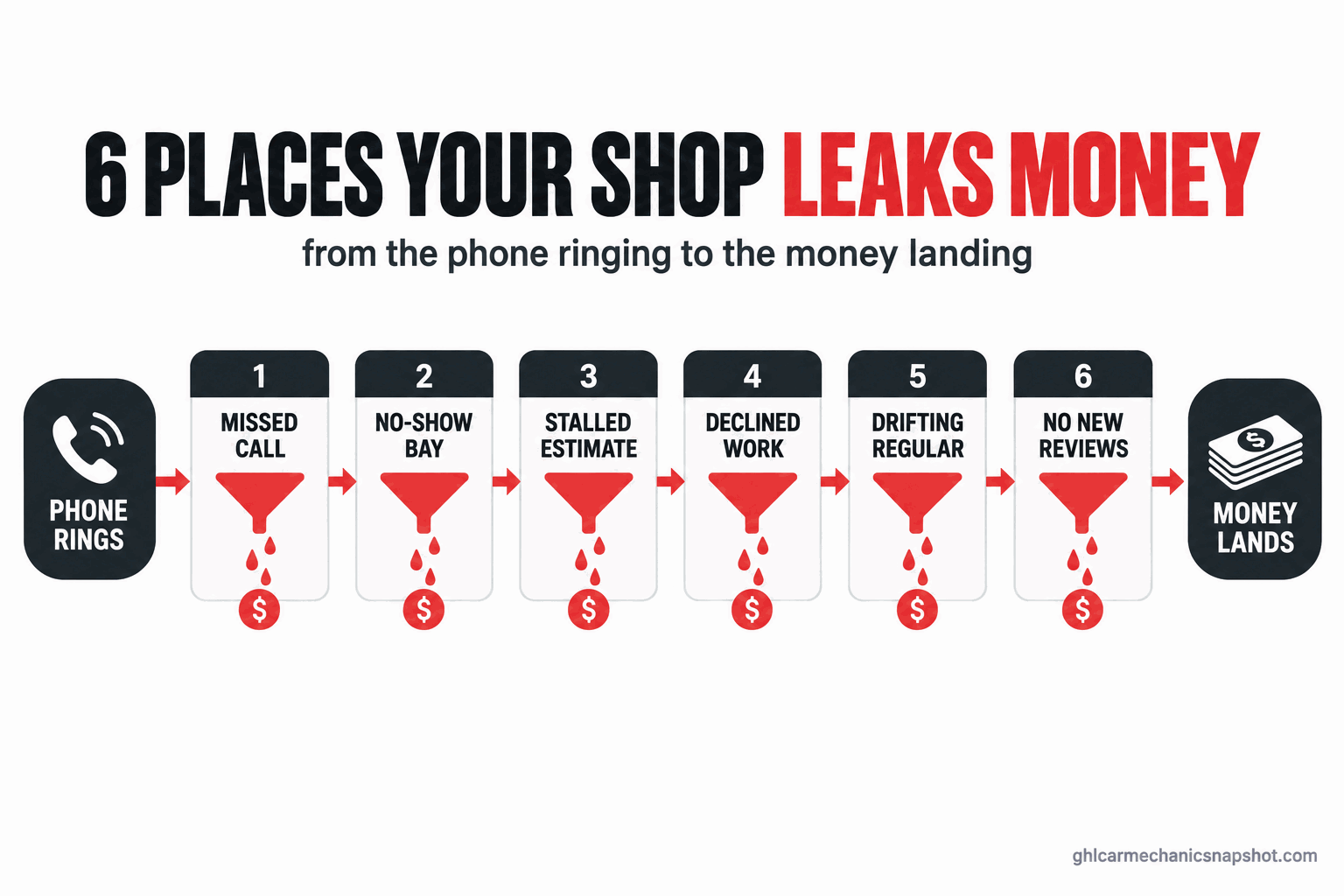
What’s on this page
- Why a full shop can still run short
- Leak 1: the call nobody answered
- Leak 2: the bay that sat empty
- Leak 3: the estimate that aged out
- Leak 4: the repair they said no to
- Leak 5: the regular who drifted
- Leak 6: the customer who never found you
- Steal these: the six messages
- Fix it at your size
- The compliance line
- Objections
- FAQ
Why a full shop can still run short
Start with the one number that reframes everything. The national average repair order is about $704, per the Tekmetric Shop Index of more than 10,000 North American shops. So every leak here is not “a missed phone call” or “a no-show.” It is a $700 event, give or take. That is the unit you are losing in.
Now the trap. When you are flat out, every leak is invisible, because you never see the car. You do not notice the caller who got voicemail and dialed the shop down the road, or the estimate that aged out while you were buried in a transmission. You feel the result, a tight Friday, but blame the thing you can see: the rate, the parts margin, the slow tech. They are not why a busy shop is broke.
The good news: you already did the hard part. You earned the call, you have the bays, the customers want the work. The money is not off in a new ad campaign or a higher door rate. It is in your parking lot, leaking out in six predictable spots. Let’s walk the path and find each hole.
Leak 1: the call nobody answered
A customer with a problem calls. You are under a car, or at the counter, or it is 7:40am and you are not open, so the phone rings out. They do not leave a voicemail. They call the next shop on the list, and you never knew they existed.
Analytics firm Marchex, which listens to real calls into auto service operators, found as many as 21% of those calls go unanswered, dropped, or mishandled, per this write-up. During your rush the real rate is higher. Put a dollar on it: miss four first-time callers in a week at a $700 ticket, and roughly $2,800 walked. Over a year that is more than $100,000 of jobs you never knew you lost. Illustrative, but the inputs are real.
The fix is the cheapest one here: an automatic text back the instant a call goes unanswered, so the caller’s phone buzzes from your number before they pull up the next shop. The lead is caught, and you answer it when your hands are free. See how shops lose jobs to missed calls and answered calls that still never book.
How it breaks: texting from a landline (it has to be a textable number), and sending the auto-text with no STOP option.
Leak 2: the bay that sat empty at 9am
You booked the 9am and planned the morning around it. At 9:15 the bay is empty and the customer is not answering. You cannot fill a 9am job at 9:20, so the slot is lost: a tech on your clock and a repair order that will not get written.
No-shows run around 15% to 20% of booked appointments by most benchmarks, and the fix is a confirmation, not nagging. The strongest evidence is from medicine: a Cochrane systematic review of controlled trials found text reminders meaningfully improve show rates. The mechanism is the same for a brake job: someone forgot, and a short message gives them a frictionless way to confirm or reschedule instead of ghosting.
The fix is a two-step confirmation with a one-tap reply, the day before and the morning of: “reply C to confirm or R to reschedule.” Someone who taps R is a rebooking, not a lost job, and when a slot opens, an automatic message to your waitlist backfills it. Full system: the confirmation setup that fills the bay anyway.
How it breaks: a reminder that fires at 2am because it ignores shop hours, and a confirmation with no reschedule option.
Leak 3: the estimate that waited three days for a yes
This is the sneakiest leak, because the job is not lost, it is stalled. You diagnose, build the estimate, and call. No answer. The customer calls back at lunch, you are under a car, you miss it. The estimate sits while the car takes a bay and the parts wait, and work that would have paid this week slides into next. Do that with three or four jobs at once and your cash runs a week behind your labor.
What kills the estimate is the phone, the one channel you both keep missing. Switch to text with photos and the yes comes back in minutes. When customers see the worn pad or split boot, they approve far more work: shops using photo-backed digital inspections report approval rates roughly double what they got over the phone. See photo-backed estimates that close and two-way texting so estimates stop dying at “I’ll call you back”.
The fix: text the estimate as a link with photos and one “Approve” button, then an automatic nudge a few hours later if it is unopened.
How it breaks: a PDF too heavy to open on a phone, a link that expires, or no follow-up nudge.
Leak 4: the repair they said no to
Every week you recommend real work that gets declined. “Not today.” “Next paycheck.” Most shops write it on the ticket and never think about it again. That deferred work is a list of customers who already trust you and told you to ask later. Americans are sitting on tens of billions of dollars of put-off maintenance, per this report on delayed vehicle maintenance, and cars are older than ever, 12.8 years on average as of 2025 per S&P Global Mobility, so the list only gets longer and more profitable.
The fix is a follow-up timed to the work, not a blast. The customer who declined brake pads in March gets one message in June: what was flagged and an easy way to book. It is the highest-trust lead you will ever text, because you are reminding them of something they already agreed needed doing. Full system, with timing by job type: the follow-up system for declined work.
How it breaks: following up too fast or too often, so it reads as pestering, and the real landmine, tacking a discount onto the reminder, which legally turns the whole text into marketing.
Leak 5: the regular who quietly drifted
This leak does not announce itself. A customer who used to come twice a year just stops, and because you are busy, you never notice one missing car, so your base erodes while the schedule still looks full. The dealer and the quick-lube chains are good at one thing you may not be: reminding people it is time. Go quiet, and the first reminder your customer sees comes from someone else.
The fix is a service reminder tied to mileage or time since last visit, so the customer hears from you first. The trick is restraint: send it when the work is genuinely due, not to everyone on one cadence, which reads as spam. See service reminders that book repairs without annoying your regulars and why your best customers went back to the dealer.
How it breaks: one generic cadence for everyone, ignoring what each car needs, which trains customers to ignore you when you need them listening.
Leak 6: the new customer who never found you
The top of the funnel is the leak you feel last and hardest. When the phone goes quiet, usually nothing is feeding new customers in, and in 2026 that intake runs almost entirely through your Google reviews. People choosing a shop they have never used read the reviews and check how recent they are. A thin or stale profile loses the customer before they ever dial, and you never see it, because it never becomes a call.
The fix is an automatic, well-timed review ask: a message a few hours after pickup, asking happy customers for a Google review and routing anyone unhappy to a private reply first, so you can make it right before it goes public. Done steadily, every satisfied customer becomes intake for the next one. See more Google reviews on autopilot and why did the phone go quiet.
How it breaks: asking too early, before the customer is happy, buying fake reviews (do not, it gets your profile suspended), and mixing a promo into the ask.
Steal these: the six messages
You do not need to write these. Copy them, change the shop name, keep them this short. Long texts get ignored.
Notice what is not in any of them: no “20% off,” no “refer a friend,” no coupon. Add a promo line and every one of these turns from a legal service text into a marketing text, which is the compliance trap below.
Share of inbound service calls that go unanswered, dropped, or mishandled, by shop type. The 21% average and near-10% best case are from Marchex call analytics; the peak-hour figure is a widely reported benchmark for the morning and lunch rush. Source: Marchex data via phone2.io.
Fix it at your size: solo, mid, and large
The six leaks are the same everywhere, but where they hurt, and what you fix first, depends on your shop.
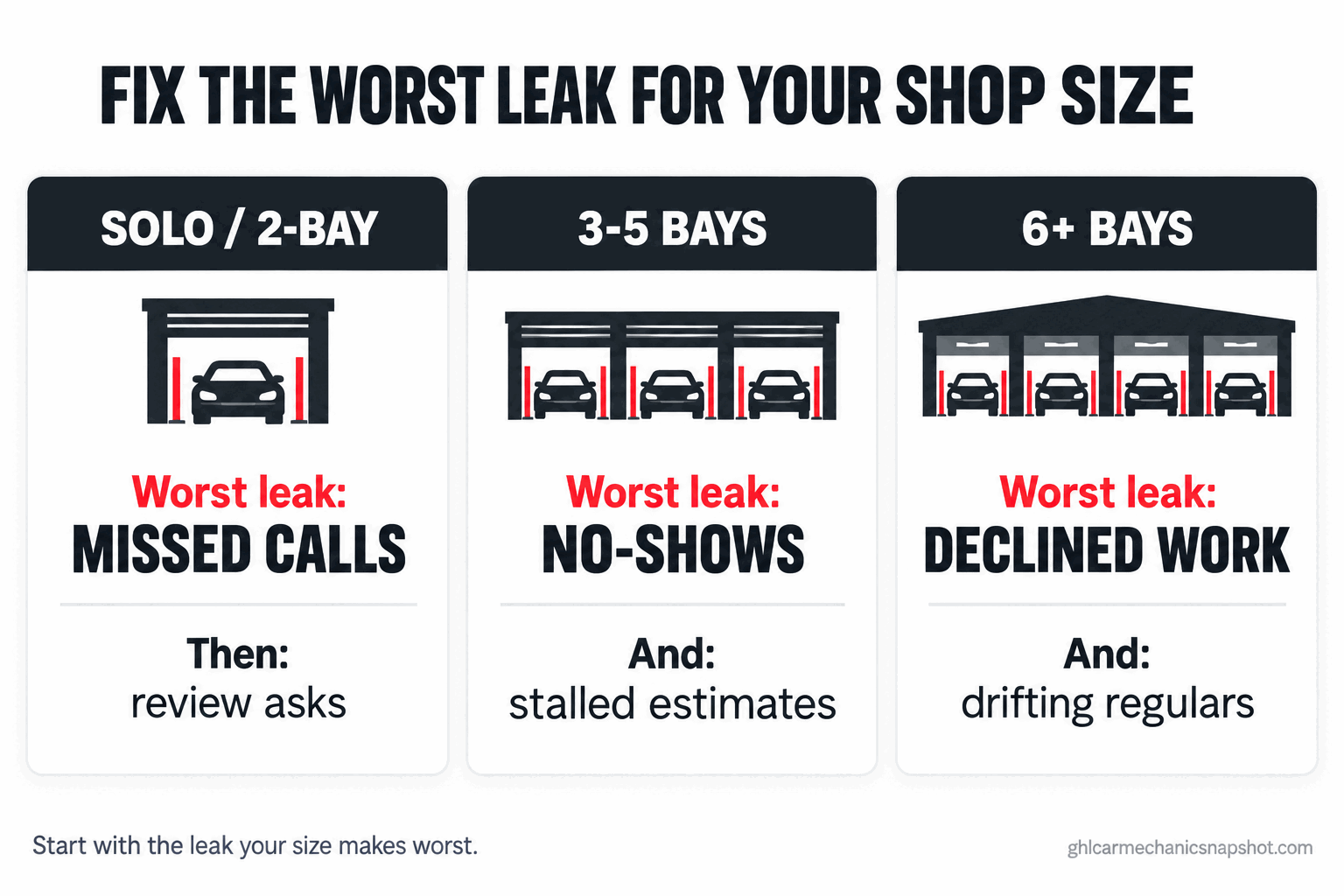
Solo or two-bay. You are front desk, tech, and owner, so your worst leak is almost always Leak 1, the missed call, because you cannot answer the phone with your hands in an engine. Start there, then add the review ask, since at your size new-customer intake is fragile.
Mid-size, three to five bays. Your leaks are Leak 2 and Leak 3: no-shows that strand a tech and estimates that stall because one advisor cannot work the phone and the counter at once. Confirmations and photo-text approvals recover capacity you already pay for, and a tech idle on a no-show morning is the most expensive empty time there is.
Larger, six-plus bays. You answer most calls, so your leaks move downstream to Leak 4 and Leak 5: deferred work nobody circles back to and regulars aging out of your base. Both lists are huge, and recovering even a small slice is real money.
The common thread: at every size, let an automatic message catch what a busy human drops.
The compliance line that rides along
Every fix above is a text, so every one lives under the Telephone Consumer Protection Act, the federal law that governs business texting. The rule that trips up shops: a purely transactional service message (a confirmation, a status update, an estimate approval) sits in one legal bucket. A marketing message (a discount, a “refer a friend”) sits in a stricter one that requires written consent and an instant, honored STOP.
The landmine is that mixing the two reclassifies the whole message as marketing. Put “and refer a friend for $20 off” at the bottom of an otherwise legal reminder, and the entire text is now marketing, usually sent without the consent marketing requires. The penalties are not theoretical: the TCPA allows $500 per text, and up to $1,500 if willful. Send a mixed blast to a few hundred customers and the math gets frightening fast. So keep service texts clean, and register your texting through the A2P 10DLC system the carriers now require, via The Campaign Registry, or your texts get filtered before they arrive. The line-by-line is in why your service reminder is legal and your refer-a-friend line is not.
Straight answers to the objections
“I’m already slammed. Why chase more work?” You are not chasing more work, you are keeping the work you already earned. Every leak here is a job that already tried to happen. Plugging the leaks does not add cars, it stops you losing the ones already coming.
“Won’t the automated texts annoy my regulars?” They annoy people when they are generic and badly timed, and they are welcome when they are specific and useful. A reminder that your brakes are actually due, or a “your car’s ready” text, saves a call: customers like those. Annoyance is a cadence problem you control.
“I already pay for Tekmetric (or Shopmonkey, or AutoLeap). Isn’t this handled?” Your shop management system is great at tickets, inventory, workflow, and invoicing. These leaks are about automatic follow-up across the whole lifecycle, before the ticket exists (the missed call) and long after it closes (deferred work, reminders, reviews). If your tools do that with nobody remembering to hit send, you are covered. If not, you are leaking. For what the platforms actually cost, see what auto repair shop software really costs in 2026.
“Do I need to be technical?” No, that is the point of a done-for-you build. The six flows get set up once, wired to your number, your hours, and your booking. If you can read a text and reply, you can run this.
Frequently asked questions
Why is my auto shop busy but not making money?
Because busy and profitable are measured at different points. Busy is bays full. Profitable is money landing, and between those two points sit six leaks that never show on a repair order: missed calls, no-shows, stalled estimates, declined work never followed up, regulars who drifted, and weak new-customer intake. A full shop can leak a real slice of its revenue there while the schedule still looks packed.
Isn't the real problem my labor rate?
Your rate matters, and the 2026 national average is about $132 an hour, so check yours. But raising the rate on a leaky shop just means you lose slightly larger repair orders. Most busy-but-broke shops lose far more to the six leaks than they would gain from a rate bump.
Which leak should I fix first?
For most small shops, the missed call. It is the earliest leak in the path, the cheapest to plug (an automatic text-back), and a missed first-time caller is a full repair order gone to a competitor. If you reliably answer your phones, start instead with no-show confirmations and photo-text estimate approvals.
Will texting customers get me in legal trouble?
Not if you keep service texts purely service and register for A2P 10DLC business messaging. The trouble starts when you mix a promotional line into a service text, which reclassifies it as marketing and triggers the TCPA's written-consent and STOP rules, with penalties of $500 to $1,500 per text. Run promos as their own opt-in campaigns.
I run paper tickets and an old system. Can I still do this?
Yes. These six flows do not require you to replace your shop management system. They layer on top as a follow-up engine tied to your phone number and calendar. Keep running your tickets however you run them today and still catch the leaks.
The money to fix a tight Friday is not in a new ad budget or a higher door rate. It is in your parking lot and your customer list, leaking out of six quiet holes. Plug them one at a time, starting with whichever one your shop size makes worst, and the same full week of work that left you short starts leaving you ahead.